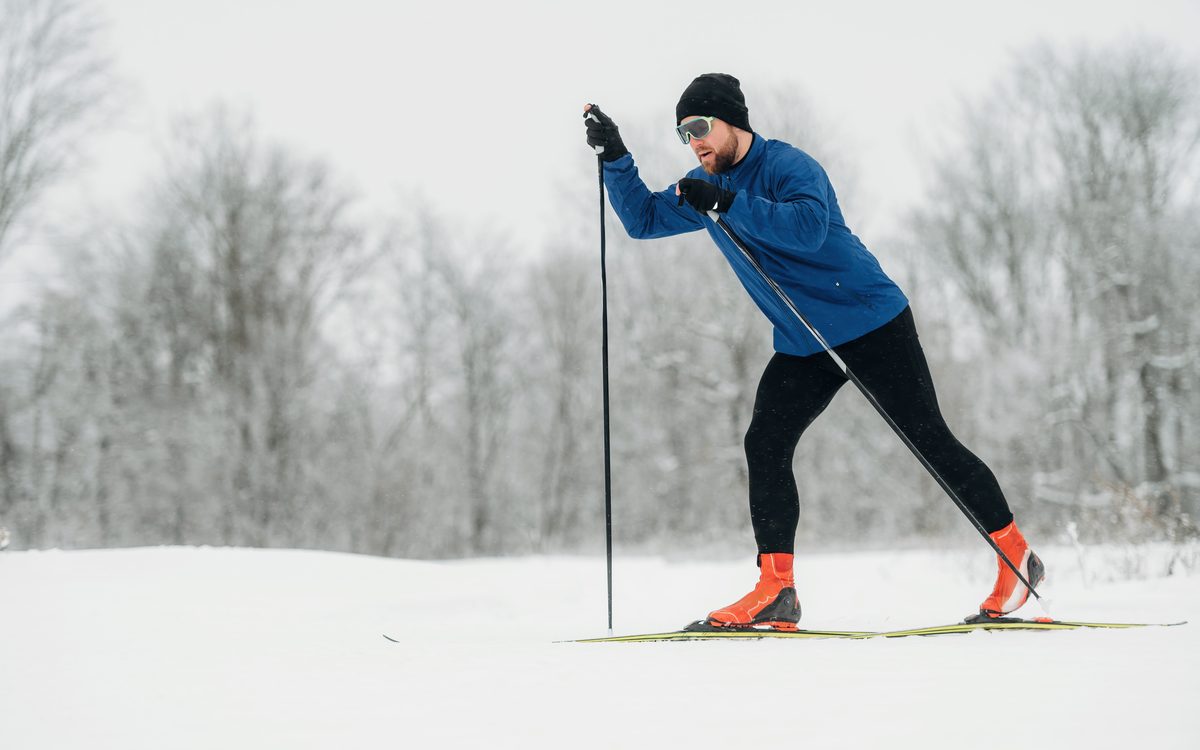
Imagine a Tuesday in a Nordic combined athlete’s autumn: a long, easy roller-ski session in the morning, heavy squats before lunch, and short, sharp practice jumps in the evening. Few sports ask a body to be both a distance runner and a jumper. Nordic combined training is the planned mix of endurance, strength and power, and ski-jump technique work that lets one athlete do both halves of the competition. This page summarises what published studies of elite athletes report. It is not a plan for you; a coach should set that.
Quick answer: Published studies of world-class athletes describe very large endurance volumes, mostly at easy intensity, plus strength, power and jump practice, with the balance shifting toward power and jumping as the season nears. Heavy strength training twice a week improved strength and jump height in one trial without hurting endurance. Beginners and juniors should build general fitness gradually under a coach; see a sports medicine professional for pain.
What the sport demands
A 2026 review of Olympic snow sports (Zoppirolli and colleagues) calls Nordic combined a hybrid of endurance-dominant sports and power and technique sports, and notes that data on it are limited. In 2016, Sandbakk and colleagues compared five world-class athletes in each of Nordic combined, ski jumping and cross-country skiing. The combined athletes had 9% higher body mass and 17% lower vertical speed in a ski-jump imitation than the jumpers, yet the laboratory capacities differed only 10 to 17% from the specialists. To reach that, they trained about two-thirds of the cross-country skiers’ endurance volume and performed about half of the jumpers’ jump-specific training.
How much, and how hard
Tønnessen and colleagues (2016) analysed the training diaries of 6 world-class Nordic combined athletes. The average annual total was 846 hours, of which 540 hours were endurance training, and 88.6% of that endurance time was low intensity, 5.9% moderate and 5.5% high. Those are elite numbers; they are not targets for a teenager or a club athlete. For young athletes, the American Academy of Pediatrics (Brenner, 2016) recommends 1 to 2 days off a week from a main sport, and an unusually high workload is a reason to ask a coach to adjust.
A French study (Schmitt and colleagues, 2018) compared national-team cross-country skiers and Nordic combined athletes during a 15-day live high, train low block. Low-intensity training made up 80% of the skiers’ work and 55% of the combined athletes’. The skiers improved specific performance, the combined athletes did not, and all the combined athletes showed signs of overreaching. The authors concluded a large amount of easy training with a moderate volume of strength and speed work is needed. This was a small elite sample over 15 days, but it shows how two skill sets can compete for recovery.
Strength and power
In a 2012 trial (Rønnestad and colleagues), 17 well-trained Nordic combined athletes either continued usual training or added heavy strength work: one lower-body and two upper-body exercises, sets of 3 to 5 repetition maximum, twice a week for 12 weeks. The strength group gained strength, muscle thickness and squat-jump height. Body mass, maximal oxygen uptake and a 7.5 km roller-ski time trial did not change. The authors concluded the strength work improved determinants of performance without increasing total body mass or compromising VO2max. Beginners should learn lifts under supervision first; the heavy loading above belongs to trained athletes.
Jump practice, skiing and the finish sprint
A case study of an Olympic champion (Rasdal and colleagues, 2018) followed his last four seasons before the Games. He first prioritised lower-body muscle mass and vertical jump velocity, then put more emphasis on technique. His number of annual imitation jumps (practice jumps done off the hill) almost doubled, endurance training rose from 462 to 635 hours a season in the third season and was cut by 12% in the Olympic season, with more focus on session quality and recovery. Finish-sprint ability was developed throughout, and both Olympic gold medals were won in a finish sprint. One athlete is not a recipe, but it shows how technique, volume and recovery can be planned together.
Periodisation: how the year is shaped
In the Tønnessen study, training frequency stayed roughly constant across the year, but total volume fell from the general preparation phase to the competition phase, mainly because of less low- and moderate-intensity work. Power and ski-jump training took a larger share as competition approached. In plain terms: build the engine in the off-season, then sharpen and reduce volume.
A general weekly shape (coaching practice, not a prescription)
The studies above do not give a weekly template, so the outline below is common practice for an experienced athlete and not a study result.
- Most sessions easy: long, conversational endurance on skis, roller skis, running or bikes.
- One or two harder sessions: intervals or race-pace work, with easy days either side.
- Two strength sessions: legs, trunk, hips and upper body, with the loading advice of a coach.
- Short jump sessions: imitation and hill jumps, fresh rather than after hard skiing.
- One full rest day.
Add a feeling-based check: unusual heaviness, poor sleep or a sudden slump in training suggest backing off. Our recovery page and the HRV guide cover load tracking. For the endurance half, see our cross-country skiing training page; for the jump half, the ski jumping hub. Risk-reduction advice is on the injury prevention page.
Frequently asked questions
Is Nordic combined training mostly skiing?
For the endurance share, mostly low-intensity work, according to Tønnessen and colleagues. Roller skiing and skiing made up over 65% of one champion’s moderate and high-intensity endurance training (Rasdal and colleagues, 2018). Strength and jump work are scheduled in addition.
Do Nordic combined athletes need big muscles?
Strength matters, but body mass matters too in the jump. The strength trial above improved strength without raising total body mass. Any weight change should be discussed with a coach and doctor; see our nutrition page.
Can I train for Nordic combined without a hill?
Imitation jumps and general strength are done off the hill, but real jumping must be taught by qualified coaches on suitable hills. Do not jump alone.
How many hours a week should a teenager train?
We found no Nordic combined-specific figure. The AAP advises at least 1 to 2 days off a week and watching for overuse; a coach and doctor should set the load.
What should I do first?
Build general fitness and a skiing base, join a club, and add strength work as taught. Start from the rules page.
Sources
- Zoppirolli et al. 2026, Olympic snow sports review
- Sandbakk et al. 2016, world-class Nordic combined athletes vs specialists
- Tønnessen et al. 2016, training characteristics of world-class Nordic combined athletes
- Schmitt et al. 2018, training intensity distribution during live high-train low
- Rønnestad et al. 2012, heavy strength training in Nordic combined
- Rasdal et al. 2018, long-term development of an Olympic champion
- AAP clinical report, Brenner 2016 (sports specialization and intensive training)
General information for education only, not medical advice. It does not replace a sports medicine doctor, physical therapist, athletic trainer, dietitian or qualified coach who knows you. See our editorial policy for how we write and source our pages.
Keep exploring: the Nordic combined hub, the skiing hub, ski jumping and every sport on our sports hub.