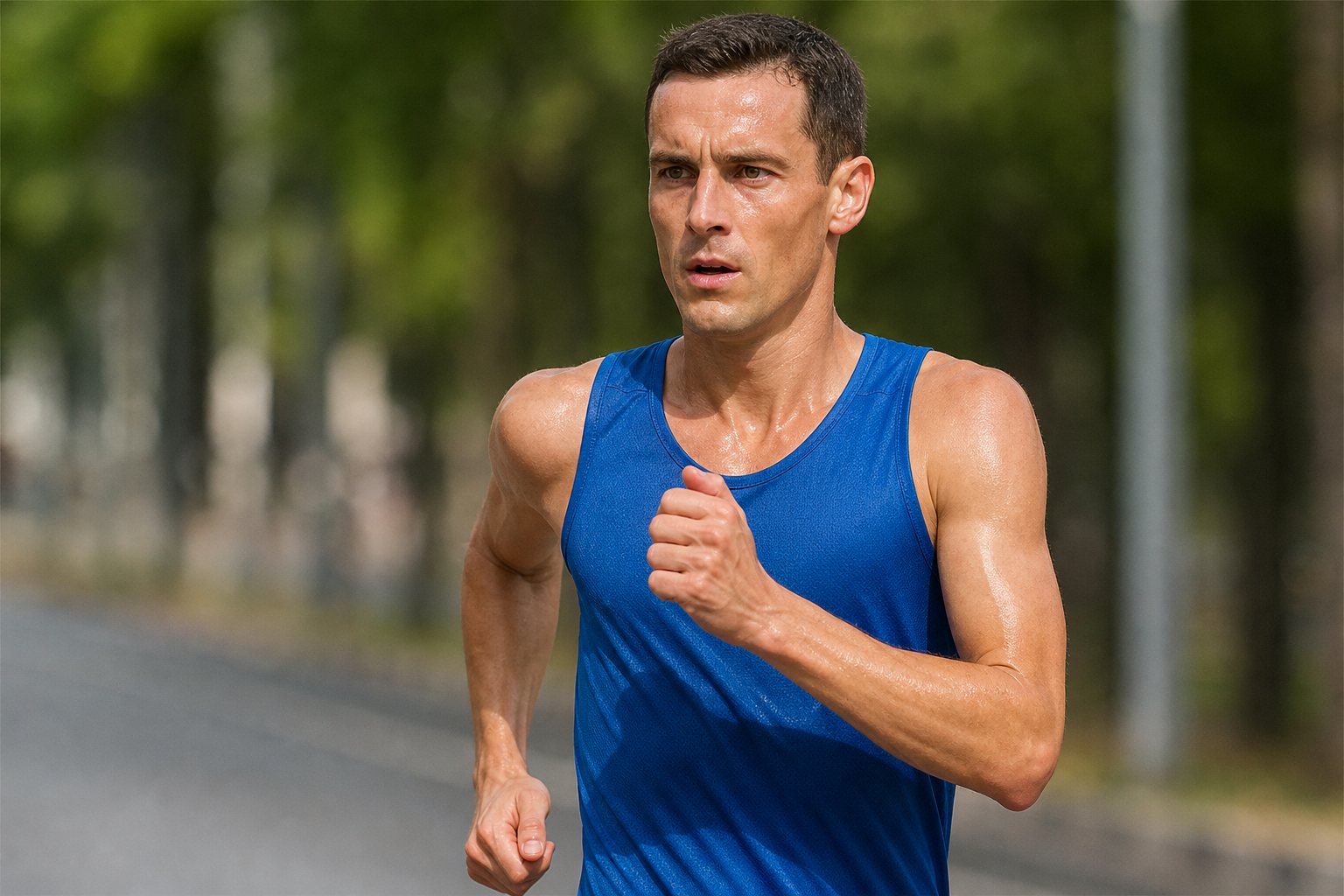
Sunday morning, a loop of road, and a walker five laps into a 25 km session at a pace that looks easy from the kerb. Race walking training is mostly this: long, steady, technically exact work, with a smaller dose of fast walking on top. This page covers what the sport demands of the body, what a sensible week can look like, strength and conditioning, and how elite walkers organise a season, using only numbers we could trace to a source.
Quick answer: Race walking is an endurance event with a technical rule on top, so training is mostly steady aerobic walking with some race-pace work, plus strength and drills. In a 2026 case study of an Olympic champion, about 82% of walking was at low intensity. Elite walkers in a survey covered 84 to 154 km a week; beginners should build far more slowly and see injury prevention first.
General information, not medical advice. Part of the race walking hub. See also track and field training.
What the sport demands
The 20 km and 35 km walks are long road races, so the aerobic system does most of the work (World Athletics lists these as the championship distances). The movement itself is unusual: a straight leg at landing, a quick short stride and rotation at the hips, repeated tens of thousands of times. That is why technique work sits next to fitness in every plan. In a 2022 account of six Australian walkers preparing for Tokyo, aerobic capacity peaked at 63.6 mL per kg per minute for women and 73.7 for men (Carr and colleagues). Those are elite numbers, not targets for a newcomer.
How much do elite walkers train?
A questionnaire study led by Brian Hanley at Leeds Beckett, summarised by Athletics Weekly, collected answers from 112 international walkers from 28 nations. Men walking 10 or 20 km averaged 97 km a week, men at 50 km averaged 154 km, and women at 20 km averaged 84 km. Men trained about nine times a week and women about seven. Outside walking, 80% also ran, 64% did resistance training, 43% swam and 30% cycled. These are self-reports from elite athletes. They show the ceiling, not a recommendation.
A sensible weekly shape
Published plans for beginners are scarce, so the next paragraph is general coaching practice and not from a study. A newer walker might do three or four sessions a week: one or two easy technique-focused walks, one longer steady walk that grows slowly, and one session with short faster segments. Rest days and an easy week every few weeks keep the load steady. A coach who knows the rule can see the knee and contact errors that appear as you tire.
For a window into elite practice, the 2026 case study of a female Olympic champion 20 km walker (Jiang and colleagues) tracked 3,719.2 km of race-walk training from December 2023 to July 2024. Of that, 81.9% was low intensity, 9.4% moderate and 8.7% high, a pyramid shape. Key sessions included 25 to 30 km long walks, repeated 1 to 2 km intervals, same-day double sessions, variable-pace long walks, and stair climbing combined with fast walking. It is one athlete, so treat it as an example of how a top walker organises work, not a template.
Strength and conditioning
Hanley and colleagues suggested strength and conditioning programmes for both men and women, with particular emphasis on the lower leg and the hamstrings, because injuries to those areas were common. Practical content is general coaching practice: single-leg strength for the hips and glutes, calf and hamstring work, trunk stability for the hip rotation, and mobility for the ankles and hips. We did not find a controlled trial that compares strength programmes in race walkers, so we cannot say which exercises work best. See injury prevention for the evidence on hamstrings and shins.
Periodisation basics
Periodisation means organising the year into phases. In the Jiang case study the phases were winter preparation, a competition-specific intensification block and a final pre-competition period. Low-intensity work stayed dominant in every phase, while race-pace exposure rose in the intensification phase. Blood-lactate tests tracked progress: estimated walking speed at 4 mmol per litre rose from 13.68 to 15.79 km per hour across the monitoring period. For heat races the Australian group did 6 to 7 weeks of intermittent heat acclimation, 2 to 4 sessions a week, then 23 more heat sessions over 18 days in camp (Carr and colleagues). Recreational walkers can borrow the principle (easy base, then a little race-specific work, then a taper) without copying the load.
Cross-training and surfaces
Most elite walkers cross-train, as the survey shows. Hanley’s group noted that 98% trained on roads and suggested varying direction on a track to avoid overloading one leg. Low-impact cross-training such as swimming or cycling is also what AAOS suggests when someone has to rest from a painful activity. See recovery for how to fit easy days in.
Tracking progress
The case study above used incremental road tests with blood lactate to see how speed at fixed lactate levels changed over the season. Most walkers do not have that, and general practice is simpler: repeat a favourite loop at the same effort every few weeks and compare time and how technique holds up, or use a GPS watch for pace. Whatever you use, the judged rule still comes first, because a fast time with a bent knee can end in a red card. See gear for the watch we list and mental training for racing under judging pressure.
Race walking training FAQs
How many days a week should I race walk?
There is no sourced answer for beginners. The elite survey found about seven to nine sessions a week, which is not a starting point. A coach can set a number that fits your history.
Do race walkers also run?
In the Hanley survey, 80% did some running and 64% did resistance training outside their walking sessions.
How fast is an elite 20 km walker?
World Athletics lists the 20 km records at 1:16:36 for men and 1:23:49 for women.
Is most training hard?
No. In the 2026 Olympic champion case study about 82% of walking was low intensity, 9% moderate and 9% high.
Do I need heat training?
Only if you race in heat. The IOC heat consensus recommends heat acclimation for athletes in hot events; see injury prevention and nutrition for detail.
Sources
- Athletics Weekly, Injury study: Walk this way (Hanley and colleagues, Leeds Beckett, New Studies in Athletics)
- Leeds Beckett repository, Hanley et al., training and injury profiles of international race walkers
- Jiang et al. 2026, periodization in a female Olympic champion 20 km race walker (PubMed 42614459)
- Carr et al. 2022, competing in hot conditions at Tokyo: Australian race walkers (PubMed 35399272)
- World Athletics, Race walks discipline page
- AAOS OrthoInfo, Shin splints
- IOC consensus statement on sport events in the heat, Racinais et al. 2023 (PubMed 36150754)
General information for education only, not medical advice. It does not replace a visit with a sports medicine doctor, physical therapist or athletic trainer. See how we write and check our pages in our editorial policy.