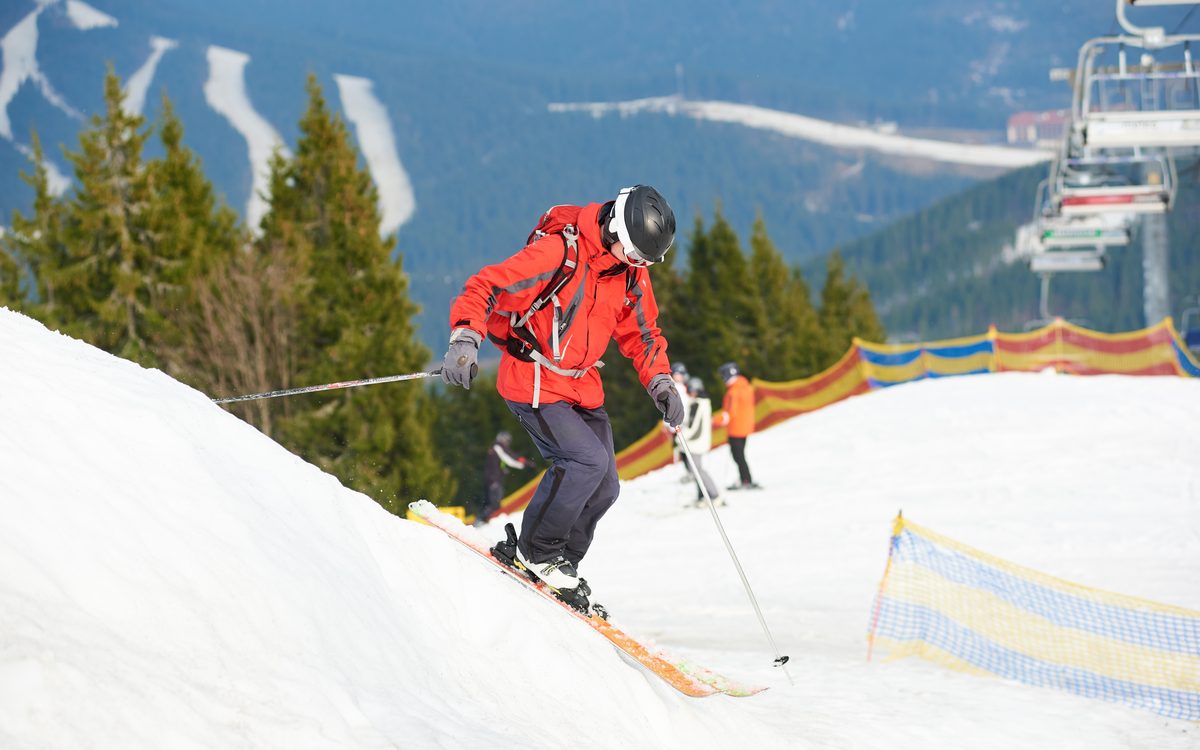
The course report comes over the radio: a racer is down in the middle of a downhill, the run is stopped, and the patrol sled heads up the hill. Most of the time the answer on the radio is a bruise or a sprain. Sometimes it is a knee. Alpine skiing injuries are the damage that comes from falls, edge catches and the heavy forces of turning at speed, and this page is about what the published numbers say about them, what rehabilitation generally involves and when to see a professional. For ways to lower the odds, see our injury prevention page. The overview is on the alpine skiing hub.
Quick answer: The knee is the most injured body part in alpine racing, and ACL tears cause the most time away (clinical review, Sports Health, 2019). In a World Cup study the injury rate rose with speed, from 4.9 per 1,000 runs in slalom to 17.2 in downhill. Rehabilitation is guided by a doctor and a physical therapist, and nobody can give you a universal recovery time. See a sports medicine doctor, physical therapist or athletic trainer for any suspected injury, and call 911 after a head injury with danger signs.
General information, not medical advice. We do not diagnose injuries, clear anyone to return to skiing, or give recovery times.
What the injury numbers show
The most-cited source is the World Cup injury surveillance run by FIS. In an early two-season study of 521 World Cup racers (Florenes and colleagues, British Journal of Sports Medicine, 2009), there were 191 acute injuries. About 45% happened in competition, at 9.8 per 1,000 runs, and the rate climbed with the speed of the event: 4.9 per 1,000 runs in slalom, 9.2 in giant slalom, 11.0 in super-G and 17.2 in downhill. The knee accounted for 36% of injuries.
A later FIS surveillance study (Haaland and colleagues, British Journal of Sports Medicine, 2016) covered nine seasons, 2006 to 2015, and put the pooled absolute rate at 33.1 injuries per 100 athletes per season. It compared before and after new ski regulations in 2012 and found a lower rate afterwards (risk ratio 0.74), with the drop seen in men but not in women, and with upper-body injuries falling while leg injuries did not clearly change. The authors point to limited statistical power, so this does not prove the regulations caused the change.
For women, a 2023 review of winter sports injuries in elite female athletes (Rotllan and Viscor) reports severe ACL injuries at 7.6 per 100 female ski racers per season. These are elite figures, not rates for recreational skiers.
The knee and the ACL
The AAOS describes the ACL as a band inside the knee that helps keep the shinbone from sliding forward and controls twisting, with a tear one of the most common knee injuries, often without being hit. In World Cup racing, a video analysis of 20 ACL injuries (Bere and colleagues, American Journal of Sports Medicine, 2011) found the slip-catch mechanism in 10 cases, a landing off balance backward in 4 and a dynamic snowplow pattern in 3. Among recreational skiers, a 2021 study (Posch and colleagues) also found the knee and ACL the most common injuries.
Other injury patterns
- Shoulder and upper body: the AAOS lists shoulder injuries and fractures among the main skiing injuries, in a recreational total of more than 76,000 treated in 2018.
- Back: in youth racers, a 2019 review says low back pain is the most common overuse complaint at the adolescent level, and knee pain in younger racers.
- Cold injury and sun: the AAP names fingers, toes, ears and noses as first places for frostbite, and the WHO notes fresh snow can reflect up to 80% of UV radiation.
Concussion and head injuries
The CDC’s HEADS UP program says to remove anyone with a suspected concussion from activity right away and to have a healthcare provider decide when it is safe to return. Call 911 for danger signs such as repeated vomiting, a seizure, or one pupil larger than the other. Helmets lower risk (a 12-study analysis found about 35% lower odds of head injury) but do not remove it. If you are on the hill, ski patrol is your first call.
Rehabilitation: general principles
Rehabilitation depends on what is injured, and a clinician decides the plan. In general terms, the AAOS says an ACL tear does not always need surgery, that the choice depends on severity, age, activity level and whether the knee feels unstable, and that therapy focuses on gradually rebuilding quadriceps strength and confidence in the knee. It also warns that returning to activity too soon can worsen instability and risk more damage. For return to skiing, ask your surgeon or physical therapist about clearance criteria.
In elite racers, studies of return after ACL surgery show wide individual variation. A 2025 American Journal of Sports Medicine study of 30 ski racers found 27 returned to the same competition level but only 16 improved their FIS points. A 2026 retrospective study of 48 elite skiers reported most returned to World Cup competition. These are small groups of top athletes with full medical support, so they do not predict anyone else’s recovery. A 2026 scoping review says there is little evidence on the psychological and social factors that shape return to performance after an ACL injury.
When to see a professional
- Pain that stays in one spot, swelling, or a knee that gives way or feels unstable.
- A fall with a pop or twist, or you cannot put weight on the leg.
- Any head impact with headache, confusion, vomiting or unusual drowsiness; call 911 for danger signs.
- A young racer whose pain returns every training day or changes how they ski.
The first stop on the hill is ski patrol, then a sports medicine doctor, physical therapist or athletic trainer. Our recovery page covers soreness versus injury, and our skiing injuries hub covers recreational skiing and snowboarding.
Frequently asked questions
What is the most common injury in alpine ski racing?
The knee. In the World Cup study of 521 racers it accounted for 36% of injuries, and a 2019 clinical review says ACL tears cause the most time away from competition.
Is downhill really the most dangerous event?
In the 2009 World Cup study the injury rate was highest in downhill, at 17.2 per 1,000 runs against 4.9 in slalom. Those figures come from elite racers, not recreational skiers.
Does an ACL tear always need surgery?
No. According to the AAOS, severity, age, activity level and knee stability all matter, and non-surgical treatment with physical therapy is always an option. The decision is made with an orthopaedic surgeon.
How long until a skier can return after an ACL injury?
There is no universal timeline. Studies of elite racers show wide variation, and clearance comes from a surgeon or physical therapist, not a website.
What should I do after hitting my head skiing?
Stop skiing, tell ski patrol, and see a healthcare provider. The CDC says to call 911 for danger signs such as repeated vomiting, a seizure or unequal pupils.
Sources
- Florenes et al., injuries among male and female World Cup alpine skiers, Br J Sports Med 2009
- Haaland et al., injury rate and patterns in FIS World Cup alpine skiing 2006-2015, Br J Sports Med 2016
- Rotllan and Viscor, winter sports injuries in elite female athletes, 2023
- Bere et al., mechanisms of ACL injury in World Cup alpine skiing, Am J Sports Med 2011
- Alpine ski racing injuries, Sports Health 2019
- Posch et al., recreational alpine skiing injuries, 2021
- Talent development in alpine ski racing, J Sports Sci 2019
- Return to on-snow performance in ski racing after ACL reconstruction, Am J Sports Med 2025
- ACL injuries in elite alpine skiing and return to competition, Knee Surg Sports Traumatol Arthrosc 2026
- Returning to performance after ACL injury in competitive alpine skiing: scoping review, Scand J Med Sci Sports 2026
- AAOS OrthoInfo: ACL injuries
- AAOS OrthoInfo: Skiing injury prevention
- Russell et al., helmets and head injury, CMAJ 2010
- CDC HEADS UP: Signs and symptoms and response
- AAP HealthyChildren: Winter safety
- WHO: UV radiation
General information for education only, not medical advice. It does not replace a visit with a doctor, physical therapist or athletic trainer. See how we write and check our pages in our editorial policy.