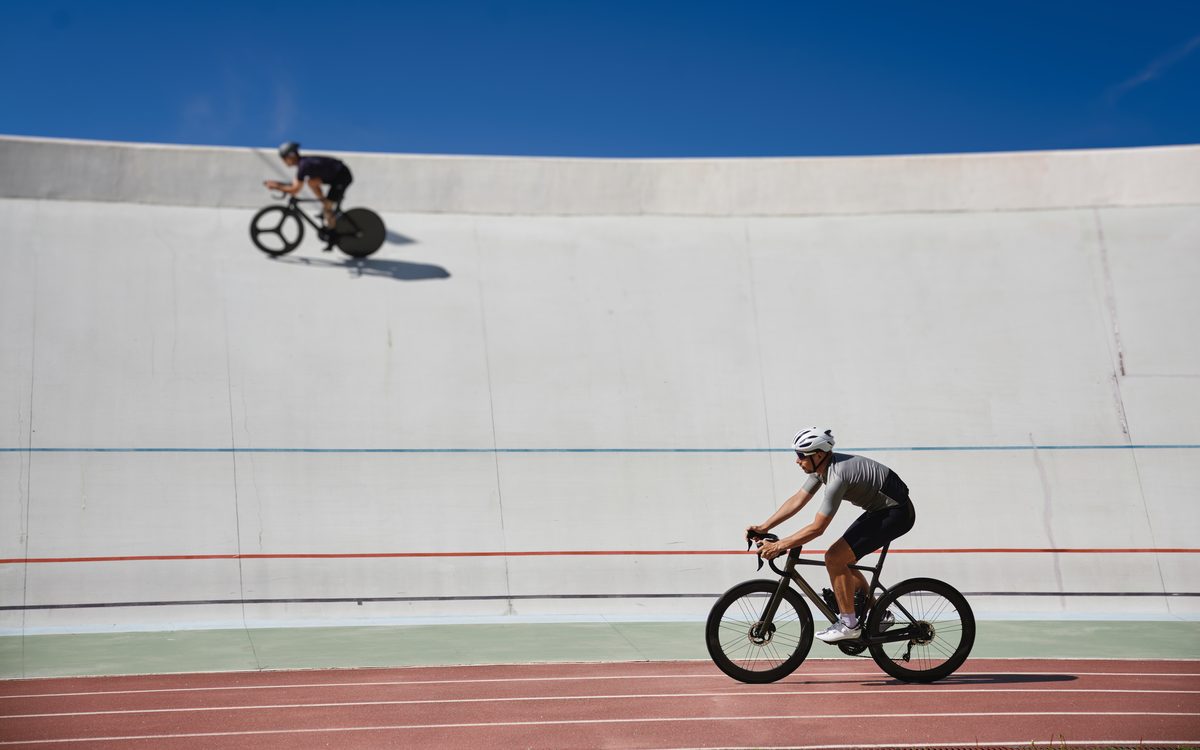
The first time on the boards, most people say the same thing: the banking looks like a wall. A coach tells you to look ahead, keep pedaling and trust the speed, and somehow the bike stays up. Getting started in track cycling means learning a handful of things in a controlled setting: how a fixed-gear bike behaves, how to move around a banked oval with other riders, and how the races are won. This page is the beginner path. The bigger picture of the sport is on the track cycling hub, and the wider family of disciplines is on the cycling hub.
Quick answer: Track racing happens on a banked oval called a velodrome, on fixed-gear bikes with no brakes. In the US, you start at a local velodrome that runs a beginner class, often with rental bikes, and then add a USA Cycling license when you want to race. Sprint events are short and tactical; endurance events are mass-start races scored by finishing order or points. Rules and class details differ by track and by edition of the Games, so check the current UCI and USA Cycling rulebooks.
The bike and the one idea that changes everything
USA Cycling describes a track bike as a fixed-gear bike with no brakes and no derailleurs. The rear cog is locked to the wheel, so the pedals turn whenever the bike moves. You cannot coast. You slow down by easing the pressure on the pedals or by riding up the banking. Drop handlebars are standard for mass-start races, and some timed events allow aero extensions. USA Cycling adds that road bikes with brakes are generally not allowed on the track, apart from the odd intro class.
That one idea explains most of the beginner skills. Because the legs always turn, you learn to keep pedaling through the turns and to stay clipped in. Because nobody can brake, you learn to hold your line and tell the riders around you what you are doing.
Beginner skills, in the order they are usually taught
USA Cycling’s getting-started guide lists three core skills: entering and leaving the track from the flat apron (the strip inside the lower edge of the banking), pedaling continuously, and carrying enough speed to hold your line on the banking. Accreditation courses at individual velodromes add group skills. The Alkek Velodrome in Texas, for example, describes a 90-minute coached Stage I class that covers fixed-gear fundamentals, velodrome etiquette and rules, pacelines and a mock race. Its Stage II is a non-sanctioned race night, and passing it allows an upgrade to a Category 4 USA Cycling license. That is one track’s system; yours may differ.
- Look before you move. USA Cycling says to check over your right shoulder before moving up the track and over your left before moving down.
- Hold your line. If another rider is passing, stay put until the path is clear. Cutting across someone is the classic mistake, because no one can brake.
- Stay in control with both hands. Alkek’s accreditation lists staying clipped in, riding in the drops with both hands on the bars and staying on the track as skills to demonstrate.
- Follow the officials. The same course lists following official instructions and avoiding sprinter-lane violations.
How the races are won
Track events split into sprint events and endurance events. USA Cycling groups match sprint, team sprint, keirin and the 500 m and 1000 m time trials as the short, explosive ones, and the pursuits, points race, scratch race, elimination race, omnium and madison as the endurance ones, running from a few minutes to about an hour. The table below follows NBC Olympics’ explainer of the Olympic formats. Field sizes and distances can change between Games, and women and men race slightly different distances in some events.
| Event | How it is decided |
|---|---|
| Individual sprint | Three laps head to head; a timed qualifier seeds knockout rounds. Tactics matter more than speed until the final burst. |
| Team sprint | Teams of three race three laps; the lead rider pulls off after the first lap and the second after the next. Fastest time wins. |
| Keirin | Six laps, with a motorized pacer leading the first three, then a three-lap sprint. Finishing order decides. |
| Team pursuit | Teams of four race 16 laps; a team’s time is taken when its third rider crosses the line. |
| Madison | Teams of two in a mass start; sprints every 10 laps score points, and gaining or losing a lap moves the score by 20. |
| Omnium | Four mass-start races in one day (scratch, tempo, elimination, points); points are added up across all four. |
Beginners rarely start in the madison or the team events. The first races at most clubs are scratch races and points races on a weekly race night, plus timed efforts where you ride against the clock instead of against other people.
Levels, licenses and where to find a club
Most US riders begin at a local velodrome. USA Cycling’s guide says to find the nearest one through its track page and join a learn-to-ride or community program, then work with a USA Cycling Certified Coach when you want to prepare for racing. Velodromes set their own entry requirements. Some run a short class and keep a waiver on file, some send riders aged 16 and under to a youth league first, and several say that rental track bikes are available. Alkek asks new riders to be able to ride about 15 mph for 30 minutes on flat ground. Racing requires a USA Cycling membership and race license, and categories run from 5 (novice) to 1 using the same system as road racing. Outside the US, the national federation plays the same role, under the world governing body, the UCI.
Juniors, collegiate riders, national-team athletes and masters all share the same events. For the Olympic picture, track cycling has twelve medal events on the programme listed for Los Angeles 2028, six each for men and women, though schedules can change, so check the official programme. Para-cyclists also race on the track; see our para-cycling page.
Safety before you start
The velodrome is a controlled space: USA Cycling points out that tracks are free of cars, dogs and pedestrians. That is a big reason many riders feel safer learning there than on the road. It does not make crashes impossible. For what usually gets hurt and what to do after a fall, read our track cycling injuries and injury prevention pages.
Next steps
When you are ready for a plan, see track cycling training. For equipment, start with the gear page. For a day at the races, read our cycling race-day page, and for the governing bodies, cycling leagues and associations.
Track cycling FAQs
Do I need my own track bike to start?
Usually not. USA Cycling says many velodromes rent or lend entry-level track bikes, sometimes for free to new riders, and Alkek says rentals are available until you buy your own. Ask your velodrome what sizes it keeps.
Can I ride my road bike on the track?
USA Cycling says road bikes with brakes are generally not allowed on the track, with rare exceptions during intro classes. Track bikes are fixed gear and have no brakes.
How long does it take to be allowed to race?
It depends on the track. One example, Alkek Velodrome, describes a 90-minute class followed by a race night completed within eight weeks of the class. Other velodromes use different steps, so contact yours.
What is the difference between sprint and endurance events?
USA Cycling calls sprint events (match sprint, team sprint, keirin and the short time trials) short and explosive, and endurance events (pursuits, points, scratch, elimination, omnium, madison) races that last from a few minutes to about an hour.
Where can I find the official rules?
The UCI publishes its track regulations on uci.org, and USA Cycling publishes its rulebook on usacycling.org. Both change from year to year, so read the current edition before a competition.
Sources
- USA Cycling: ultimate guide to getting started in track cycling
- Alkek Velodrome: track accreditation
- Dick Lane Velodrome: rider FAQs (waiver, youth league, track certification)
- NBC Olympics: track cycling rules and competition format
- NBC Olympics: cycling at Los Angeles 2028
- UCI: about the UCI and its disciplines
- USA Cycling: first-time racer guide
General information for education only, not medical advice. It does not replace a sports medicine doctor, physical therapist, athletic trainer or registered dietitian who knows you. See our editorial policy for how we research and write. More on this sport: track cycling hub, cycling hub and all sports.