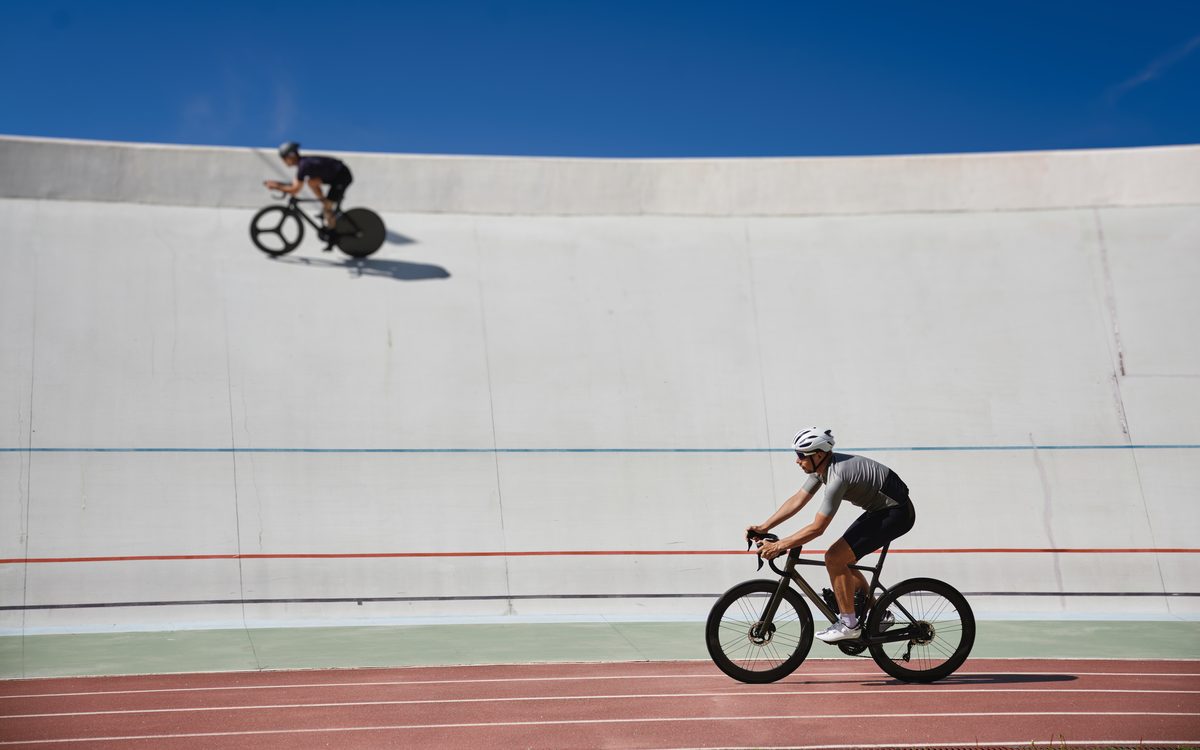
A sprinter eats a sandwich in the stands, a pursuit rider sips a carb drink between rounds, and the whole room is warm enough that bottles empty faster than anyone planned. Nutrition for track cycling means matching food and fluid to very different events, from ten-second efforts to a four-minute pursuit and a 50-minute madison, while keeping the body healthy over years of training. This page is about food, hydration, energy availability and supplement safety, not a meal plan. Training sits on our training page.
Quick answer: Eat enough to fuel your training, keep carbohydrate in your diet around hard sessions, drink to thirst and in heat more deliberately, and do not under-eat to chase a light body. Supplements are optional and carry risks: use food first, choose third-party tested products and check the anti-doping rules. Low energy availability can harm bone, hormones and recovery. See a doctor or registered dietitian if you are losing weight, feel run down or have changes in periods.
Fuel for the type of rider
The 2016 joint position of the American College of Sports Medicine, the Academy of Nutrition and Dietetics and Dietitians of Canada gives daily carbohydrate ranges by training load: 3 to 5 g per kilogram of body weight for light training, 5 to 7 g for about an hour a day, 6 to 10 g for one to three hours and 8 to 12 g for the heaviest loads, with protein of 1.2 to 2.0 g per kilogram a day. These are ranges for planning, and a dietitian can fit them to you. Which range fits depends on the week: a rider on a heavy block sits higher than one on a light week. Sprint-heavy riders still need carbohydrate for repeated efforts. In the middle of a session, a 4 km pursuit is too short to need much fueling, but a madison or points race can last close to an hour.
A 2019 review of racing across consecutive evenings (Richard and Koehle) says track and criterium riders burn mostly carbohydrate because they ride near and above lactate threshold, and it recommends carbohydrate, protein and fluid before and after racing. Our recovery page covers the hours after racing.
Heat, fluids and the velodrome
Indoor tracks can be warm and still, and warm-up suits trap heat. The National Athletic Trainers’ Association position statement on exertional heat illnesses recommends acclimatizing over 7 to 14 days and cold-water immersion for suspected exertional heat stroke, a medical emergency. Elite team-pursuit riders studied by Tebeck and colleagues (2023) trained for heat acclimation before a world record and saw plasma volume rise 8.2%; that is a specialized method, not something to try alone. For everyday sessions, drink regularly and weigh yourself before and after a hot session if you want to know how much you lost: the 2016 position advises 125 to 150% of lost weight in fluid afterward. Electrolyte drinks help some riders in long, hot sessions.
Relative energy deficiency in sport (RED-S)
Cycling is often described as a high-risk sport for low energy availability. A 2021 review of male cyclists (Schofield, Thorpe and Sims, European Journal of Sport Science) says cycling combines low-impact riding, high energy demands and a belief that leanness helps, and describes daily and weekly energy deficits, lower spine bone density and hormone changes. A 2022 case study of four elite male track cyclists (Schofield and colleagues, International Journal of Sports Physiology and Performance) found energy availability of 26 to 41 kcal per kilogram of fat-free mass a day and lowered resting metabolic rate in some, and suggested they might be in a catabolic state within the day. It is four riders. A 2023 study of 93 elite cyclists (Hilkens and colleagues, Medicine and Science in Sports and Exercise) found low lumbar spine bone density in 64% of advanced-career men and 45% of early- and advanced-career women, and a 2025 review (Florvag and colleagues) found cyclists and swimmers at higher risk of low bone density. The 2023 IOC consensus statement on RED-S (Mountjoy and colleagues) treats low energy availability as a spectrum that affects men and women.
Warning signs include fatigue that does not lift, repeated illness or injury, stress fractures, loss of periods and constant preoccupation with food or weight. They are reasons to see a doctor, not to keep training. Track cycling has no weight classes, but power per frontal area matters to sprinters, so the pressure to be lean is real.
Supplements: a cautious approach
The IOC consensus statement on dietary supplements (Maughan, Burke and colleagues, 2018) separates sports foods, such as drinks and gels, from performance supplements, and says only a few have good evidence. A 2017 meta-analysis (Christensen and colleagues, Frontiers in Physiology) of placebo-controlled studies of 45 seconds to 8 minutes, which names 4,000 m track cycling, found small improvements for caffeine (effect size 0.41) and bicarbonate (0.40), and trivial effects for nitrate and beta-alanine. Individual responses vary, and caffeine can cause jitters, poor sleep and a fast heart rate; check with a doctor if you have a heart condition or are pregnant.
- Check the label for third-party testing. NSF Certified for Sport and Informed Sport test products for banned substances. A UEFA expert group statement (Collins and colleagues, 2021) cited a study in which about 15% of 634 supplements from 13 countries contained undeclared prohormones, and notes testing programs reduce but do not eliminate risk.
- Athletes are responsible for what they take. Anti-doping rules apply strict liability. Check the current WADA Prohibited List and ask your national anti-doping agency if you compete in sanctioned events.
- Iron and vitamins. The UEFA statement says routine iron supplementation can do more harm than good; get a blood test and medical advice first.
- Creatine. Many athletes use it; it is one of the most studied supplements and can add body mass. The American Academy of Pediatrics advises against creatine for young people (LaBotz and Griesemer 2016).
Youth riders
Teenagers need enough energy for growth as well as training. The AAP advises against sports and energy drinks for most children and supports regular meals. A registered dietitian who works with young athletes can help; look for one before restricting food.
Track cycling FAQs
How many carbohydrates does a track cyclist need?
The 2016 joint position gives 6 to 10 g per kilogram per day for 1 to 3 hours of training and 8 to 12 g for heavier loads. A dietitian can adjust for your size and events.
Does caffeine help in a track pursuit?
A 2017 meta-analysis found a small improvement for caffeine in efforts from 45 seconds to 8 minutes, but responses vary and it is not for everyone. Check with a doctor if you have a heart condition.
What is RED-S?
Relative energy deficiency in sport is a set of health and performance problems linked to not eating enough for training. The IOC updated its consensus statement in 2023.
How do I pick a safe supplement?
Look for third-party certification such as NSF Certified for Sport or Informed Sport, check the label against the WADA Prohibited List, and ask a doctor or dietitian first.
Should kids use supplements?
The AAP advises against creatine and energy drinks for young people. Focus on regular meals and talk to a pediatrician.
Sources
- ACSM, Academy of Nutrition and Dietetics and Dietitians of Canada 2016 joint position (PubMed)
- Richard and Koehle 2019, multi-evening cycling competition (PubMed)
- Mountjoy et al. 2023, IOC consensus statement on RED-S (BJSM)
- Schofield et al. 2021, low energy availability in male cyclists (PubMed)
- Schofield et al. 2022, energy availability in elite male track cyclists (PubMed)
- Hilkens et al. 2023, low bone density in elite cyclists (PubMed)
- Florvag et al. 2025, bone density in low-impact sport athletes (PubMed)
- Christensen et al. 2017, caffeine and bicarbonate meta-analysis (PubMed)
- IOC consensus statement on dietary supplements (Maughan, Burke et al. 2018)
- UEFA expert group statement on nutrition in elite football (Collins et al. 2021, PubMed)
- NATA: exertional heat illnesses position statement (PMC)
- Tebeck et al. 2023, heat acclimation before a team-pursuit world record (PubMed)
- WADA: Prohibited List
- Dorel et al. 2005, track sprinters (PubMed)
General information for education only, not medical advice. It does not replace a sports medicine doctor, physical therapist, athletic trainer or registered dietitian who knows you. See our editorial policy for how we research and write. More on this sport: track cycling hub, cycling hub and all sports.