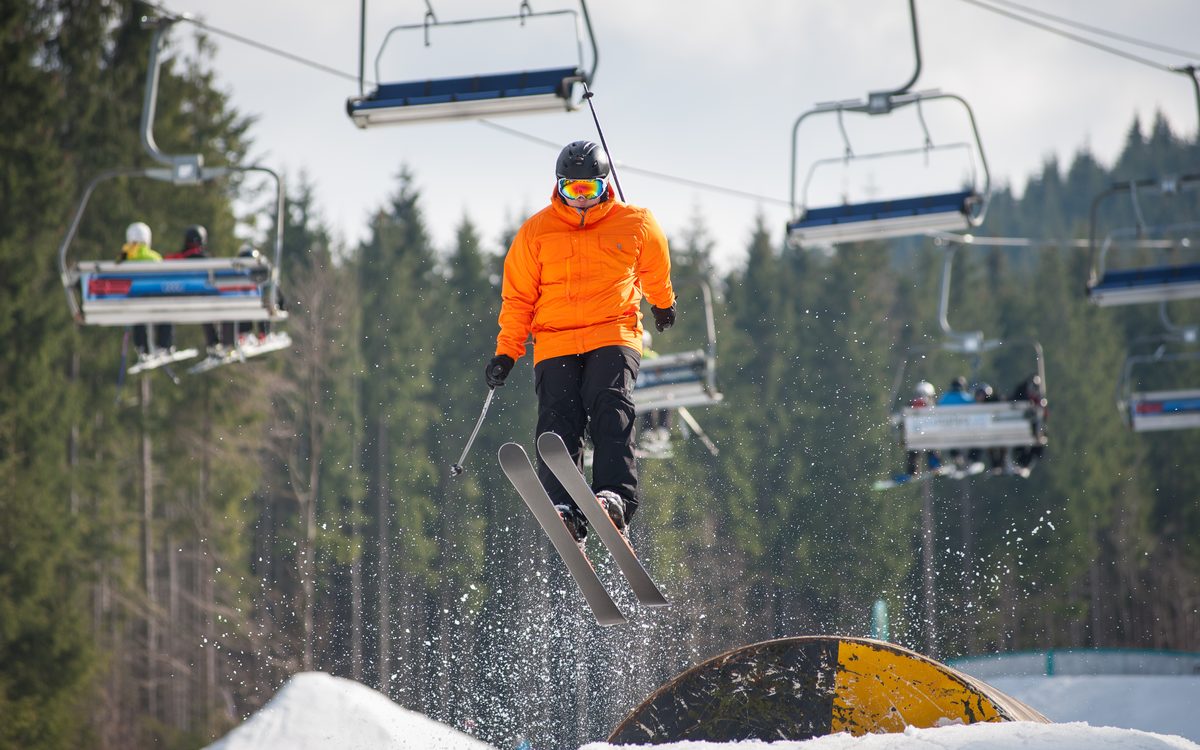
A kid stands at the top of a bump run with a coach at the bottom, running through the plan one last time: absorb the first bumps, stay on the fall line, hit the jump, do not stop. Ten minutes later a different kid is lining up at the top of a ski-cross course with three other racers beside them. Both are doing freestyle skiing, and almost nothing about the two runs looks the same. This page explains how each event works, how it is scored or won, and how a beginner finds a safe way in. For the sport as a whole, see our freestyle skiing hub and the skiing hub.
Quick answer: Freestyle skiing is several events under one name. Moguls, aerials, halfpipe, slopestyle and big air are judged; ski cross and each duel in dual moguls are decided by who finishes ahead or wins the judges’ points. A beginner starts with ordinary ski-school skills, then a club or coach, and smaller park features first. Official rules are in the FIS competition rules, and the details below are as of 2026.
The events at a glance
| Event | What the skier does | How it is decided |
|---|---|---|
| Moguls | One run down a bump field with two jumps | Judges score turns, air and speed; 100 points in all (FIS) |
| Dual moguls | Two skiers race side by side down paired bump lines | Judges split points between the two skiers; the duel winner advances (FIS) |
| Aerials | Launch off a kicker for flips and twists, land on a steep slope | Judges score air, form and landing, multiplied by a degree of difficulty (FIS) |
| Ski cross | Four racers at a time on a course of jumps, rollers and banked turns | Finishing order; first body part across the line counts (NBC Olympics explainer) |
| Halfpipe, slopestyle, big air | Tricks in a pipe, along a line of features, or off one large jump | Judges give an overall score out of 100 (Olympic explainers) |
Moguls and dual moguls
The International Ski and Snowboard Federation (FIS) explains that a moguls run is scored out of 100: 60 points for turns, 20 for air and 20 for speed. Five judges score the turns (fall line, carving, absorbing the bumps, upper-body position) and the highest and lowest are dropped. Two jumps on the course are scored on form, height, distance and fluidity, then multiplied by the difficulty of the trick, and two different tricks are needed for full credit. Speed is measured against a pace time set for the course. Elite runs last about 25 to 30 seconds.
In dual moguls, FIS describes a bracket from the round of 16 to the final, with each duel a single run. The weights change to 50% turns, 25% air and 25% speed, and seven judges (four for turns, two for air, one for speed) each divide a pool of points between the two skiers. The skier with more points wins the duel.
Aerials
In aerials, FIS says the skier takes off from a kicker and performs flips and twists before landing on a steep, inclined landing hill. Each jump is scored for air (take-off and height), form (body control and balance) and landing. FIS gives the weights as 20% air, 50% form and 30% landing; that total of up to 30 points is multiplied by a degree of difficulty that FIS sets for each trick, with a cap of 5.0, so a perfect score is 150. Five judges score each part and the highest and lowest are dropped. Mixed team aerials has three jumpers per team, at least one of each gender, and the team score is the sum of the three. In the off-season, FIS notes that aerialists train by launching from competition-style kickers into aerated water pools and by using trampolines with harnesses.
Ski cross
Ski cross is a race. NBC Olympics’ explainer for Milano Cortina 2026 describes one timed seeding run, then elimination heats of four skiers in which the top two advance. Placings go by the first body part to cross the line, not the skis. The course has jumps, rollers and banked turns, and contact rules apply: a yellow card ranks a skier last in the heat and a red card disqualifies.
Halfpipe, slopestyle and big air
These park-and-pipe events are scored out of 100 on overall impression. Olympic and national-team explainers list what judges weigh as amplitude, difficulty, variety, execution and progression. Halfpipe runs the whole pipe; slopestyle is a run down a course of rails and jumps; big air is a single large jump, and a skier’s best scores from separate jumps count. We could not find a plain-language FIS page for these three, so check the FIS judging handbook for the exact wording before you rely on any detail.
Basic skills before the tricks
General coaching practice, not a rule: freestyle events are built on ordinary skiing skills. Most programs want a skier comfortable on blue and black trails, able to stop and turn on command, and able to ski in balance when the snow is bumpy or choppy, before they roll a mogul line or a park jump. Coaches then add skills in small steps: short turns, absorbing bumps with the legs, straight-air jumps on small features, and only then spins and flips. Aerials flips are normally learned on trampolines and water ramps first, as the FIS description above implies.
How a beginner starts
- Learn to ski well first. U.S. Ski & Snowboard’s freeski pathway starts with learning to ski at a local resort and taking ski-school lessons.
- Find a club or coach. U.S. Ski & Snowboard has a search tool for certified clubs and coaches, and certifies coaches, judges, officials and clubs. Membership is required for sanctioned events.
- Start in the progression park. The National Ski Areas Association (NSAA) Park SMART program for terrain parks has five habits: start small, make a plan, always look, respect, and take it easy. Terrain parks are marked with an orange oval on the trail sign (NSAA trail signage).
- Try a first event. The U.S. Ski & Snowboard freeski pipeline lists USASA events as the entry level (check the current age rules there).
Levels, licences and the Olympics
Youth club events lead to national-level events and then to the FIS circuit. FIS licences have age minimums that change, so ask your national association (U.S. Ski & Snowboard in the US) for the current rule. NCAA skiing covers alpine and cross-country, not freestyle events. Freestyle is an Olympic sport: NBC Olympics counted 15 freestyle events at Milano Cortina 2026, including dual moguls. FIS lists para alpine, para cross-country and para snowboard as its Paralympic disciplines, so freestyle skiing is not among them. The IOC added freeride to the 2030 French Alps program; check the official programme for the current Games for the full freestyle list.
Where to read the official rules
The FIS competition rules are public: the International Ski and Snowboard Competition Rules (ICR) and the FIS Freestyle Skiing Judging Handbook are both on fis-ski.com, along with equipment specifications. Ski areas post their own terrain park rules; read them before your first jump.
Next: how to build the body for it on the training and performance page, how to lower risk on the injury prevention page, and what to wear on the gear page.
Freestyle skiing FAQs
What are the freestyle skiing events?
Moguls, dual moguls, aerials (including mixed team aerials), ski cross, halfpipe, slopestyle and big air. NBC Olympics counted 15 freestyle events at Milano Cortina 2026.
How are moguls scored?
FIS gives 60 points for turns, 20 for air and 20 for speed, out of 100. In dual moguls the weights are 50, 25 and 25, and judges split points between the two skiers.
How is aerials scored?
FIS multiplies air, form and landing (20%, 50% and 30% of a 30-point maximum) by the degree of difficulty, which is capped at 5.0.
Is ski cross judged?
No. It is a race in heats, and the first body part across the line counts. Contact rules apply, with yellow and red cards.
Can a beginner try freestyle skiing?
Yes, once they ski comfortably. Start with ski school, a certified club or coach, and the smallest park features, and follow the park rules.
Is freestyle skiing in the Paralympics?
Not according to FIS, which lists para alpine, para cross-country and para snowboard as Paralympic disciplines.
Sources
- FIS, Moguls 101: understanding moguls and dual moguls
- FIS, Aerials 101: understanding aerials and aerials mixed team
- NBC Olympics, Freestyle skiing 101: ski cross
- NBC Olympics, freestyle skiing at Milano Cortina 2026
- Olympics.com, slopestyle, halfpipe and big air explainer
- FIS Freestyle Skiing Judging Handbook (August 2024)
- FIS International Competition Rules, Art. 200 general rules (May 2025)
- NSAA, Park SMART terrain park safety
- NSAA, trail signage
- U.S. Ski & Snowboard, About Freeski
- NCAA, skiing
- FIS, Facts and figures
- AP via WTOP, 2030 Winter Olympics program (July 2026)
General information for education only, not medical advice. It cannot replace a sports medicine doctor, physical therapist or athletic trainer who knows you. Read how we work in our editorial policy.