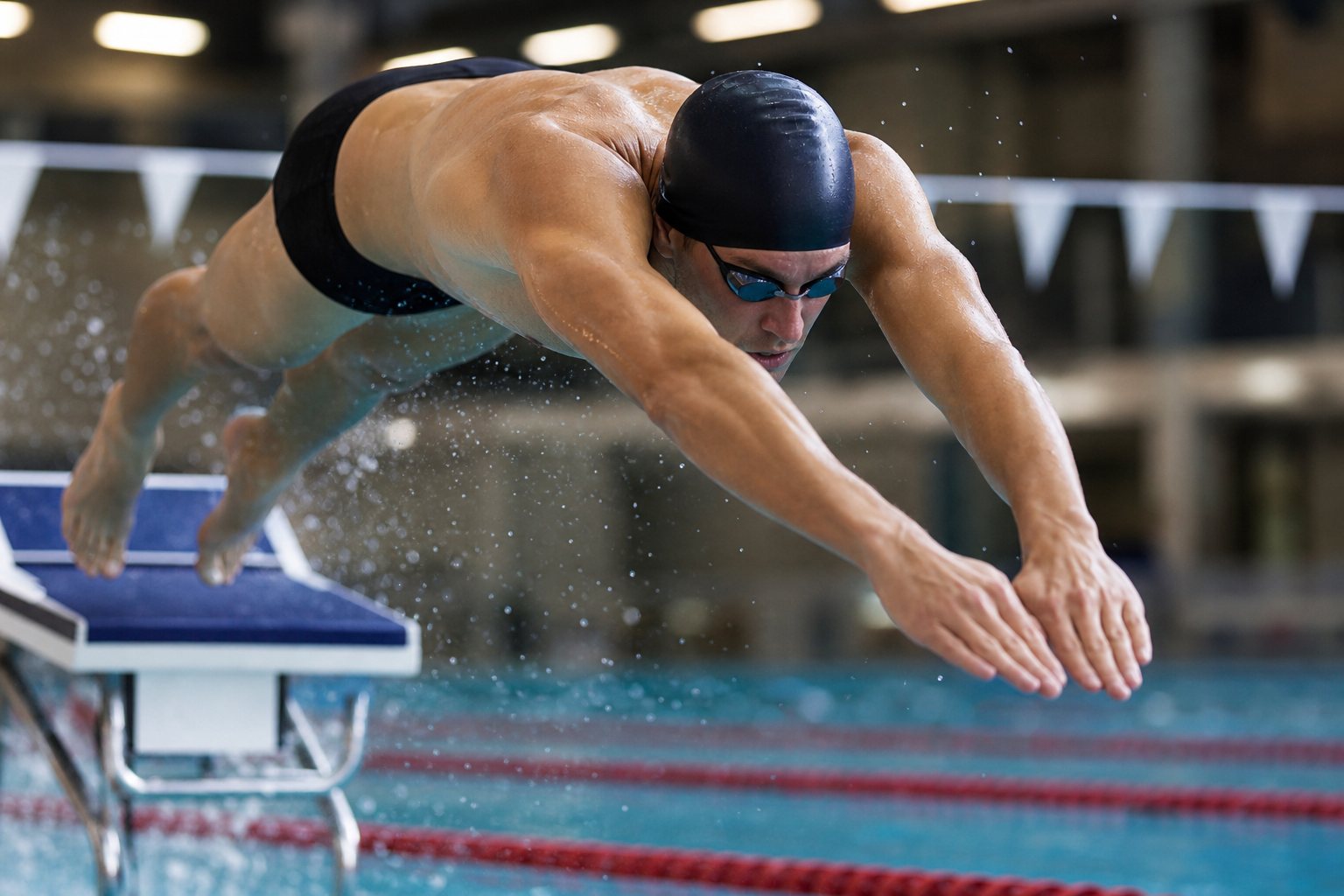
A 14-year-old swimmer finishes a hard set, climbs out, and wraps her wet hair in a towel while her ears still hold water. Down the deck a diver is chalking up for the next dive, and a water polo player is tugging the strap of an ear-guard cap. Aquatic injury prevention is the set of habits around the water that lower the odds of getting hurt or sick: a warm-up, sensible training load, shoulder and trunk strength, water-safety rules, and gear that fits. They lower the odds. They cannot promise anything.
Quick answer: The best-supported steps for aquatic athletes are a short warm-up, building training gradually, strengthening the shoulders and upper back, drying the ears and following water-safety rules (lifeguards, never swimming alone, no shallow-water dives). Evidence is stronger for the water-safety rules than for any single exercise program. See a sports medicine doctor, physical therapist or athletic trainer for pain that stays in one place, and call emergency services for a head injury with danger signs, an unresponsive swimmer or a neck injury after a dive.
Warm-up
The American Academy of Orthopaedic Surgeons (AAOS) advises warming up for 5 to 10 minutes with light activity such as jumping jacks, cycling or marching in place, then gentle stretching, because cold muscles are more prone to injury. A 2022 scoping review of swimmers’ warm-ups (PMC9509505) mapped how in-water and dryland warm-ups and the gap before racing are used; it was about swimmers, not divers or water polo players. In practice, many coaches warm up the shoulders with band work and then move into the water. That sequence is common coaching practice, not a published program like the FIFA 11+ in soccer. We did not find an equivalent named, tested warm-up for the aquatic sports as a whole.
Technique
Poor technique and repetition combine badly. Breaststroke kick technique has been linked with knee pain in older studies (Rovere and Nichols, 1987; Stulberg et al., 1980), and diving coaches build progressions step by step. Ask a certified coach to review your stroke, takeoff or throwing mechanics, especially if pain shows up in the same spot at the same point in a session. Learn skills in the order your coach sets, with spotters and equipment where they are used (coaching practice).
Progressive load and rest
Sudden jumps in training are a recognized injury risk. The IOC consensus statement on load in sport and injury (Soligard et al., 2016) addresses that link. For young athletes, the American Academy of Pediatrics advises 1 to 2 days off a week and about 3 months off a year from a single sport (Brenner 2016). Among elite swimmers, hours and weekly mileage tracked with shoulder tendon problems (Sein et al., 2010). The practical rule: raise volume, intensity and new skills one at a time. See aquatic training and recovery.
Strength and conditioning
AAOS says shoulder pain from repetitive motion is the most common swimming injury and suggests a general strengthening program for the shoulder and upper back. A 2025 randomized trial in competitive swimmers found that twice-weekly programs over 12 weeks led to less rotator imbalance than a sham program (PMID 40077099). That is balance between muscles, not proof that injuries were prevented. Core and hip strength, and control of the shoulder blades, are common coaching targets. For young athletes, the AAP advises supervised strength training.
The water, the air and the deck
- Drowning and supervision. The CDC advises formal swimming lessons, close adult supervision of children, life jackets around natural water, and CPR knowledge. AAOS adds: swim where lifeguards are on duty, never alone, check the weather and avoid alcohol.
- Hypoxic blackout. USA Swimming, the American Red Cross and the YMCA warn against hyperventilating or long breath-holds before swimming underwater; swimmers can pass out without warning, even in a pool. Breath-hold sets belong under a coach’s eye.
- Diving into water. AAOS says never dive in shallow or murky water, you should see the pool bottom at its deepest point, dive only off the end of the board, one person at a time, bounce once and swim away. AAOS reports more than 1,900 diving spinal cord injuries a year in the US.
- Lightning. The NATA lightning statement counts pools, including indoor ones, as unsafe during thunderstorms and recommends waiting 30 minutes after the last thunder (PMC3600929).
- Cold open water. World Aquatics requires wetsuits below 18 °C (64.4 °F) for its events and cites 16 °C (60.8 °F) as the minimum safety standard; recreational swimmers need their own plan for buddies and safety craft.
- Pool chemicals and ears. The CDC says chloramines cause the stinging eyes and cough; showering first and good ventilation help. For swimmer’s ear it advises ear plugs, a cap or custom molds, drying ears by tilting the head and towelling (or a hair dryer on low heat, several inches away), and no cotton swabs. See a provider for ear pain or drainage.
- Illness. AAOS advises against swimming vigorously with a fever, a chest infection or an ear infection.
Protective equipment and fit
Goggles protect the eyes from chemicals and let you see the wall; a good seal matters more than price. Caps keep hair out of eyes, and the CDC lists a bathing cap as one way to reduce what swimmers add to the water. Water polo is the aquatic sport where protective gear is a rule: the NFHS requires every player to wear a cap with ear guards at all times, and World Aquatics rules call for malleable ear protectors. Whether a particular brand is “official” or “approved” is the maker’s statement unless a federation page confirms it. See our gear page.
Youth
Children benefit most from the steps above that are not exercises: lessons, supervision, rest days and a coach who knows when to stop a skill. Young bodies are still growing, so the AAP advises supervised strength training and avoids maximal lifts before skeletal maturity. The AAP report on overuse injuries recommends time off and variety.
What prevention cannot do
None of this removes risk. Water polo is a contact sport; World Aquatics rules state its incidence of traumatic injuries is the highest of its sports (Rule 17.7). Diving involves hard impacts. Overuse injuries can appear in athletes who do everything “right.” Prevention lowers the odds, and early reporting shortens problems.
When to see a professional
See a sports medicine doctor, physical therapist or athletic trainer if pain lasts more than a couple of days, wakes you at night, changes your stroke or takeoff, or comes with numbness or weakness. After a blow to the head, use the CDC HEADS UP approach: remove the athlete from the water for the day and have a healthcare provider decide when to return. For injury patterns and rehab basics, see aquatic injuries, and the sport pages swimming, diving, water polo and artistic swimming.
Frequently asked questions
What is the best way to prevent swimmer’s shoulder?
No single method is proven. AAOS suggests a general strengthening program for the shoulder and upper back, a warm-up, gradual increases in volume and a coach’s technique review. A 2025 trial found shoulder programs improved muscle balance in swimmers.
How do I prevent swimmer’s ear?
The CDC advises keeping ears dry with a cap, plugs or custom molds, drying them after swimming, asking a provider about ear-drying drops, and never using cotton swabs. See a provider for ear pain or drainage.
Is it safe to practice holding my breath underwater?
Only under supervision. USA Swimming, the Red Cross and the YMCA warn that hyperventilating or long breath-holds can cause blackout without warning.
Do goggles and caps prevent injuries?
They protect eyes and hair and can help comfort. They do not prevent musculoskeletal injuries. In water polo, ear guards are a rule.
Should kids swim every day?
The AAP advises at least 1 to 2 days off a week and time off during the year. A coach can build a schedule from the child’s age and level.
Sources
- AAOS OrthoInfo: swimming injury prevention
- CDC: preventing swimmer’s ear
- CDC: preventing eye irritation from pool chemicals
- CDC: drowning prevention
- CDC HEADS UP: signs and symptoms
- Swimming warm-up scoping review, Sports Med Open 2022
- Soligard et al., IOC consensus on load and injury
- Brenner (AAP), overuse injuries and burnout
- Shoulder-strengthening RCT in swimmers, 2025
- NATA lightning safety position statement
- World Aquatics: 16 C open water threshold
- USA Swimming, Red Cross and YMCA on hypoxic blackout
- NFHS water polo uniform rules 2024-26
- World Aquatics water polo rules (Part Six, 2023)
- Sein et al., elite swimmers’ shoulder pain
General information for education only, not medical advice. It does not replace a visit with a doctor, physical therapist or athletic trainer. See how we write and check our pages in our editorial policy.