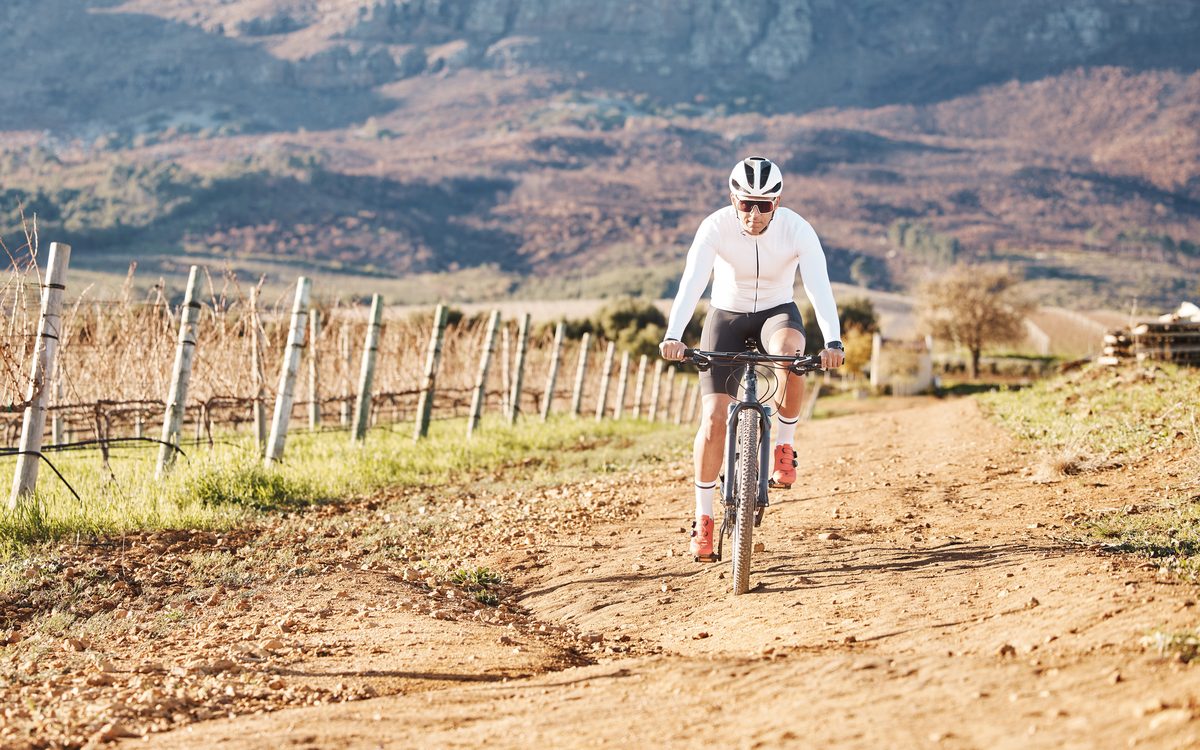
Six hours into a 100-mile gravel day, the gel flask is empty, the last water refill was an hour ago and the next town is twenty miles away. The rider who planned food, bottles and salt rides it out; the one who did not is walking. Gravel cycling nutrition is the food, drink and, for some riders, supplements that fuel long unpaved rides and protect health along the way. The limited research on gravel itself says the main challenge is logistics: how you carry and eat food on rough ground.
Quick answer: For rides over about 2.5 to 3 hours, the ACSM’s 2016 guidelines suggest up to 90 grams of carbohydrate per hour from mixed sugars, and a 2026 review suggests the upper limit could be raised to 120 grams for trained athletes while noting the evidence for more is thin. Practice your plan in training, drink regularly, and eat enough every day. Supplements are optional, can contain banned substances and should be third-party tested; a doctor or registered dietitian can tailor advice.
General information, not medical advice. Part of the gravel cycling hub; see also the cycling hub. Post-ride eating is on our recovery page.
Everyday fuel
The ACSM, Academy of Nutrition and Dietetics and Dietitians of Canada 2016 position statement gives daily carbohydrate ranges by training load: 3 to 5 grams per kilogram of body mass for light training, 5 to 7 for moderate (about an hour a day), 6 to 10 for 1 to 3 hours of moderate-to-high training and 8 to 12 for 4 to 5 hours a day. It suggests protein of 1.2 to 2.0 grams per kilogram per day. Those are ranges for a person, not a recipe, and a registered dietitian can fit them to your weight, event and health.
Fueling during long rides
The same position statement suggests up to 90 grams of carbohydrate an hour, from multiple transportable carbohydrates such as glucose and fructose mixtures, for exercise longer than about 2.5 to 3 hours. A 2026 review in the Journal of Nutrition (Morton and colleagues) notes that endurance athletes are experimenting with 120 to 200 grams an hour, says the efficacy of those doses is not yet substantiated, and suggests the upper limit could be raised from 90 to 120 grams an hour for trained participants. A 2026 narrative review of the professional peloton (Wilson) says it remains unresolved whether 100 grams or more an hour improves performance. Gut tolerance can be trained, so build up slowly in rides you can afford to feel rough on.
The UCI Sports Nutrition Project review of gravel and esports (Whitfield, Mujika and Burke, 2026) used interviews with athletes and notes that the logistics of eating and drinking in gravel racing differ from road cycling. Practical, general ideas, not sourced: pockets, frame and top-tube bags and bottles you can reach on rough ground; food you can open with gloves on; a plan for refills at checkpoints.
Hydration, sodium and heat
The AAOS advises drinking regularly on long rides, about once an hour. Hot, remote rides add risk: the NATA position statement on exertional heat illness recommends acclimatizing over 7 to 14 days, and treating exertional heat stroke as an emergency with rapid cooling. We do not give a fluid volume or sodium dose per hour, because needs vary by person and conditions; sweat rate and the label on your drink mix are the starting points. Know where you can refill before you set off.
Energy deficiency and RED-S
Relative energy deficiency in sport (REDs) is health and performance problems caused by not eating enough for the energy you use. The 2023 IOC consensus statement (Mountjoy and colleagues) describes it in men and women, with effects on bone, hormones and other systems. A 2026 UCI Sports Nutrition Project review (Burke and colleagues) says cyclists tend to be weight-conscious, frequently report restrictive eating and may be at high risk of low energy availability, and recommends supporting body-mass goals while protecting long-term health. A 2025 review (Florvag and colleagues) found cyclists and swimmers at elevated risk of reduced bone density. Warning signs include repeated illness or injury, stress fractures, missed periods, and fatigue that does not lift. Gravel’s long hours make this relevant. If you recognize these signs or find food rules taking over, see a sports medicine doctor or registered dietitian. Our mental health note is on the mental training page.
Supplements: cautious facts
The 2018 IOC consensus statement on dietary supplements (Maughan, Burke and colleagues) separates sports foods and drinks from performance supplements such as caffeine, creatine, nitrate and beta-alanine. The Whitfield review says supplements including caffeine, creatine, buffering agents and glycerol may enhance performance when used per evidence-based protocols. We give no doses beyond a product’s label.
- Banned-substance risk. Athletes are responsible for what they take. A 2021 UEFA expert statement cited a study (Geyer and colleagues) in which about 15% of 634 supplements from 13 countries contained undeclared prohormones, and said third-party testing programs reduce but do not eliminate the risk. If you are drug tested at a UCI-level event, check the substance against the WADA list and the event rules.
- Third-party testing. NSF Certified for Sport and Informed Sport are two programs; check the product on the program’s own site. Makers’ claims are not testing.
- Caffeine. Not for everyone: sensitivity, heart conditions and pregnancy are reasons to check with a doctor first.
- Creatine and beta-alanine. Studied more in strength and sprint sports; for long gravel riding the case is weaker. Creatine commonly adds 1 to 2 kg of body mass, per the UEFA statement.
- Iron. The UEFA statement says routine iron supplementation can do more harm than good. Get blood tests and advice first.
- Youth. The AAP advises against creatine and energy drinks for children and teens.
Compare drink mixes and gels in our electrolyte powder guide and energy gels guide. Talk to a doctor or dietitian before starting supplements.
Gravel cycling nutrition FAQs
How many carbohydrates should I eat per hour on a gravel ride?
The ACSM’s 2016 statement suggests up to 90 grams an hour for events over about 2.5 to 3 hours. A 2026 review suggests the limit could rise to 120 grams for trained athletes, but evidence for higher doses is limited. Practice in training.
What is RED-S?
Relative energy deficiency in sport: health and performance problems from not eating enough for your training load, described in the 2023 IOC consensus statement. See a doctor or dietitian if you suspect it.
Do I need electrolyte drinks?
Many riders use them on long, hot rides. Check labels and ideally third-party testing. We give no dose, because needs vary.
Is caffeine safe for racing?
It is widely studied and used, but it is not for everyone. Check with a doctor if you are sensitive or have a heart condition.
Are supplements safe for drug-tested events?
There is a contamination risk. Third-party testing reduces it but does not remove it, and the athlete is responsible.
Sources
- ACSM, AND and DC 2016 joint position statement: nutrition and athletic performance
- Morton et al. 2026, carbohydrate guidelines for endurance athletes
- Wilson 2026, high-carbohydrate fueling in the professional peloton
- Whitfield, Mujika and Burke 2026, nutrition for esports and gravel (UCI Sports Nutrition Project)
- Burke et al. 2026, body composition and energy availability in cycling (UCI Sports Nutrition Project)
- IOC consensus statement on relative energy deficiency in sport (REDs) 2023
- Florvag et al. 2025, bone density in low-impact sport athletes
- IOC consensus statement on dietary supplements and the high-performance athlete (Maughan et al. 2018)
- UEFA expert group statement on nutrition in elite football (Collins et al. 2021)
- AAOS OrthoInfo: bicycle safety
- NATA: exertional heat illnesses position statement
- UCI Gravel World Series: 2026 world championship courses, Nannup
General information for education only, not medical advice. It does not replace a sports medicine doctor, physical therapist, athletic trainer or registered dietitian. See our editorial policy for how we write and update pages.