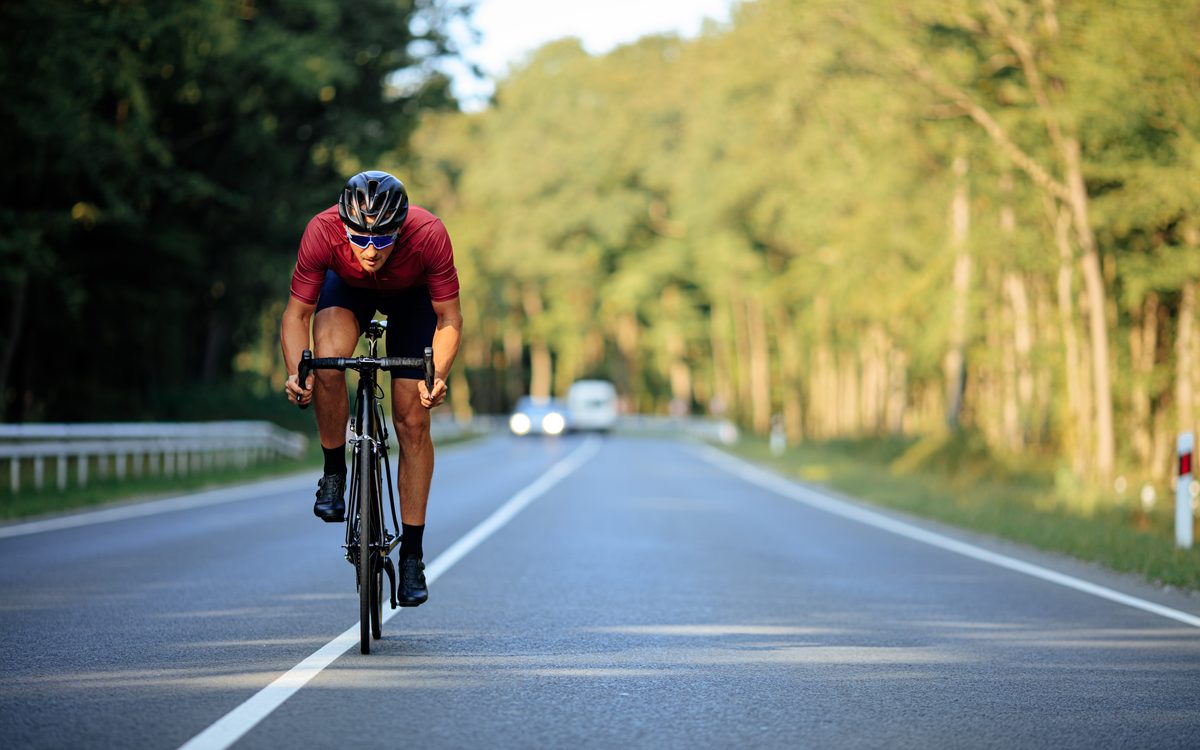
The call comes over the race radio: crash in the second half of the bunch, riders down on a downhill bend. Within minutes the first aid tent has a rider with deep road rash across the hip and shoulder, another holding a collarbone. Road cycling injuries fall into two groups: sudden ones from crashes, and gradual ones from thousands of pedal strokes in a fixed position. This page describes the patterns that surveillance studies report and the general principles of rehabilitation. For ways to lower risk see injury prevention; for the discipline see the road cycling hub.
Quick answer: Crashes produce skin abrasions first and fractures next, often in the arm, hand or collarbone; overuse problems in road cyclists most often involve the low back and knee. This page cannot diagnose anything. See a sports medicine doctor, physical therapist or athletic trainer for pain that persists, and a healthcare provider decides when it is safe to return after a head injury or fracture. Call 911 for danger signs after a head injury.
Crash injuries: what studies report
A 2025 systematic review and meta-analysis across competitive cycling (Fallon and colleagues, BMJ Open Sport and Exercise Medicine, 44 studies) found that in road cycling about 48% of injuries were to the upper limb and about 14% to the head, neck or face. Skin lacerations and abrasions were the most common injury type, with fractures second. Road cycling had the lowest concussion share among the disciplines studied, about 4.7%, though the authors note thin evidence for some disciplines.
A 2025 prospective study of 47 professional cyclists over one season (Fallon and colleagues, Sports) logged 55 injury events and reported abrasions as the most common type and fractures as the most burdensome. Injury rates were 4.14 per 1,000 hours in racing and 1.23 per 1,000 hours in training.
A 2026 retrospective questionnaire study of 192 competitive cyclists across an Olympic cycle (Lambert and colleagues, BMC Sports Science, Medicine and Rehabilitation) counted severe injuries, meaning at least three weeks of lost time. Seventy-two of the 192 (37.5%) had at least one over five years, among 237 injuries. The upper extremity (33.8%) and lower extremity (27.8%) were most often affected. The commonest diagnoses were hand fractures (14), clavicle fractures (13) and non-specific knee injuries (9). The authors note clavicle fractures occurred mainly during competition and knee injuries during training. This sample included several disciplines, including BMX, so not every number applies to road riders alone.
Overuse injuries
In a study of 109 professional road cyclists (Clarsen, Krosshaug and Bahr, 2010, American Journal of Sports Medicine), 45% of overuse injuries were in the low back and 23% in the knee, and the knee accounted for most time-loss injuries (57%). In the previous 12 months 58% of the cyclists had low back pain and 36% had anterior knee pain; few had missed competitions because of them (6% and 9%). A 2007 review (Wanich and colleagues) lists other lower-limb problems: patellar and quadriceps tendinitis, iliotibial band syndrome, hip pain, medial tibial stress syndrome, stress fracture, compartment syndrome, foot numbness and metatarsalgia (pain in the ball of the foot). It attributes them to a combination of inadequate preparation, inappropriate equipment, poor technique and overuse. Our gear and training pages cover fit and load.
Concussion
If a rider hits their head, follow CDC HEADS UP guidance: recognize the signs (for school-aged children and adolescents, the CDC lists appearing dazed, confusion, trouble concentrating or remembering, slower reactions, clumsiness, vomiting and mood changes), remove the rider from the ride or race, and have a healthcare provider decide when return is safe. The CDC’s danger signs for 911 or an emergency department are seizures, repeated vomiting, a headache that worsens, drowsiness, slurred speech, weakness or numbness, unusual behavior, double vision, or one pupil larger than the other. Do not move someone with neck pain or tingling after a crash. That last point is general first-aid practice.
General rehabilitation principles
We are not able to give a rehab plan, and no source gives a universal recovery time. The sources do support several principles:
- Get the injury assessed. Fractures, head injuries and wounds that are deep or dirty need a clinician.
- Rehabilitation depends on the injury. Wanich and colleagues say non-surgical management of cycling overuse injuries may include rest, anti-inflammatory medicines, ice, reduced training intensity, orthotics, night splints and physical therapy, and that prevention should focus on fit, equipment, position, pedalling mechanics and training. Whether any of these suits you is a clinician’s call.
- Find the cause. For overuse injuries, bike fit, cleat position, equipment and recent load changes are the usual suspects the review names.
- Return gradually, with clearance. A healthcare provider decides when it is safe to resume riding or racing after a concussion or fracture. We do not clear anyone to ride.
- Look at the whole athlete. Low energy availability and low bone density are recognized issues in cyclists; the UCI Sports Nutrition Project and a 2026 resistance training review discuss them. See our nutrition and recovery pages.
When to see a professional
See a sports medicine doctor, physical therapist or athletic trainer for a suspected broken bone, a joint that looks out of shape or will not take weight, pain at rest or at night, pain that is getting worse over weeks, numbness or tingling that persists, and any head injury with symptoms. Wounds that are deep, will not stop bleeding or look infected also need care.
Related
Neighboring disciplines have different patterns: see track cycling, cyclocross and mountain biking. The wider sport is on the cycling hub.
Road cycling injuries: FAQs
What is the most common injury in road cycling?
From crashes, skin abrasions and lacerations, then fractures, according to a 2025 systematic review of 44 studies. From overuse, low back pain and knee pain were most common in a study of 109 professional road cyclists.
How common is concussion in road cycling?
A 2025 systematic review found road cycling had the lowest concussion share of the disciplines studied, about 4.7% of injuries, but the authors say evidence is thin for some disciplines. Any head impact with symptoms should be treated as a possible concussion.
Is road rash dangerous?
Most abrasions are minor, but deep, dirty or infected wounds need medical care. We do not give wound-care instructions; a clinician or first aid provider can.
What causes knee pain in cyclists?
A 2007 review links lower-limb cycling injuries to inadequate preparation, inappropriate equipment, poor technique and overuse, with bike fit and alignment as prevention priorities. A clinician can tell which applies to you.
How long does a broken collarbone take to heal?
We cannot give a universal time. It depends on the break, treatment and the person, and a healthcare provider decides when riding is safe again.
Sources
- Fallon et al. 2025, injury and illness across competitive cycling disciplines (BMJ Open Sport and Exercise Medicine)
- Fallon et al. 2025, injury and illness in professional cycling, year-long prospective study (Sports)
- Lambert et al. 2026, severe injuries in competitive cycling during an Olympic cycle
- Clarsen, Krosshaug and Bahr 2010, overuse injuries in professional road cyclists
- Wanich et al. 2007, cycling injuries of the lower extremity
- CDC HEADS UP: signs and symptoms
- Burke et al. 2026, UCI Sports Nutrition Project: energy availability in cycling
General information for education only, not medical advice. It does not diagnose, treat or clear anyone to ride or race. Talk to a sports medicine doctor, physical therapist or athletic trainer about your own body. How we write and check our pages is in our editorial policy.