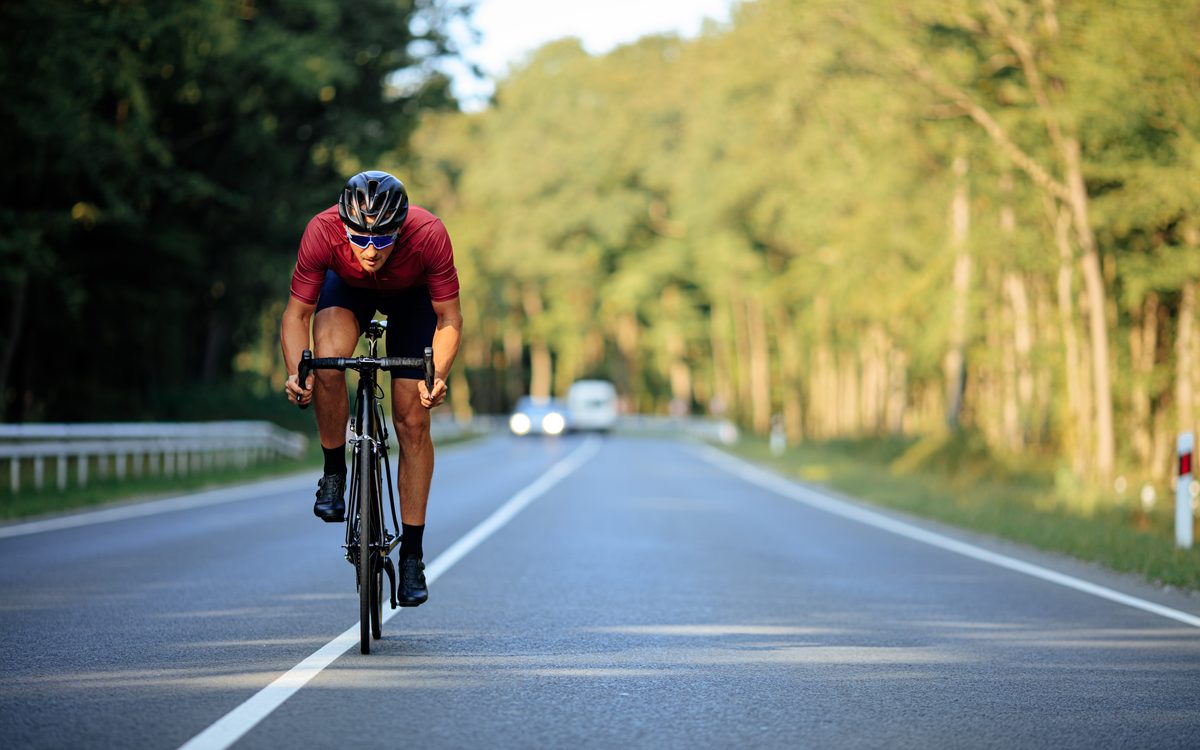
Tuesday, 6 a.m., and a club racer is on the trainer with a power meter, watching a number he has watched a hundred times: the effort he can hold for twenty minutes. By Saturday he will do a hard group ride, Sunday a long steady one. Road cycling training is the planned mix of long aerobic riding, harder intervals, strength work and rest that prepares a rider for racing. This page is about how that mix is built. For rules and getting started see the road cycling rules page; for the whole discipline see the road cycling hub.
Quick answer: Road racing is an endurance sport with sharp spikes: hours at a steady effort plus bursts for climbs, attacks and sprints. Published training data come mostly from professionals, whose weeks are far larger than a club rider’s, so copy the shape (mostly easy riding, some hard, some strength, planned rest), not the hours. Build slowly, and see a coach or a sports medicine doctor if pain or exhaustion does not settle.
What road racing asks of the body
A scientific review of power profiling in cycling (Leo and colleagues, 2022) describes the power-duration relationship: the best average power a rider can produce falls as the effort gets longer. That is why coaches test efforts of different lengths, from short sprints to 20 minutes or more, rather than one number. In a race a rider sits at an aerobic effort for hours, then needs repeated hard efforts: following an attack, sprinting, or climbing at a threshold effort. Fuel and skill matter too; see our nutrition page and rules page.
What professional riders actually do
A 2026 study in Biology of Sport (Mateo-March and colleagues) tracked 16 women and 16 men from WorldTour teams for the 10 weeks before their first race of the season. Both groups completed about six sessions a week (5.9 for women, 6.0 for men), and the men trained more hours (19.1 compared with 16.7 hours a week). More than 90% of riders followed a pyramidal intensity pattern: most time at low intensity, a moderate share at medium, the least at high. Training load measures were similar between sexes, because the women spent relatively more time at higher intensities. The women’s volume dropped more in the last week before the competitive phase. These are the weeks of full-time professionals, so a beginner should use them to learn the pattern, not to set a target.
Intensity distribution in plain words
Coaches talk about three common patterns. A 2025 review in Frontiers in Physiology (Sun and colleagues) compares pyramidal, threshold and polarized distributions in cyclic endurance sports and concludes that the best choice depends on the sport, the goal, the phase of the season and the individual, and that the models can be combined across phases. In plain words: polarized means mostly easy riding and some very hard riding with little in between, pyramidal means a lot of easy riding, a fair amount of moderate work and a little hard work. The evidence does not name one winner, so we do not either.
A sensible weekly shape (general coaching practice)
This is a general outline used by many coaches, not a prescription, and not taken from one study. Adjust it for age, health, work and sleep, and ask a coach.
- Two to three easy endurance rides, one of them longer, ridden at a pace where you could talk.
- One or two harder sessions: intervals, hills or a group ride, placed with an easy day on each side.
- One or two short strength sessions (see below).
- At least one full rest day, plus lighter weeks built in on a regular schedule.
Strength training
Strength work is one of the better-supported additions for cyclists. A 2026 narrative review in Scandinavian Journal of Medicine and Science in Sports concluded that adding one to two sessions a week of resistance training with moderate to high loads (60% to 85% of one-repetition maximum), two to four sets of three to five compound lower-body lifts, and limited fatigue within sets improved key cycling performance measures, and that it did not appear to hurt performance through unwanted muscle growth. The authors also say it may help counter the low bone mineral density commonly seen in competitive cyclists. A 2025 survey of 147 professional road cyclists (Vikestad and colleagues, PLoS One) found most did about two strength sessions a week in the off-season and pre-season, dropping to one maintenance session in the race season, with travel, fatigue and racing the main obstacles, and coaches guiding their choices. Learn the lifts with a qualified coach before loading them.
Periodisation basics
Periodisation means arranging training in phases. The 2025 Frontiers review above describes how the intensity pattern shifts across general preparation, specific preparation, pre-competition and competition phases. Many coaches describe the same idea in plainer terms: a base period of mostly easy volume, a build period that adds intensity, then a race period where you freshen up and protect form. That description is general practice; timing depends on your race calendar. Lighter weeks and a reduced load before an important race are standard coaching tools, and the professional data above show volume falling in the final pre-season week.
Measuring load
Many riders use heart-rate monitors or power meters. Power shows how hard you worked regardless of wind or hills, while heart rate shows how your body responded that day. Neither number is a goal on its own; they are tools for noticing trends. Our heart-rate monitor guide at /best-heart-rate-monitor-for-athletes/ compares options. The 2013 consensus statement of the European College of Sport Science and the American College of Sports Medicine warns that excessive overload combined with inadequate recovery can lead to nonfunctional overreaching and overtraining syndrome, which can take a long time to resolve and needs a clinician’s review. Rising fatigue, falling performance and mood changes are reasons to ease off and ask for help.
Getting started if you are new
If you are new to training or returning after a break, check with a doctor if you have health concerns, then build gradually. Adding a bit of time or intensity at a time and keeping rest days is common coaching advice; it is not a rule from a study we can cite. Riding with a club adds skills and motivation at no extra cost. The rules and getting started page explains how to find one.
Related sections
Injury prevention, recovery and mental training belong with this page. Nearby sports: triathlon and gravel cycling.
Road cycling training: FAQs
How many hours a week do road racers train?
It varies enormously. In the 2026 WorldTour study, men averaged 19.1 hours and women 16.7 hours a week in the 10 weeks before the season. Amateur and beginner riders train far less. We found no published standard for club racers, so a coach should set yours.
What is polarized training?
It means doing most of your training at easy intensity, some at very hard intensity and little in between. A 2025 review compares it with pyramidal and threshold approaches and says the right choice depends on the sport, the phase and the athlete. Most professional riders in the 2026 WorldTour data followed a pyramidal pattern.
Should road cyclists lift weights?
A 2026 review found adding one to two sessions a week of moderate-to-high-load strength work helped key cycling measures, and found no sign that it hurt performance through unwanted muscle growth. Learn the lifts with a qualified coach.
Do I need a power meter?
No. Heart rate, perceived effort and time are enough for most riders. A power meter measures work regardless of wind or hills and helps with pacing and tracking, but it is a tool, not a requirement.
How do I know I am training too much?
Warning signs named in the ECSS and ACSM overtraining consensus include a performance drop, persistent fatigue and mood disturbance. If rest does not fix them, see a sports medicine doctor.
Sources
- Leo et al. 2022, power profiling and the power-duration relationship in cycling
- Mateo-March et al. 2026, training of WorldTour road cyclists before the competitive phase
- Sun et al. 2025, training intensity distribution theory for cyclic endurance sports
- Resistance training for cyclists: evidence and practical recommendations (2026)
- Vikestad et al. 2025, strength training among professional UCI road cyclists
- Meeusen et al. 2013, ECSS and ACSM overtraining consensus statement
General information for education only, not medical advice. It does not diagnose, treat or clear anyone to ride or race. Talk to a sports medicine doctor, physical therapist or athletic trainer about your own body. How we write and check our pages is in our editorial policy.