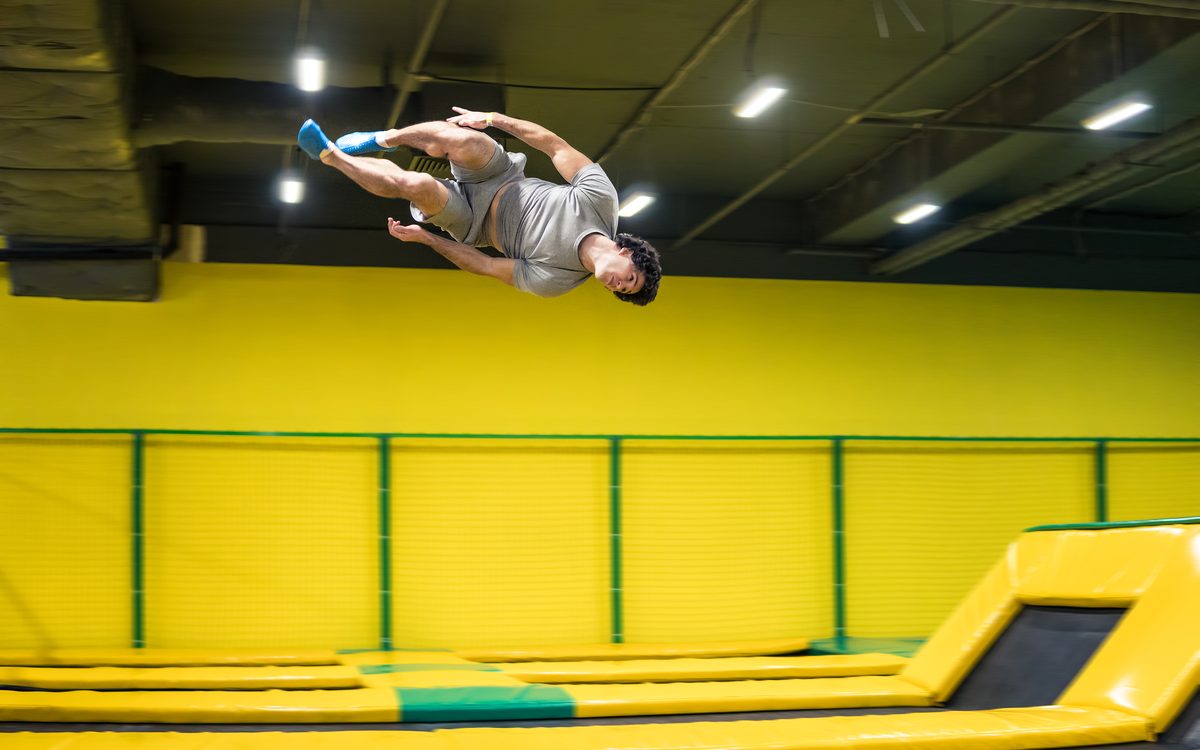
The judge’s signal comes, the hall goes quiet, and the athlete has one minute to start. There is no teammate to pass to and no timeout, and the routine is ten skills long with no pause to reset. Trampoline mental training is the practice of skills such as focus, confidence, routines and imagery that help an athlete perform what they have trained, under pressure. It is a performance topic; if the problem is anxiety, low mood, disordered eating or burnout, that is a health topic, and the section near the end explains the difference. The rules of competition are on our rules page.
Quick answer: Trampoline gymnastics puts one athlete on the bed at a time with a fixed signal, a strict start window and no coaching during the routine. Elite athletes interviewed in one study named four recurring problems: starting at the right moment, keeping the right mindset to finish, recovering normal movement control and fixing problems quickly mid-routine. Practicing a routine around the start, a calm breathing and focus cue, and a plan for after a mistake are common sport-psychology practices, though we found no trampoline-specific trial and none of them guarantees results. Anxiety, depression, disordered eating or burnout need a qualified professional; in the United States call or text 988 in a crisis.
What competition asks of the mind
The FIG Code of Points 2025-2028 sets the stage. After the start signal, the athlete has one minute to begin; late starts cost points, from 0.2 at 61 seconds, and after 181 seconds the athlete does not start. Each athlete gets one warm-up touch of up to 45 seconds on the competition trampoline, in order. Once the routine starts, the athlete’s own spotters may not talk to or signal them, a 0.6 penalty. The routine can end early if the athlete lands on one foot, leaves the bed or does a straight bounce in the middle. In senior qualification there are two routines, with the better one counting.
Hauw and Durand (Journal of Sports Sciences, 2007) analyzed 52 exercises by 10 elite trampolinists using observation and interviews. They identified four types of problem that appeared singly or together: finding the best moment to begin; finding and keeping the best mode of involvement to the end; recovering normal sensory-motor capacity; and solving problems quickly and definitively while performing. It describes athletes’ experience, not a cure.
Confidence and focus
Confidence in trampoline usually comes from reliable skills: the athlete has done the routine many times, in practice and in simulated competition, and knows how it feels. General sport-psychology practice is to build it by routines performed under mild pressure in training, honest feedback and recognizing what went well. Focus in this sport is often external and visual. Natrup and colleagues (Human Movement Science, 2020) found that experienced gymnasts fix their gaze on a point on the bed to prepare for landing during a back tuck, and that opening earlier lets them orient sooner.
Motivation and goal setting
Goal setting is common practice in sport psychology: outcome goals (a place or score), performance goals (a clean landing on every routine) and process goals (the three things to do in the warm-up). Because flight time and landing position are measured by machines, process goals about height, control and centering are things the athlete can influence directly. Goals should be realistic and agreed with the coach. We did not find a trampoline-specific goal-setting trial.
Imagery and pre-competition routines
Imagery means rehearsing the routine in the mind: the take-off, the shape, the opening, the landing. It is widely taught in sport psychology (general practice), though we did not find a trampoline-specific trial and it does not guarantee a better score. A pre-routine routine is another general practice: a few breaths, a cue word, a short visual check of the center of the bed, then the first bounces. The start signal and the one-minute window make it practical to plan this ahead.
Handling pressure
Hardy and colleagues (Perceptual and Motor Skills, 2001) studied 12 experienced female trampolinists in a field study of the “conscious processing” idea, in which thinking about how to move combined with high state anxiety is expected to hurt performance, and found results that supported it, while noting another possible explanation. In practice, coaches suggest cues that point to the outcome (“tall, tidy, centered”) rather than a step-by-step analysis of the movement while performing. That is general coaching practice, not a finding from this one small study.
Responding to setbacks
In trampoline, a mistake is visible and sometimes immediate. If the athlete lands off-center, takes a step or loses a skill, the routine continues or ends depending on the rules, and Hauw and Durand’s category of “solving problems quickly and definitively while performing” describes the need to make a decision in the next bounce. Afterward, coaches commonly use short, specific reviews with the athlete: what happened, what to repeat, what to fix, then move on. If a skill that usually goes well suddenly does not, the coach may want to look at load, fatigue and growth as well as mindset: Patel and colleagues (2021) found injury risk highest around the growth spurt in trampoline gymnasts.
Decisions, routine choice and teamwork
Senior routines are voluntary, so athletes and coaches choose the ten skills and write them on a competition card before the round. The FIG Code adds up difficulty with no cap, but a higher difficulty also means more risk and more deductions if form or landing slips, so deciding how much difficulty to include is a real decision, not only a mental skill. Repeated elements earn no extra difficulty. Synchronized pairs add another layer, since two athletes must match each other. The Code requires the elements to be written on the competition card in the order they will be performed, so these decisions are made before the start, with the coach.
Competition preparation
Plan what can be planned: the card, travel and sleep, meals, a warm-up on training equipment before the single 45-second touch on the competition bed, and what to do between qualification routines. See training for how load builds toward a meet and nutrition for fueling. Keep the pre-meet routine similar to what has been rehearsed in practice.
Youth considerations
We did not find trampoline-specific guidance on young athletes’ mental skills. The American Academy of Pediatrics (Brenner, 2016) recommends young athletes take one to two days a week off from the main sport. Parents and coaches can ask about the athlete’s goals and keep comments focused on effort and learning (general advice).
Mental health is not the same as mental performance
Skills such as focus and routines are performance tools. Persistent anxiety, low mood, panic, an intense preoccupation with food or weight, or exhaustion that does not lift are health matters that need a qualified professional such as a doctor, psychologist or psychiatrist who works with athletes. The International Olympic Committee consensus statement on mental health in elite athletes (Reardon and colleagues, British Journal of Sports Medicine, 2019) says mental health symptoms and disorders are common among elite athletes and can impair performance, and that management should address the whole athlete and the environment around them. In the United States, the 988 Suicide & Crisis Lifeline offers free, confidential support by call or text, and AASP lists sport psychology resources. If an athlete is in danger, call emergency services.
Trampoline mental training FAQs
How do I stop nerves before a trampoline routine?
Nerves are normal. Common tools are a short pre-routine routine, breathing, a cue word and rehearsing the routine in training. None is guaranteed, and persistent anxiety deserves a conversation with a professional.
What happens if I mess up during a routine?
Under the FIG Code, some mistakes end the routine (landing on one foot, leaving the bed) and others cost deductions. A coach can help plan what to do next.
Does imagery work?
It is widely used in sport psychology, but we found no trampoline-specific trial, and it is not a guarantee. It is best as an addition to physical practice.
What if a skill suddenly feels scary?
It is common to lose confidence in a skill. Tell the coach; they may step back to earlier steps. Check for pain or fatigue too, and see a doctor for injury concerns.
Where can I find help for anxiety or low mood?
Start with a doctor or a licensed mental health professional. In the United States, 988 offers call or text support in a crisis.
Sources
- FIG Trampoline Gymnastics Code of Points 2025-2028: PDF
- Hauw D, Durand M, Situated analysis of elite trampolinists’ problems in competition using retrospective interviews, J Sports Sci 2007: PubMed
- Hardy L, Mullen R, Martin N, Effect of task-relevant cues and state anxiety on motor performance, Percept Mot Skills 2001: PubMed
- Natrup J et al., Gaze behavior of trampoline gymnasts during a back tuck somersault, Hum Mov Sci 2020: PubMed
- Patel TS et al., J Sports Sci 2021: PubMed; AAP, Brenner JS 2016: PubMed
- Reardon CL et al., Mental health in elite athletes: IOC consensus statement (2019), Br J Sports Med: PubMed
- 988 Suicide & Crisis Lifeline: 988lifeline.org; Association for Applied Sport Psychology resources: appliedsportpsych.org
Keep going: the trampoline hub, skills, rules and getting started, the gymnastics hub and the sports hub.
General information for education only, not medical advice. It does not replace a sports medicine doctor, physical therapist, athletic trainer or your coach. How we research and write these pages is in our editorial policy.