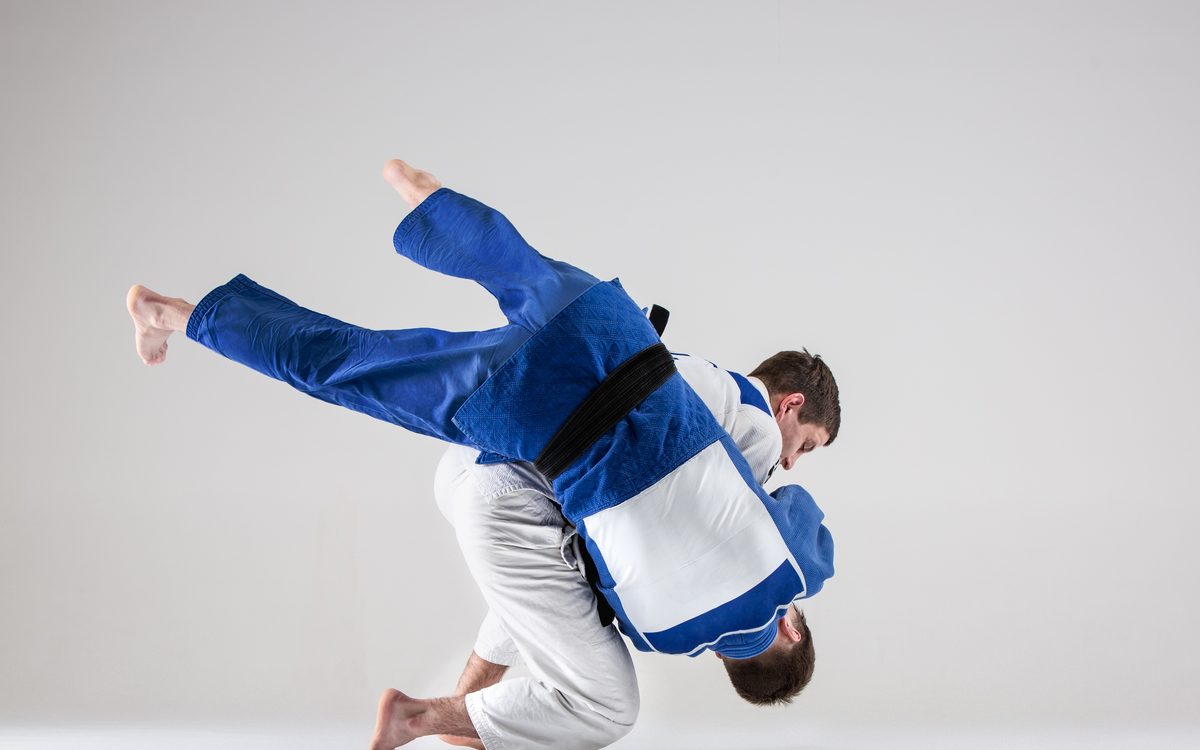
The first night in a judo club rarely involves a throw. A new student in a borrowed white jacket stands at the edge of the tatami, bows when told to, and then spends twenty minutes lying down: rolling over one shoulder, slapping the mat with an arm, getting up, doing it again. Judo skills, rules and getting started is the practical side of the sport: how a contest is scored, which actions are forbidden, what a beginner learns first, and how to find a club. For the bigger picture of the sport, start at the judo hub.
Quick answer: Judo is won by ippon, a clean throw onto the back, a 20-second hold-down, or a submission, and a senior contest lasts four minutes of real time. Beginners learn falling (ukemi) first, then basic throws and holds, and the simplest way to start is a class at a club found through USA Judo, which says it has more than 500 clubs. Many clubs lend a gi for a first class, and rules for children vary by organizer, so ask the club.
How a contest is scored
Under the International Judo Federation (IJF) rules, as published by British Judo in February 2025, a contest between seniors, juniors (under 21) or cadets (under 18) lasts four minutes of actual fighting time, with the clock stopped when the referee calls a pause. Contestants are guaranteed at least 10 minutes of rest between contests. The aim is ippon, which ends the match at once.
- Ippon (full point): a throw that lands the opponent largely on the back with speed, force and control; a hold-down (osaekomi) kept for 20 seconds; or a submission by choke or elbow armlock, including when the opponent taps or loses consciousness.
- Waza-ari (half point): a throw that lands with only some of the ippon qualities, or a hold-down of 10 to 19 seconds. Two waza-ari in one contest combine into ippon (waza-ari-awasete-ippon).
- Yuko: a smaller score for a hold-down of 5 to 9 seconds, and for throws that land on the side. The IJF removed yuko in 2017 and reinstated it in 2025, according to Olympics.com coverage of the rule update. Yuko scores do not add up to a waza-ari.
- Shido (penalty): given for passivity, false attacks, leaving the area and similar faults. Under the rules shido no longer gives the opponent points, but a third shido is hansoku-make, a disqualification.
If the score is level at four minutes, the contest goes to “golden score”: extra time with no limit, no rest, and existing scores and penalties carried over. The first technical score or penalty decides it. A study of international men’s contests from 2010 to 2019 (Frontiers in Psychology, 2022) found golden score was used in about 21% of contests in 2018 and 2019.
What is not allowed
Most of the forbidden actions in judo exist to protect the neck, spine and knees, so they are worth knowing as a beginner. The rules published by British Judo list several of them. Grabbing the opponent’s legs with the hands is penalized. Diving head-first, or throwing in a way that puts the head toward the mat, can end a contest by hansoku-make. Several named techniques are never allowed, including kawazu-gake, kani-basami, do-jime and ashi-garami. Armlocks are allowed only on the elbow, and lifting an opponent and slamming them down is banned. In cadet contests a competitor may not use the head to throw or to defend.
The IJF also writes into its rules that a cadet who loses consciousness during a choke cannot continue the contest. The habit that goes with all of this is the tap: a partner who taps the mat or your body with a hand or foot, or says “maitta,” is saying stop, and you release at once.
The basic skills a beginner learns
Judo teaching has an order, and clubs vary in detail, but most follow the same arc. This list describes common club practice, not a single official syllabus.
- Ukemi (breakfalls): rolling and slapping out so a throw lands on the whole body and not on a hand or the head. It comes first because a fall is the thing every judoka does most.
- Kumi-kata (grips): how to take hold of the jacket sleeve and lapel, and how to break the opponent’s grip. Much of a contest is a fight for grips.
- Tai-sabaki and kuzushi: moving the body and unbalancing the partner. A throw works when the partner is off balance, not because of strength alone.
- Nage-waza (throws): hip, leg and hand throws, usually practiced first as uchikomi, repeated entries without lifting the partner.
- Ne-waza (groundwork): hold-downs, escapes, and later chokes and elbow armlocks with a training partner.
- Randori: free practice with a partner, usually after weeks or months of drills, at an agreed intensity.
Belts show progress. The colored belts are kyu grades and black belt is the first dan. We did not find an official figure for how long black belt takes, because promotion depends on the national federation and the club, so ask your instructor how grading works.
How a beginner starts
- Find a club. USA Judo has a club locator on usajudo.com. Outside the US, look for the national federation, which is the member of the IJF for your country.
- Watch a class first. Ask whether beginners have their own session, whether they start with breakfalls, and how the instructor handles size and experience differences when pairing partners.
- Wear simple clothes for a trial class. Many clubs lend a gi. When you buy one, our judo gear page explains what matters.
- Tell the instructor about injuries. Neck, shoulder, knee or head problems change what a safe class looks like. See our injury prevention page for habits that lower risk.
- Go steady. A first month of two classes a week is normal for adults. Our training page covers building up.
Levels and where to compete
Club judo is the base: evening classes, grading days and local tournaments, open to adults at any age. Divisions are by sex, age and weight. USA Judo lists a Youth Nationals and a Senior Nationals each year, with its 2027 events announced for March 20 to 21 in Salt Lake City and May 15 to 16 in Irving, Texas, as of 2026, and a Judo in Schools program on its site. Above that are cadet (under 18) and junior (under 21) international events and the senior world circuit run by the IJF.
Judo has been on the Olympic program since Tokyo 1964 (men), with women’s judo a demonstration at Seoul 1988 and a medal event from Barcelona 1992, and a mixed team event added at Tokyo 2020, according to Olympics.com. The Los Angeles 2028 organizers list judo with 15 events: seven men’s weight classes, seven women’s and the mixed team. Check la28.org for dates and any changes.
Para judo
Paralympic judo is for athletes with a vision impairment, who compete in classes J1 and J2, in sex and weight categories. In plain terms, classification groups athletes by how much vision they have so that competition is fair. The rules are those of Olympic judo with one change: both athletes must have hold of each other’s judogi before and during the contest. The International Blind Sports Federation (IBSA) governs it, and paralympic.org lists it as contested from Seoul 1988, with women added in 2004. Para judo is on the initial program for the LA28 Paralympic Games. Athletes and parents should ask their national federation about classification and access routes.
Official rulebooks
For exact wording, go to the source: the IJF publishes its Sport and Organisation Rules on ijf.org, and national federations publish their own contest rules. Rules change between Olympic cycles, so check the date on any copy. Local and youth events often modify the rules, for example on chokes and armlocks for children; we could not confirm a single US age limit, so ask the organizer of any event your child enters.
Frequently asked questions
Do I need to be fit or flexible to start judo?
No. Clubs expect beginners to be out of shape. Fitness builds from the classes, and breakfalls and basic grips are taught slowly. If you have a medical condition or an old injury, ask a doctor and tell the instructor.
How do you win a judo match?
By ippon (a clean throw on the back, a 20-second hold-down or a submission) or by being ahead on technical scores when four minutes end. A tied score goes to golden score with no time limit. Three shidos disqualify.
How old should a child be to start judo?
We found no single age from a medical body. The American Academy of Pediatrics says to look for qualified instructors who understand a child’s limits for age and maturity. Ask clubs how they teach falling and what they allow in practice.
Is judo in the Olympics?
Yes. Judo has been an Olympic sport since Tokyo 1964, and the Los Angeles 2028 organizers list it with 15 events. Check the official programme for the current Games.
What is the difference between judo and Brazilian jiu-jitsu?
Judo emphasizes throws, with ground work after, and its contests end at ippon. Brazilian jiu-jitsu is mostly ground grappling with a different points system. Both are grappling arts in the martial arts family.
Sources
- IJF Sport and Organisation Rules (Jan 2025)
- British Judo Contest Rules based on IJF rules (22 Feb 2025)
- USA Judo
- LA28: Judo
- Olympics.com: IJF rule updates for the LA2028 cycle
- Paralympic.org: Judo
- AAP: Youth Participation and Injury Risk in Martial Arts
- Combat time in international men’s judo 2010-2019 (PMID 35369231)
General information for education only, not medical advice. It does not replace a sports medicine doctor, physical therapist or athletic trainer who knows you. See how we work in our editorial policy, and return to the judo hub.