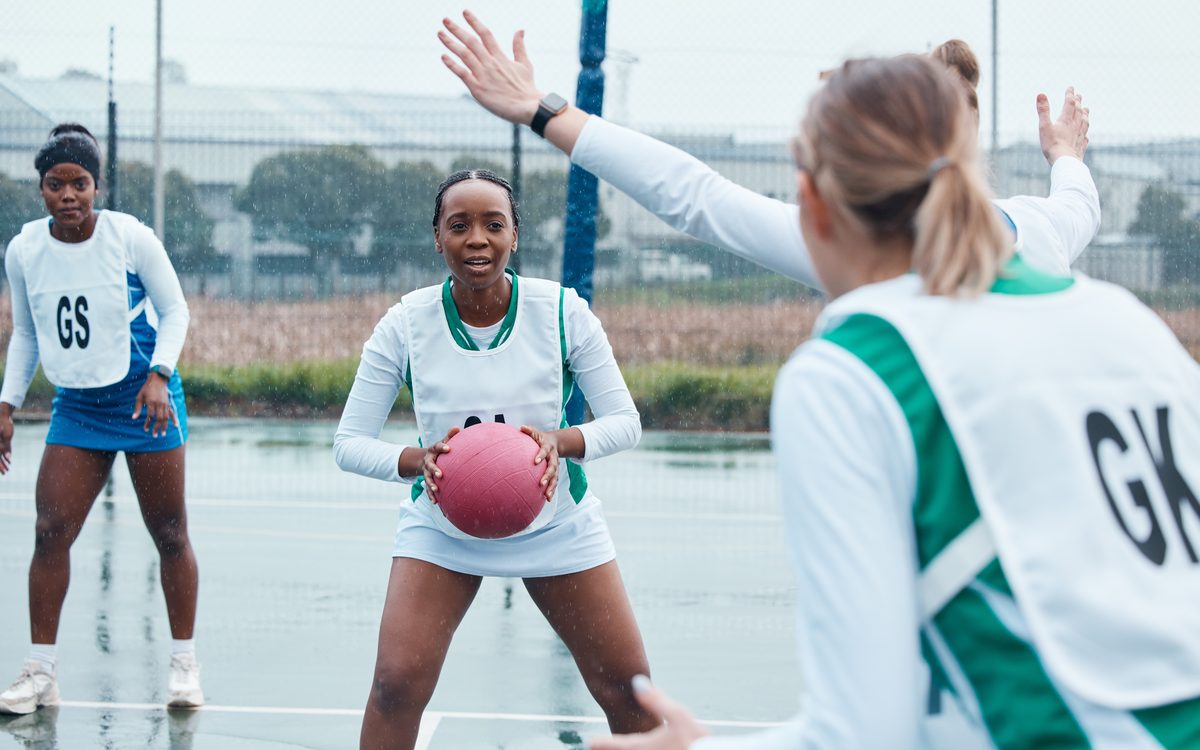
A high pass sails over the circle edge, the goal shooter leaps for it, the defender’s hand is in her eyeline, and she comes down leaning back with her knees close together. That moment, a jump, a distraction and an unbalanced landing, appears again and again in studies of serious knee injuries in netball. Netball injury prevention is the set of habits around a player, a proper warm-up, practised landings, strong legs and hips, sensible training load and enough sleep, that aim to lower the chance of getting hurt. They lower the odds. They cannot promise anything.
Quick answer: The best-supported ideas for netball are a warm-up that includes landing and balance work, practising controlled, balanced landings (including after jumping for a pass), building leg and hip strength, and not adding training load too fast. Most evidence is from small or observational studies, and the sport’s own KNEE Program has no independent trial results that we could find. See a sports medicine doctor, physical therapist or athletic trainer if pain stays in one place, if a joint gives way, or if you can’t put weight on it, and call emergency services after a head injury with danger signs.
General information, not medical advice. This page is about lowering risk. What each injury is and how it is managed is on our netball injuries page. For the sport as a whole, start at the netball hub.
Warm up for the court, not only for the legs
Netball Australia, with the Australian Institute of Sport, built the KNEE Program as an on-court warm-up aimed at movement efficiency and injury prevention, with a junior version for 11 to 14 year olds. We found no independent trial results for the programme, so we call it a sensible routine from the sport’s own association, not a proven way to prevent injuries. A programme only helps if it is used, and a 2010 study looked at how coaches found putting one into practice in junior community netball (Saunders and colleagues, British Journal of Sports Medicine). Ask your coach whether the club uses one, and how.
Landing is where the risk concentrates
The 2021 systematic review of netball injury research (Downs and colleagues, Sports Medicine – Open; 46 studies) lists landings, collisions and falls as the main circumstances of injury. Two video analyses of anterior cruciate ligament (ACL) injuries in elite players, taken from televised games, are more specific:
- Sixteen injuries (Stuelcken and colleagues, Journal of Sports Sciences, 2016): eight were indirect contact and eight non-contact. One common pattern was jumping to receive or intercept a pass, then being knocked off balance in the air and landing unbalanced. Apparent knee collapse inward was seen in several cases.
- Twenty-one injuries (Belcher and colleagues, Sports Biomechanics, 2024): 17 happened on a jump landing and 2 while cutting. The common scenario, in 11 players, was rapid braking after jumping to receive a high pass, landing on both feet with a wide base, mostly on the injured leg with the knee near straight and the player leaning back. The authors suggest landing about shoulder-width apart, bending the knee at least 30 degrees, practising balance and being nudged off balance, and securing the ball above the pelvis while turning the whole body toward the next pass.
These were elite players and the authors describe patterns, not proof of cause. For recreational and school players the takeaway is modest: practise landing with the ball, with a defender nearby and with a decision to make, not only on a clear mat. Your coach or physical therapist can check your landing on video.
Strength and neuromuscular training
In a 2017 randomised study of 23 players aged about 12 (Hopper and colleagues, Frontiers in Physiology), 6 weeks of neuromuscular training improved landing mechanics linked to knee injury compared with regular netball training alone. It tested mechanics, not injury rates, and it was small. The AAOS notes that quadriceps strength and stability matter for knee recovery and preventing a second injury. Strength work for young players should be supervised and well taught; a 2014 international consensus (Lloyd and colleagues) considers it safe and beneficial. See our training page for how a week can be shaped.
Ankles
The Downs review found ankle and knee injuries the most common in netball, with the share varying from 13% to 84% for the ankle depending on the study. A year-long study of 94 club players (Attenborough and colleagues, Physical Therapy in Sport, 2017) recorded 11 ankle sprains, 1.74 per 1,000 hours of play, and found one risk factor, a short reach on a balance test (a posterior-medial star excursion reach of 77.5% of leg length or less, odds ratio about 4, with a wide confidence interval). That is one small study, so it is not a screening standard. The AAOS lists poor balance, unsupportive or slippery shoes and a previous sprain among sprain risks, and advises warming up, strengthening the ankle, improving balance and wearing supportive footwear. A 2020 study of an Australian community club (Franettovich Smith and colleagues, Physical Therapy in Sport) found a previous injury raised the odds of a lower-limb injury that season by about seven times, so finish rehab fully.
Braces and tape
A 1999 study of 15 netball players (Hopper and colleagues, British Journal of Sports Medicine) found a brace reduced muscle activity in two calf and outer-ankle muscles during landings, while peak landing force was not changed by bracing or taping. That is lab data, not an injury trial. Whether to wear a brace is a question for a clinician, particularly after a previous sprain. Our gear page covers fit and standards.
Training load, sleep and recovery
In a 2021 study of 536 elite and pre-elite netballers (Horgan and colleagues, Scandinavian Journal of Medicine and Science in Sports), reports of poor sleep and soreness were associated with later injury and illness. The authors recommend monitoring sleep and recovery. The Downs review adds that more studies are needed in recreational netball. As general guidance, a 2015 study of young athletes (Jayanthi and colleagues) found that training more hours a week than your age in years went with about twice the odds of a serious overuse injury. See our recovery page.
Head injuries and collisions
At the 2018 Australian under-17 and under-19 national championships (Smyth and colleagues, Journal of Science and Medicine in Sport, 2020), ankle sprains, ACL ruptures and concussions led to the most time incapacitated. The CDC’s HEADS UP programme says to remove an athlete from play at once if concussion is suspected, keep them out until a health care provider clears them, and seek emergency care for danger signs. Defenders must stay 0.9 m from the player with the ball and contact must not impede play, but collisions still happen.
What prevention cannot do
No habit on this page removes the risk. Netball involves jumping, landing and contact, and much of the research is small, observational or from elite players. A player can do everything right and still be hurt. An injury is not a failure of effort. How long healing takes and when to return belong with the clinician treating you.
When to see a professional
- Emergency now: a head injury with danger signs (worsening headache, repeated vomiting, seizure, growing confusion), neck pain after a fall, numbness, or a joint that looks out of place.
- Soon: a knee that pops, swells or gives way, an ankle you cannot put weight on, pain in one spot that does not settle, or pain that changes how you land.
Netball injury prevention: FAQs
What is the KNEE Program in netball?
It is a warm-up from Netball Australia and the Australian Institute of Sport, aimed at movement efficiency and injury prevention, with a junior version for ages 11 to 14. We found no independent trial results.
How can netball players protect their knees?
The sources point to balanced landings with a bent knee, neuromuscular training and leg strength. None guarantees protection.
Should I wear an ankle brace for netball?
Ask a sports medicine doctor, physical therapist or athletic trainer. A 1999 lab study found bracing changed muscle activity in landings, but it did not test injury rates.
Why do so many netball injuries happen on landing?
The footwork rule means players land on one or two feet and must stay planted, often after jumping to receive a pass. Reviews list landings, collisions and falls as the main circumstances.
Is netball safe for children?
Children are injured too, with more upper-limb injuries such as fractures, according to the 2021 review. Coaching on landing, warm-ups and sensible load help; no sport is risk-free.
Sources
- Downs et al., Injuries in Netball: A Systematic Review, 2021
- Netball Australia: KNEE Program
- Saunders et al., coaches’ perspectives on a prevention programme in junior community netball, 2010
- Stuelcken et al., ACL injuries in elite women’s netball: video analysis, 2016
- Belcher et al., 21 ACL injuries in elite netball: video analysis, 2024
- Hopper et al., neuromuscular training in 11-13 year old netball athletes, 2017
- Attenborough et al., risk factors for ankle sprains in netball, 2017
- Franettovich Smith et al., injury surveillance of a community netball club, 2020
- Hopper et al., landing in netball: taping and bracing, 1999
- Horgan et al., impaired recovery, injury and illness in 536 netballers, 2021
- Smyth et al., health problems at the 2018 Australian National Netball Championships, 2020
- Jayanthi et al., sports specialization and overuse injury, 2015
- Lloyd et al., youth resistance training consensus, 2014
- AAOS OrthoInfo: Sprained Ankle
- AAOS OrthoInfo: ACL Injuries
- CDC HEADS UP: Concussion response
General information for education only, not medical advice. It does not replace a visit with a doctor, physical therapist or athletic trainer. See how we write and check our pages in our editorial policy.