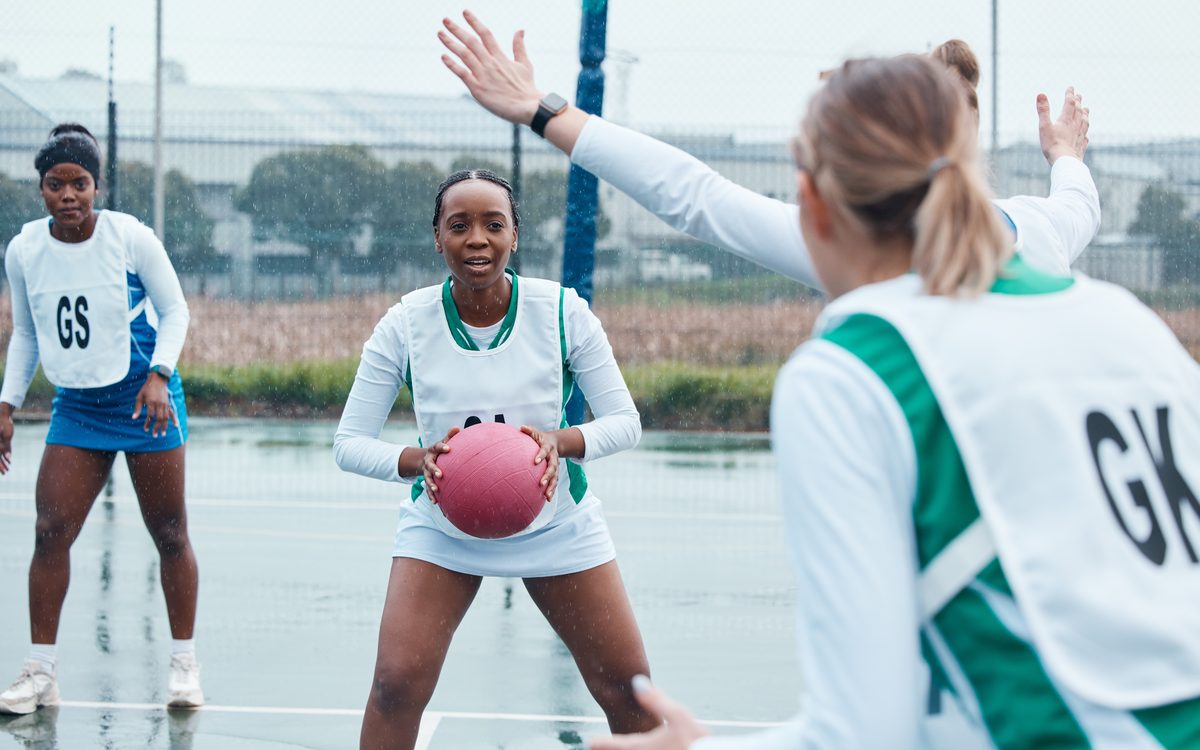
Third quarter, a tight game, and the centre has just made her fourth sprint to the circle in a minute. Netball looks like a game of passing, but the body keeps working in short, sharp bursts: sprint, brake, jump, land on one foot, turn, go again. Netball training is the mix of skills practice, strength, conditioning and rest that prepares a player for those bursts across 60 minutes. This page covers the demands, a sensible weekly shape and how to add load without overdoing it.
Quick answer: Netball is a game of short sprints, hard stops, jumps and one-foot landings, and different positions load the body very differently. A sensible week mixes skills practice, strength work, short high-effort conditioning and at least one or two days off. Add load slowly and learn to land well before adding speed. Evidence for netball-specific training is thin, so treat the numbers here as examples, not targets, and see a coach or physical therapist for a plan that fits you.
How the game works is on our rules and getting started page. This page is about preparing for it. Injury detail is on the injuries page, and prevention habits on the injury prevention page.
What the evidence base looks like
A 2021 scoping review (Whitehead and colleagues, Sports Medicine) searched four databases and included 150 studies on the applied sports science and medicine of netball. Injury made up 45 of them and physical qualities 37, but only 4 looked at training load, 9 at fatigue and recovery and 3 at nutrition. Nearly all the studies were of female players. The authors describe the evidence base as thin in those areas. That is useful to know: much of what is written about netball training is borrowed from basketball, handball and other court sports, and we will say so when that is the case.
The physical demands
Netball is intermittent. Players sprint, decelerate, change direction, jump for high passes and land on one foot, because the footwork rule makes every catch a controlled landing. Three studies of elite play show how much position matters:
- Distance. In a 2020 indoor-tracking study of Australian national league matches (Brooks and colleagues, Journal of Sports Sciences), the centre covered the most distance (about 5,462 m on average) and the goal shooter the least (about 2,134 m). Change-of-direction demand relative to the space available was highest for the goal shooter and goal keeper.
- Load. In accelerometer data from 12 elite players over 15 games (Young and colleagues, International Journal of Sports Physiology and Performance, 2016), the goal shooter, goal keeper and goal defence had lower load than the attacking and wing positions, mainly because they spent more time at low intensity. Match intensity was higher than training intensity, although time at moderate-to-high intensity was not practically different.
- Energy. A small 2024 study of 13 Netball Super League players found average energy expenditure of about 13.5 megajoules a day (about 3,200 calories), with match days about 2.85 megajoules higher than training days.
These are elite women’s groups with small numbers, so use them to understand how the game loads the body, not as targets for your own training. A recreational player, a teenager and a goal keeper each need something different.
A sensible weekly shape
No study gives a universal netball week. What follows is a common structure for a team sport player, not a prescription. Adjust it with your coach.
- Skills and team session, 1 to 2 a week. Passing, footwork, landing, defensive timing and set plays, at game pace for part of the session.
- Strength, 1 to 2 a week. Squat and hinge patterns, single-leg work, calf and hip strength, and core control. Lifting is not only for adults: a 2014 international consensus on youth resistance training (Lloyd and colleagues, British Journal of Sports Medicine) considers well-taught, supervised resistance training safe and beneficial for young athletes.
- Speed and conditioning, 1 a week. Short sprints, change-of-direction runs and repeat efforts that look like the game, not only long steady runs.
- Rest days. The American Academy of Pediatrics (Brenner, 2016) recommends at least 1 to 2 days off a week from the main sport for young athletes. Adults benefit from planned easy days too.
- Game day. Usually a lighter day before and a recovery day after; see our recovery page.
Strength, landing and change of direction
Because ACL and ankle injuries are tied to landings, landing practice belongs in training, not only in warm-ups. In a 2017 randomised study of 23 netball players aged about 12 (Hopper and colleagues, Frontiers in Physiology), a 6-week neuromuscular training programme improved landing mechanics associated with knee injury compared with regular training alone. It measured landing mechanics, not injuries, and it was small. Video analyses of ACL injuries in elite players, covered on our injury prevention page, point to balanced two-foot landings with the knee bent after jumping for a pass. Good practice is to learn the landing with no ball, then with a ball, then with a defender and a decision. Speed and agility tools are in our speed training equipment guide.
Periodisation basics
Periodisation means planning the year in blocks. A common team-sport pattern has a pre-season that builds strength and fitness, an in-season block that maintains them around games, and an off-season of lighter, different activity. The Australian pro competition shows what the top end looks like, with a 2026 Suncorp Super Netball season running from 14 March to 4 July, but a school or club season is shorter and calendar-bound. Whatever the schedule, the principle most sources agree on is gradual increases. A 2015 study of young athletes (Jayanthi and colleagues) found that those who trained more hours a week than their age in years had about twice the odds of a serious overuse injury. It was not netball-specific and is an association, not a rule, but it is a reason to count hours and to ask a coach about your total weekly load across school, club and rep teams.
Tournaments and congested weeks
Netball often comes as multi-game weekends. In a 2019 study of 11 female players across three matches on consecutive days (Birdsey and colleagues, Journal of Sports Sciences), external load was similar across matches, but well-being, jump height and some hormone and muscle-damage markers shifted across the days, and three days after the tournament some were still changed. For a tournament, plan sleep, food and lighter training around it, and think of match load as training load.
Tracking what you do
You do not need a lab. A simple log of sessions, how hard they felt, sleep and any aches is enough to spot trends. Wearables can help, but they are optional; our recovery tools guide covers some. Pain that stays in one spot, shows up at rest or changes how you land is a reason to see a sports medicine doctor, physical therapist or athletic trainer, not a reason to train through it.
Netball training: FAQs
How fit do you need to be to start netball?
You do not need to be elite fit to start. Most clubs run beginner or social sessions, and the game builds fitness. If you have a health condition, a past injury or have been inactive for a long time, check with a doctor first.
Does netball need strength training?
There is no netball-specific trial showing how much. Sources on youth and team-sport training consider supervised strength work useful, and landing control and single-leg strength are sensible priorities for a game with so many one-foot landings.
How often should I train?
It depends on age, level and what else you do. The AAP advises at least 1 to 2 days off a week from the main sport for young athletes, and the 2015 Jayanthi study is a reason to watch total weekly hours.
Do all positions train the same?
Not exactly. Elite tracking studies found the centre covers far more distance than the goal shooter, and goal-based positions had lower load than attacking and wing positions. Ask a coach how position-specific work fits.
Is there a numerical target for netball fitness tests?
We did not find an official fitness standard for recreational players. Elite squads use their own tests, and published scores come from small groups.
Sources
- Whitehead et al., Applied Sports Science and Medicine of Netball: scoping review, Sports Med 2021
- Brooks et al., movement demands of elite netball, J Sports Sci 2020
- Young et al., Player load in elite netball, IJSPP 2016
- Daily energy expenditure and water turnover in female netball players, 2024
- Hopper et al., neuromuscular training in 11-13 year old netball athletes, Front Physiol 2017
- Lloyd et al., international consensus on youth resistance training, Br J Sports Med 2014
- AAP, Brenner, sports specialization and intensive training, 2016
- Jayanthi et al., sports specialization and overuse injury, 2015
- Birdsey et al., responses to an elite netball tournament, J Sports Sci 2019
- Netball Australia: Suncorp Super Netball season 10
General information for education only, not medical advice. It does not replace a visit with a doctor, physical therapist or athletic trainer. See how we write and check our pages in our editorial policy.