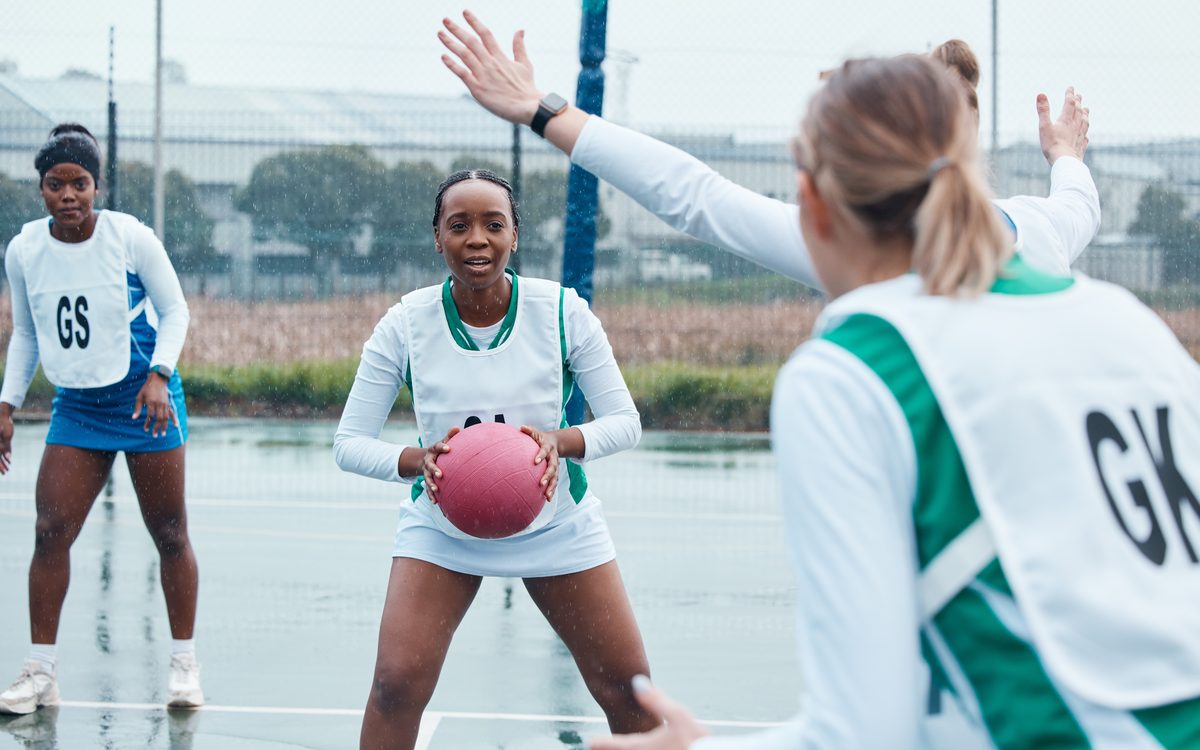
Your first netball training usually starts with a surprise. You catch a pass, take one step, and a coach calls out that you have moved your landing foot. Nobody is allowed to run with the ball, and that single rule shapes everything else. Netball is a seven-a-side court game in which teams pass the ball toward a high ring and score only from inside the goal circle. This page covers how the rules work, the skills a beginner learns first, and how to find a place to play.
Quick answer: Seven players a side pass the ball up a hard court and cannot run with it; only the goal shooter and goal attack may score, from inside the goal circle. Learn the footwork rule and the bib positions first, because they explain almost everything on court. A national association or local club is the best way to start; ask them which rule set they use, because junior and social games are often modified. This is general information, not coaching or medical advice.
This is the rules and getting-started page. The sport as a whole, with levels and Olympic status, is on our netball hub. Injuries, training and gear each have their own page, linked at the end.
The court and the equipment
World Netball’s facilities and equipment page sets the court at 30.5 m long and 15.25 m wide, divided into thirds. The goal post is 3.05 m high with a ring 380 mm across and no backboard. The ball measures 690 to 710 mm around and weighs 400 to 450 g. World Netball’s rules require non-spiked sports footwear, which is why netball is played in court shoes. Each team has seven players on court, and games are four 15-minute quarters.
Positions and where each player may go
Each player wears a bib with the initials of a position. The court is split into thirds and two goal circles, and each position is allowed in certain areas only. According to the summary of the rules of netball we used (a secondary source; see the sources list), the arrangement is:
- Goal shooter (GS): the attacking third, including the goal circle. Scores.
- Goal attack (GA): the centre third and attacking third, including the goal circle. Scores and feeds the shooter.
- Wing attack (WA): the centre and attacking thirds, but not the goal circle. Feeds the circle.
- Centre (C): everywhere except the two goal circles. Takes the centre pass.
- Wing defence (WD): the defending and centre thirds, but not the defending goal circle.
- Goal defence (GD): the defending and centre thirds, including the defending circle.
- Goal keeper (GK): the defending third, including the circle.
A player in the wrong area is “offside.” Because areas are fixed, positions feel very different. A 2020 tracking study of elite matches in Australia (Brooks and colleagues, Journal of Sports Sciences) found the centre covered the most distance (about 5,462 m on average in the study) and the goal shooter the least (about 2,134 m).
How a game runs
Play starts each quarter, and restarts after every goal, with a centre pass. The two centres begin in the centre third, and the pass has to be caught or touched there. After that, four rules do most of the work:
- Footwork. Once you catch the ball and lift your landing foot, that foot may not touch the ground again before you pass or shoot. You may pivot on the grounded foot but you may not run or hop with the ball.
- Three seconds. You may hold the ball for less than three seconds, so passes come quickly.
- Distance. A defender must stand at least 0.9 m (3 ft) from the player holding the ball, and the same distance from a shooter’s landing foot. Defending is about timing, reach and jumping.
- Contact. Contact is allowed only if it does not impede an opponent or the play. Contact that gets in the way is penalised.
World Netball’s updated rules, in force for international matches from 1 January 2024, focus on player safety and game management, with changes to contact, advantage, foul play and playing the ball. Your national association sets the date for domestic play, so check which edition your league uses. The list of penalties is in the rule book.
Basic skills a beginner learns first
We found no single official beginner curriculum, so this list simply follows the skills the footwork and timing rules demand.
- Catching and passing. Chest, bounce and shoulder passes, thrown quickly and to where a teammate will be, not where they are.
- Landing. Catch in the air or on the move and land under control, on one foot or two, so the footwork rule is met and the knee and ankle stay stable. This is also where most serious injuries happen; see our injury prevention page.
- Pivoting. Turn on the grounded foot to find the pass while staying legal.
- Marking and intercepting. Staying 0.9 m away, watching the ball and the opponent’s hands, and timing the jump.
- Shooting. For the goal shooter and goal attack: balance, a steady release and a quick reset after the shot.
Levels, formats and where to start
Netball is strongest in Australia and New Zealand. A 2021 systematic review of netball injury research (Downs and colleagues, Sports Medicine – Open) found that 74% of the 46 studies came from those two countries. In the US it is a small, community-level game, with USA Netball and Netball America as the main organisations; availability varies a lot by city, so look for community clubs, university groups and expatriate leagues.
For a beginner the usual route is a social or “come and try” session at a local club or school, then a place in a team. World Netball also runs Fast5, a five-a-side format in which a shot can be worth one, two or three goal points. Ask any club which rules and which age groups it follows. At the top, the best-known professional league is Australia’s Suncorp Super Netball, and international play includes the Netball World Cup, returning to Sydney in 2027. The hub has the full picture of levels and Olympic status.
What to bring and what to ask before the first session
Most clubs lend a ball and a bib; you need court shoes that grip and a water bottle. Our gear page explains shoes, balls and ankle braces. Before your first session, ask:
- Which rule set and which edition of the rule book does the league use?
- Is there a beginner or junior pathway, and what is the age or level cut-off?
- Does the club use a warm-up programme for landing and knee safety? Netball Australia and the Australian Institute of Sport publish one, called the KNEE Program, which we cover on the injury prevention page.
Where to read the official rules
World Netball publishes the rules of netball and the rule book, including the 2024 updates, on netball.sport. National associations publish their own versions and their own rules for junior, social and mixed play. When an umpire’s call and this page disagree, the rule book wins. For fitness and conditioning, see our training page; for the mental side of the game, see mental training. Related sports with similar passing and landing demands are basketball, handball and volleyball.
Netball rules and getting started: FAQs
Can you run with the ball in netball?
No. After you catch the ball, your landing foot has to stay put until you pass or shoot, and you may hold the ball for less than three seconds. You can pivot on the grounded foot.
Who can score in netball?
Only the goal shooter and the goal attack, and only from inside the goal circle. Every other position helps get the ball there or stop it.
How long is a netball game?
Four 15-minute quarters, with breaks between them. Junior and social games are often shorter, so ask your league.
What position should a beginner play?
There is no rule. Many coaches rotate beginners so they learn what each area of the court demands. Positions differ a lot in distance covered, according to the 2020 Brooks study of elite matches.
Do I need to be tall to play netball?
Height helps in some positions, especially for reaching and intercepting, but fixed court areas mean there is a role for fast, agile and accurate players too. Ask a coach where your strengths fit.
Where can I find the official netball rule book?
On World Netball’s website (netball.sport), which publishes the rules and the 2024 rule book. Your own league’s association will say which edition applies to your games.
Sources
- World Netball: Facilities and Equipment
- World Netball: The Rules of Netball (2024 changes)
- World Netball Rules Book 2024 (PDF)
- Rules of netball (secondary summary of positions, footwork and timings)
- Brooks et al., movement demands of elite netball match-play, J Sports Sci 2020
- Downs et al., Injuries in Netball: A Systematic Review, 2021
- Netball Australia: KNEE Program
- World Netball: Netball World Cup Sydney 2027
General information for education only, not medical advice. It does not replace a visit with a doctor, physical therapist or athletic trainer. See how we write and check our pages in our editorial policy.