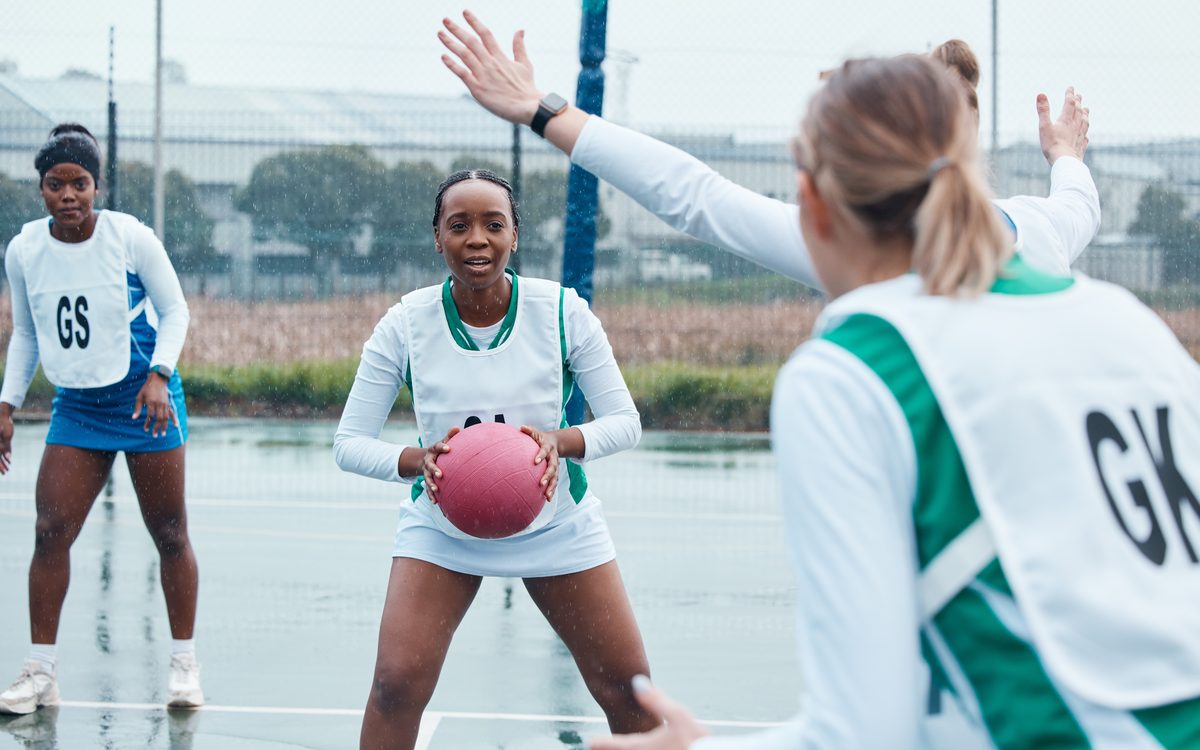
Two goals down at the start of the last quarter, the centre pass is about to be taken, and the shooter is still thinking about the shot she missed. Netball mental training is the practice of skills such as focus, confidence, routines, imagery and resetting so that a player can think clearly under pressure. It is not a trick, and it is separate from mental health, which has its own section below.
Quick answer: Netball gives players little time to think: the ball must move within three seconds and every catch has footwork rules. Useful mental skills are a quick reset after a mistake, a simple routine before a centre pass or a shot, specific goals, and imagery of skills you already know. Studies show elite netballers feel mental fatigue across a match and a season, so rest is part of mental training. Techniques help some players and guarantee nothing. Anxiety, low mood, disordered eating or burnout are health issues for a qualified professional.
General information, not psychological or medical advice. The rules and positions are on our rules page, physical load on the training page and recovery on the recovery page.
What is distinctive about netball
Three features of the game shape the mental side. First, speed: a player may hold the ball for less than three seconds, so decisions are quick. Second, position: each player’s court area is fixed, so a goal keeper and a goal shooter face different mental jobs, one reading the shooter’s movement, the other managing a few high-stakes shots. Third, teamwork: seven players share one ball, and a mistake by one is seen by six. Because netball is played in short quarters with a centre pass after every goal, there are many natural moments to reset.
The research base is thin. A 2021 scoping review of netball science (Whitehead and colleagues, Sports Medicine) found only 13 psychology studies among 150. Much of what follows is therefore general sports psychology applied to netball, and it is labelled as common coaching practice where it is not tied to a study.
Focus and attention
A simple rule helps: attention on the next action, not the last mistake. A common coaching tool is a cue word for the next job, for example “eyes up” or “hands ready”, chosen by the player. For a defender, that means watching the ball and the hands, not the crowd. This is common practice, not a netball trial.
Confidence and self-talk
Confidence in sport grows from preparation, success in small drills and kind coaching, more than from hype. Short, instructional self-talk (“step, pivot, pass”) during play and neutral language after mistakes are standard advice in applied sport psychology. We did not find a netball study of self-talk, so treat this as an idea to try with a coach.
Routines for shooters and the centre pass
A short, repeatable routine, such as a breath, a look at the ring and the same shooting rhythm each time, is widely used by shooters, and the same idea can steady a centre pass. Practise the routine in training under mild pressure, such as a scoreboard or a teammate watching, so it holds in a match. This is common practice; we did not find a netball-specific trial.
Imagery
Imagery means rehearsing a skill in your mind, with the movement, the timing and the feeling. A systematic review of imagery training across five disciplines (Schuster and colleagues, BMC Medicine, 2011) looked at which elements of imagery training are used in practice. Players can imagine a perfect landing, a drive to the circle edge or a shot, and combine it with real practice. It adds to physical training, it does not replace it, and it comes with no guarantee.
Resets after a mistake
Netball’s structure gives you several moments for a reset: a turnover, a goal, a quarter break. A common three-part reset is breathe, name the next job, move. Teams can agree on a shared cue so a teammate can help. The key is speed: dwelling on a missed pass is the mental equivalent of leaving a foot planted.
Mental fatigue in a long game and season
Netball-specific research is clearest here. In 12 players in the Australian Netball League (Russell and colleagues, Journal of Science and Medicine in Sport, 2020), self-rated mental and physical fatigue both rose from before to after matches, mental fatigue rose with minutes played, and the two were only weakly related. In 154 elite Australian players followed across two seasons (Russell and colleagues, International Journal of Sports Physiology and Performance, 2022), daily mental fatigue changed across the rounds and did not simply track physical fatigue, and the authors argue for including it in athlete self-report measures. What it means in practice: a player with a heavy school, work or travel load may be mentally tired even when the legs feel fresh. Talk with your coach about rotating minutes, rest days and sleep; see our recovery page, where a netball study linked longer tournament sleep with better placing.
Handling pressure and competition preparation
The usual advice is to prepare for pressure by simulating it: end-of-game scenarios in practice, short routines, and a plan for the first and last five minutes. Pack the bag the night before, know your position’s job, warm up with your team and keep your own routine. These are common coaching practices. Our gear page covers the practical bag.
Young players
For young players, the best mental work is fun, small goals, encouragement and a good coach. We did not find netball-specific youth mental-skills trials. A 2021 review of netball injury research found children have more upper-limb injuries such as fractures, a reminder that fear after a fall is normal and worth a conversation with a coach or parent.
Mental health is not the same as mental performance
Mental skills are for performance. Anxiety that will not settle, low mood, panic, constant worry, disordered eating or burnout are health matters for a qualified professional such as a doctor, psychologist or counsellor, not a skill to be coached away. In a 2023 interview study at a Super League club (O’Donnell and colleagues, PLoS One), players, coaches and medical staff described appearance pressure from inside and outside the team being linked with restricting food; see our nutrition page. In the US, the 988 Suicide and Crisis Lifeline offers free, confidential support by call or text to 988, 24 hours a day. In other countries, use your local crisis line or doctor. The American Psychological Association and the Association for Applied Sport Psychology can help you find a sport psychologist; we did not check their listings. After a head injury, see the CDC HEADS UP steps on our injuries page, since concussion can affect mood and concentration.
Netball mental training: FAQs
How do I stay calm taking a centre pass or a shot?
Use a short routine, a breath and a look at the target or the receiver, and practise it under mild pressure. It is common coaching practice rather than the result of a netball trial.
What should I do after a turnover?
Reset quickly: breathe, name the next job and move. The footwork and three-second rules leave little time for dwelling.
Does imagery work in netball?
Imagery is used across sports and a review looked at what makes imagery training elements work, but we found no netball trial. Use it as an addition to real practice.
Can you be mentally tired in netball?
Yes. Elite studies found mental fatigue rose across matches and changed across a season, separately from physical fatigue.
When is it more than nerves?
If worry, low mood, panic, disordered eating or loss of enjoyment lasts or affects daily life, see a doctor or mental health professional. In the US you can call or text 988.
Sources
- Whitehead et al., netball scoping review, 2021
- Russell et al., mental and physical fatigue during netball games, 2020
- Russell et al., mental fatigue over 2 elite netball seasons, 2022
- Schuster et al., motor imagery training elements across five disciplines, BMC Med 2011
- O’Donnell et al., RED-S perspectives at a Super League netball club, 2023
- Downs et al., Injuries in Netball: A Systematic Review, 2021
- 988 Suicide and Crisis Lifeline
- CDC HEADS UP: Concussion response
General information for education only, not medical advice. It does not replace a visit with a doctor, physical therapist or athletic trainer. See how we write and check our pages in our editorial policy.