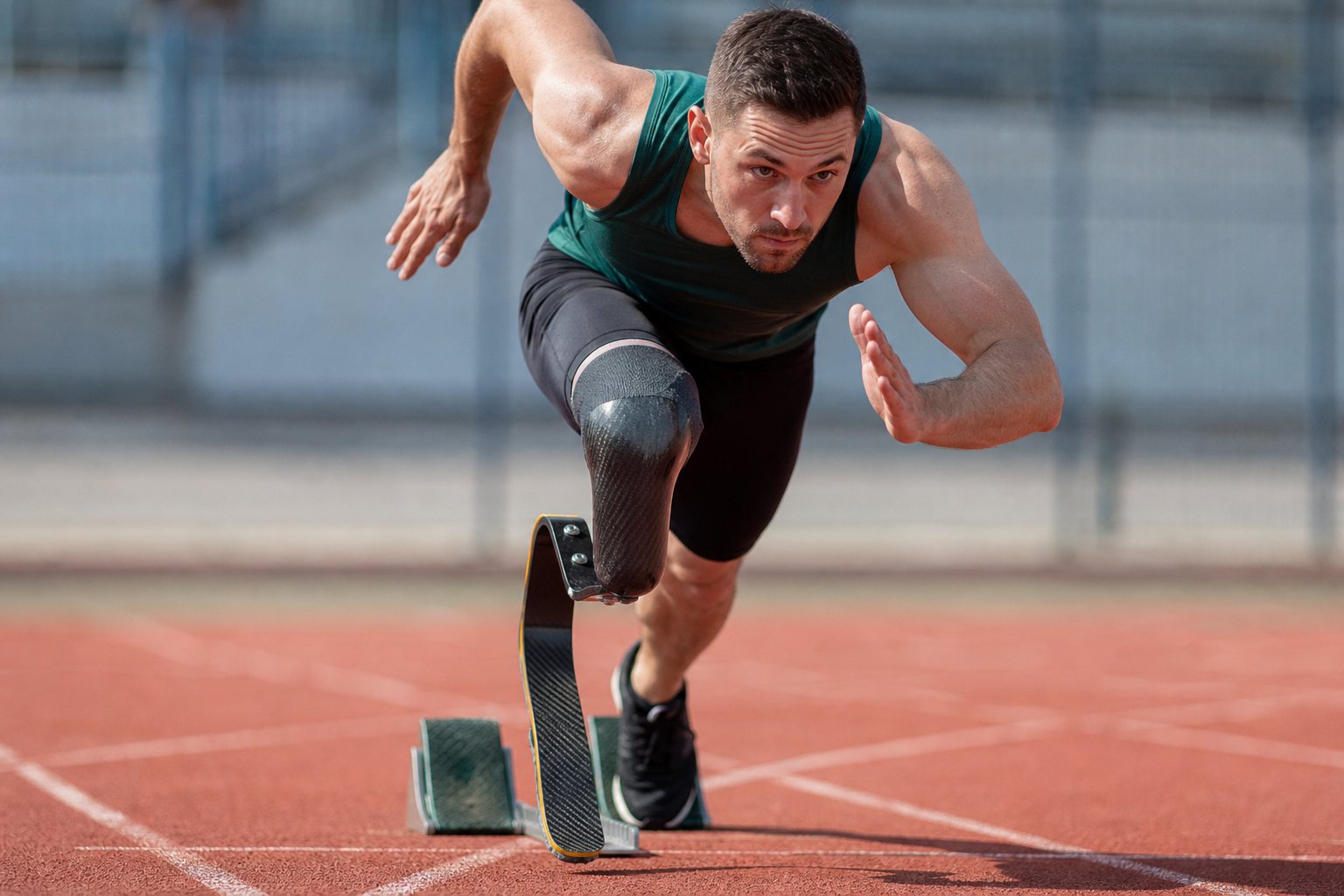
Call room, Stade de France, 30 August. A T54 racer sits behind the line while the crowd noise swells, and the thing between her and the start is not her fitness, it is the next ninety seconds in her head. Mental training in Para athletics means the skills athletes use to focus, handle pressure and bounce back: goal setting, routines, imagery, self-talk and working with a guide or coach. It is separate from mental health, which is covered below.
Quick answer: Mental skills such as goal setting, a pre-race routine, imagery and a plan for setbacks are common in athletics. We found no trials of these skills in Para athletics, so treat them as habits to try, with no promise of results. Anxiety, depression, disordered eating or burnout are health matters: see a qualified professional, and in the US call or text 988 in a crisis.
Goals that fit your event and class
Useful goals are specific and within your control: a clean start, a smooth push, a set number of throws at full effort, a personal best at a given meet. Outcome goals such as medals and rankings depend on other people. Para athletics adds its own wrinkle: results are compared inside a sport class, and USATF Para says an observation during competition can confirm or change a provisional class. That can be stressful. Many athletes keep process goals so that a class decision does not decide whether the season felt worthwhile. Talk with your coach about how to plan for classification events.
Focus and routines
A pre-competition routine is a short, repeatable sequence: how you warm up, what you eat, when you check equipment, what you do in the call room, what you say to yourself on the line. The routine gives your mind something to do instead of worry. Build it in training, then use it at small meets before bigger ones. Guided runners can add a short agreed routine with the guide, for example the tether check and signals for turns and the finish. Logistics, travel and the schedule are on our rules and getting started page.
Imagery and self-talk
Imagery means rehearsing a movement in your mind: the start, the approach, the release. Self-talk is the short instruction you give yourself, such as “long push” or “smooth”. Athletes in many sports use both, and they cost nothing to try. We did not find a Para athletics study that tests them, so we make no claim about how well they work. Use senses that fit you: a blind athlete may rehearse sound, touch and rhythm rather than pictures.
Handling pressure
Pressure shows up as a racing heart, tight muscles and a busy mind. Common ways athletes respond are slower breathing, a set cue word and sticking to the routine. Heat and long call-room waits add stress, so plan food, shade and fluids ahead (see our nutrition page). Nerves are normal and are not a sign of weakness.
Setbacks, injury and class changes
Setbacks are part of athletics: a false start, a missed jump, an injury or a class change. The shoulder and the thigh are the most common injury sites in the London 2012 study (Blauwet and colleagues, 2016), and a long time out can be a mental strain as well as a physical one. Helpful habits include talking to your coach, keeping some training that you can do, setting small goals and keeping perspective. If low mood or worry stays, see the next section. Injury details are on our injuries page.
Teamwork: guides, callers and coaches
Para athletics can be a partnership. Athletes with a vision impairment may run with a guide on a tether, and in jumps and throws a caller or acoustic device can signal the take-off or target, according to Paralympic.org. Trust and clear communication are part of performance. Agree signals in advance, rehearse them, and talk afterward about what worked.
Competition preparation
Prepare as you will compete: practise the call room, the warm-up and the equipment checks, with the same food and clothes. Plan travel and rest, and have a back-up for equipment. Pack a list so there is one less thing to think about. A classification event adds paperwork and timing, so know the dates and forms in advance from the USATF Para and World Para Athletics pages.
Mental health is not the same as mental performance
Mental skills are for performance. Anxiety, depression, disordered eating, sleep trouble that does not go away and burnout are health matters that need a qualified professional, such as a doctor, psychologist or psychiatrist who works with athletes. The IOC consensus statement on mental health in elite athletes (Reardon and colleagues, 2019) says symptoms and disorders are common among elite athletes, may have sport-related features and can impair performance. We did not find a large, reliable measure of how common they are in Para athletes; one 2023 PM&R cohort followed 78 Para athletes with screening questionnaires, and small pre-Games studies exist. If you or a teammate is struggling, tell a doctor, coach or someone you trust. In the US, call or text the 988 Suicide and Crisis Lifeline at 988 in a crisis, and call 911 in an emergency. We did not confirm an NCAA or IOC mental-health resource page for this page.
Frequently asked questions
Do mental skills guarantee better results?
No. They are habits some athletes find useful, and we found no Para athletics trials. They are not a substitute for training or health care.
How can a blind athlete use imagery?
Many use sound, touch, rhythm and feel instead of pictures. A coach or sport psychologist can help build a version that fits.
Is pre-race anxiety normal?
Nerves are common. If worry or low mood is constant, interferes with sleep or daily life, or you have thoughts of self-harm, see a qualified professional and call or text 988 in the US.
How do I handle a class change?
Talk to your coach, keep process goals and ask about the rules for reviews. Classification is a competition rule, not a judgment of you.
Who can help with mental health?
A doctor, psychologist or psychiatrist, ideally one who works with athletes. In the US, 988 is available for crisis support.
Sources
- Reardon et al. 2019, mental health in elite athletes: IOC consensus statement, BJSM
- PM&R 2023: prospective screening in Para athletes preparing for the Paralympic Games (Meidl et al.)
- 988 Suicide and Crisis Lifeline
- USATF Para: classification
- Blauwet et al. 2016, injuries in Paralympic track and field, London 2012 (PubMed)
- Paralympic.org: Paris 2024 introduction to Para athletics
- Paralympic.org: Para athletics classification explained
General information for education only, not medical advice. It does not replace a visit with a doctor, physical therapist or athletic trainer who knows Para sport. See how we write and check our pages in our editorial policy. Back to the Para athletics hub or the sports hub.