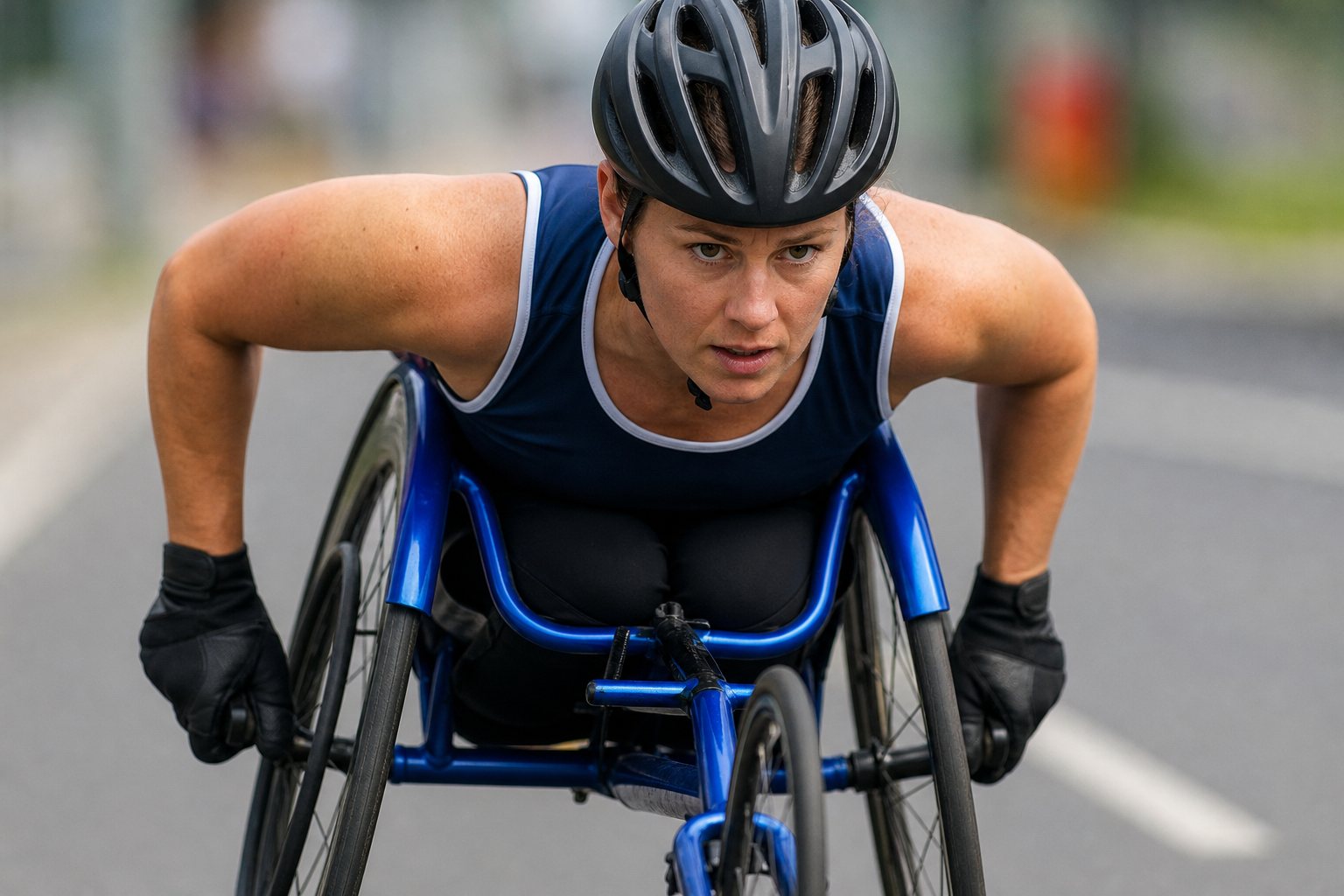
A wheelchair athlete notices a nagging ache at the front of the shoulder after a week of handcycle intervals. A standing athlete finds a sore red patch where the prosthetic socket meets the skin. A third has a scratchy throat on arrival at a race. Para triathlon injuries and illnesses are different from those in standard triathlon, and the numbers we have come mostly from Paralympic Games surveillance and from small studies of related sports. This page names what those sources found, explains general rehabilitation principles, and says when to see a professional.
Quick answer: At the Paris 2024 Paralympics, triathlon was not among the sports with the highest injury rates but had the highest illness incidence. Across Para sport, the International Paralympic Committee says the upper limb carries the highest injury risk. Skin and pressure problems, heat illness and, for some athletes, autonomic dysreflexia are health matters to take seriously. This page does not diagnose or clear anyone to return to sport: see a sports medicine doctor, physical therapist or athletic trainer, and call emergency services for danger signs after a head injury.
General information, not medical advice. How to lower risk is on our injury prevention page; recovery habits are on the recovery page. Back to the Para triathlon hub.
What surveillance numbers show
The Paris 2024 Paralympic study (Derman and colleagues, British Journal of Sports Medicine, 2026) monitored 4,450 athletes over 14 days, 62,300 athlete days. It recorded 535 injuries in 485 athletes, an incidence of 8.6 per 1,000 athlete days, and 19.1 percent of injuries caused time loss from training or competition. Taekwondo, 5-a-side football and sitting volleyball had higher injury incidence than other sports. It also recorded 520 illnesses (8.3 per 1,000 athlete days), higher in female athletes, and triathlon had the highest illness incidence among sports (18.2 per 1,000 athlete days in the abstract). The abstract does not state why.
A separate report on Team USA at Paris 2024 (Post and colleagues, 2025) found 20.5 injuries per 1,000 athlete days among Paralympic athletes versus 14.6 among Olympians. Injuries outside sport settings made up 38.5 percent (30 of 78) of Paralympic injuries. Respiratory illness was the most common, reported by 7.4 percent of all athletes, and no Team USA Paralympic athlete reported a heat-related illness. The IPC’s surveillance page says injury rates in Para athletes are slightly higher than in Olympic athletes, the upper limb carries the highest risk, and a clinician at a 10-day summer event with 100 athletes should expect about 12 to 13 injuries, roughly half of them new acute injuries.
Common problem areas
Shoulders and the upper limb
Because wheelchair classes swim, handcycle and push with the arms, a case report in Frontiers in Rehabilitation Sciences notes the substantial upper-extremity demands and the need to avoid overuse injuries. The IPC says older athletes and those with spinal cord injury carry greater upper-limb risk. A survey of 21 elite US Para swimmers (2022) found 11 reported an injury that altered training. Specific diagnoses are for a clinician to make; if you have pain at the front, side or back of the shoulder that lasts more than a few days or wakes you at night, get it checked.
Skin, pressure and prosthesis contact
A 2026 scoping review on pressure injury in disability sport found only ten sources, with little sport-specific evidence, so there is no tested race-day routine. Pressure and friction problems can arise from long sessions in a handcycle seat, racing chair or socket. Redness that does not fade, blisters or an open area need a clinician’s opinion, not a bandage and another long session.
Overuse across three sports and illness
The IPC reports that illness in Para athletes is mostly respiratory, skin and gastrointestinal, and that urinary tract infections often occur in athletes with spinal cord injury. A single-centre study of ten professional Para cyclists across the 2024 season (2025) found an overall injury rate of 1.94 per 365 athlete days and an illness rate of 3.60, with illness higher in women (5.40 versus 1.80 in men). It is a small sample in a related sport and should not be generalized.
Heat illness and autonomic dysreflexia
The Gatorade Sports Science Institute says athletes with spinal cord injury face higher heat illness risk because of reduced sweating and sensory input below the injury, and athletes with injury above T6 may also develop autonomic dysreflexia, a sudden rise in blood pressure. Treat a pounding headache, flushing and a very high blood pressure reading in an athlete at risk as an emergency and call for help. Know your own warning signs and plan with your doctor.
Crashes and head injuries
Bike crashes can cause head, shoulder and skin injuries. The CDC HEADS UP guidance is to recognize signs of a concussion, remove the athlete from activity, and have a healthcare provider decide when to return. Call 911 for danger signs such as repeated vomiting, a seizure, a worsening headache, or confusion that gets worse.
General rehabilitation principles
Rehabilitation depends on the injury, the impairment and the athlete, so we do not give timelines or return-to-sport criteria; only a clinician can. The principles below are widely used in sport medicine, and we found no Para-triathlon-specific trial supporting any one of them.
- Get an early assessment from a clinician who knows Para athletes; the 2024 position statement on periodic health evaluation in Para athletes says these athletes tend to under-report health issues and benefit from baseline checks.
- Reduce the load that irritates the problem, rather than stopping everything, if your clinician agrees; cross-training in another discipline may fit.
- Rebuild strength and range of motion gradually with a physical therapist, with return to full training decided by a clinician.
- Tell your clinician about any equipment, prosthesis or chair changes. A 2025 review for orthopedic surgeons notes that treatment can potentially influence classification, so ask how a plan fits with your sport class.
When to see a professional
See a sports medicine doctor, physical therapist or athletic trainer if pain lasts more than a few days, is sharp, wakes you, or comes with numbness or weakness; if skin stays red or breaks down; if you have fever or illness symptoms that last; or if equipment no longer fits. The IPC adds that a delay of more than 24 hours in reporting a problem can have clinical implications, so report early.
Related: Para swimming, Para cycling and triathlon.
Para triathlon injuries FAQs
What are the most common injuries in Para triathlon?
No Para-triathlon-specific injury study was found. For Para sport overall, the IPC says the upper limb carries the highest injury risk, and illness is common, mostly respiratory, skin and gastrointestinal.
Was triathlon high for injuries at the Paris 2024 Paralympics?
No. Taekwondo, 5-a-side football and sitting volleyball had higher injury incidence. Triathlon had the highest illness incidence.
What is autonomic dysreflexia?
A sudden rise in blood pressure that can follow a stimulus below the injury level in people with spinal cord injury, mainly at or above T6. It can be an emergency; learn your warning signs and plan with your doctor.
How long does an injury take to heal?
It depends on the injury and the person. We give no universal times. Ask a clinician for your own plan.
Can I race with a skin sore?
Ask a clinician first. A 2026 review found little evidence on race-day management of pressure problems.
Sources
- Derman et al., Paris 2024 Paralympic injury and illness, Br J Sports Med 2026 (PMID 42103446)
- Post et al., Team USA Paris 2024 injury and illness, BMJ Open Sport Exerc Med 2025
- IPC: Injury and illness surveillance
- Quittmann et al., wheelchair triathlete case report (2022)
- Fallon et al., injury and illness in Para-cycling, Sports 2025 (PMID 40559670)
- Injury and injury prevention in US Para swimming (2022)
- Pressure injury in disability sport: scoping review (2026)
- GSSI, Thermoregulatory challenges in para sport (SSE 259)
- Autonomic dysreflexia following spinal cord injury (PubMed)
- Periodic health evaluation in Para athletes (2024)
- Sacks and Karamitopoulos, care of the para athlete (2025)
- CDC HEADS UP: respond to a concussion
General information for education only, not medical advice. It does not replace a visit with a doctor, physical therapist or athletic trainer. See how we write and check our pages in our editorial policy.