This article contains affiliate links: if you buy through them we may earn a commission, at no extra cost to you. Learn more.
A disco ball turning over a rink on a Friday night, the DJ calling “all skate” and a few hundred people rolling counterclockwise under the lights. A Sunday morning on a beachfront path, someone in pastel quads gliding past cyclists with headphones on. A banked track where inline racers come out of the last turn shoulder to shoulder. Roller skating is all of that: a childhood birthday party, a fitness habit, a dance culture and an art form judged like figure skating, plus a racing sport that runs from 100-meter sprints to the marathon.
Roller Skating, page by page
- Rules: how the game works at every level
- Leagues & associations: pro, college, high school and youth
- Youth & high school: ages, safety and recruiting, for players and parents
- Injuries & sports health: prevention, concussion, when to see a pro
- Training & conditioning: before: off-season to in-season
- Game day: during: fueling, hydration, heat
- Recovery: after: games, tournaments, sleep
- Nutrition & supplements: what to eat, tested supplements
- Best wearables: trackers and watches for the sport
- Gear: the complete equipment list
Buying guide · Our Roller Skating buying guide compares the gear we'd pick, with prices and sizing:
This page is roller skating for skaters and the people who look after them: quad versus inline, rink and outdoor skating, rhythm and jam skating, artistic and speed competition, how it looks from a first lap at the rink to the world championships, and, most of all, how to keep skating for years. Sports health is the heart of it: the injuries that send skaters to the doctor most (wrists, above all), the protective gear with real evidence behind it, concussion, and when to see a professional. Then training, recovery and the gear that matters. Roller derby, the full-contact team sport on quads, has its own guide in our roller derby section.
Roller skating at a glance
| Two kinds of skates | Quad skates (two pairs of wheels side by side, the classic rink skate) and inline skates (wheels in a single line, often called “rollerblades”). |
|---|---|
| Ways to skate | Rink sessions and skate nights, outdoor and trail skating, rhythm and jam skating, artistic (figure) roller skating, and speed skating on quads and inlines. |
| Artistic disciplines (USARS) | Figures, singles (free skating), pairs, solo dance, team dance, precision team and show team. |
| Speed racing (World Skate) | Banked tracks of 175 to 200 meters and road circuits; world-championship races from a 100 m sprint to a 15,000 m elimination race, plus the marathon (42.195 km) on the road. |
| Governing bodies | World Skate worldwide; USA Roller Sports (USARS) in the US. Rinks are represented by the Roller Skating Association International. |
| Biggest events | The World Skate Games (Asunción, Paraguay, October 2–18, 2026, with the speed world championships October 10–18) and the USARS national championships. |
| Most common injuries | Wrist and forearm fractures from falls onto the hands, sprained ankles, knee injuries, bruises and scrapes. |
How roller skating works
Quad skates or inline skates
The American Academy of Pediatrics (AAP) puts it simply: in-line skates are roller skates with the wheels in a line instead of side by side. Quads have a wide, stable base, a toe stop at the front, and turn by leaning on the trucks; they’re the skate of the rink, of rhythm, jam and dance skating, and of most artistic skating. Inlines have a long, narrow wheelbase and usually a heel brake; they roll faster and smoother over rough pavement, which makes them popular for fitness skating on trails and for speed racing. Both are raced: World Skate’s speed rules allow up to five wheels in a line or two pairs side by side. More on choosing on our roller skating gear page.
Rink skating and skate nights
The roller rink is where most skaters start and where many stay. Rinks run public sessions, adult nights, birthday parties and learn-to-skate classes, with floor guards and a set direction of travel (counterclockwise, with faster skaters on the outside). The rinks themselves have their own trade group: the Roller Skating Rink Operators Association was founded in 1937 by a group of rink owners and is known today as the Roller Skating Association International, which runs a Learn to Skate program and trains instructors. Our roller skating rules and etiquette page has the rink rules.
Rhythm and jam skating
Skating to music is as old as the rink, and in some places it’s the whole point. Jam skating mixes roller skating with dance, gymnastics and breakdancing; it took off in the early 1970s, and its exact birthplace is still argued over, with claims from the Great Lakes region, New York, Florida and California. Detroit skater Bill Butler is credited with the “jammin’” style. Regional styles grew from there, like Chicago’s JB skating, inspired by James Brown’s music and footwork, and New York’s spins and circles. It’s athletic: quick footwork, lunges, spins and long stretches on one skate.
Outdoor and trail skating
Boardwalks, bike paths and smooth park loops are the outdoor skater’s rink. Softer, larger wheels roll over cracks and pebbles more smoothly, and inlines in particular are built for distance. The AAP’s advice: skate on the right side of paths and trails, pass on the left, stay off crowded streets and obey traffic rules, and never hold on to a moving car or bike.
Artistic roller skating
Artistic roller skating is the wheeled cousin of figure skating, and USA Roller Sports calls it the largest division of competitive roller skating in the US. Its disciplines are:
- Figures: skaters retrace patterns of edges and turns on circles painted on the floor, a test of balance and control.
- Singles (free skating): jumps, spins and footwork set to music.
- Pairs: partners skating side-by-side spins, jumps and footwork, plus overhead lifts.
- Solo dance and team dance: set patterns and rhythms, plus free dance. Solo dance is the only individual event where men and women compete against each other.
- Precision and show: teams (precision teams have 8 to 24 skaters) skating formations such as circles, lines, wheels and blocks, or a themed show program.
USARS judges score technical merit and manner of performance; at World Skate events, the RollArt system is used for free skating, pairs, dance, inline and precision.
Speed skating on wheels
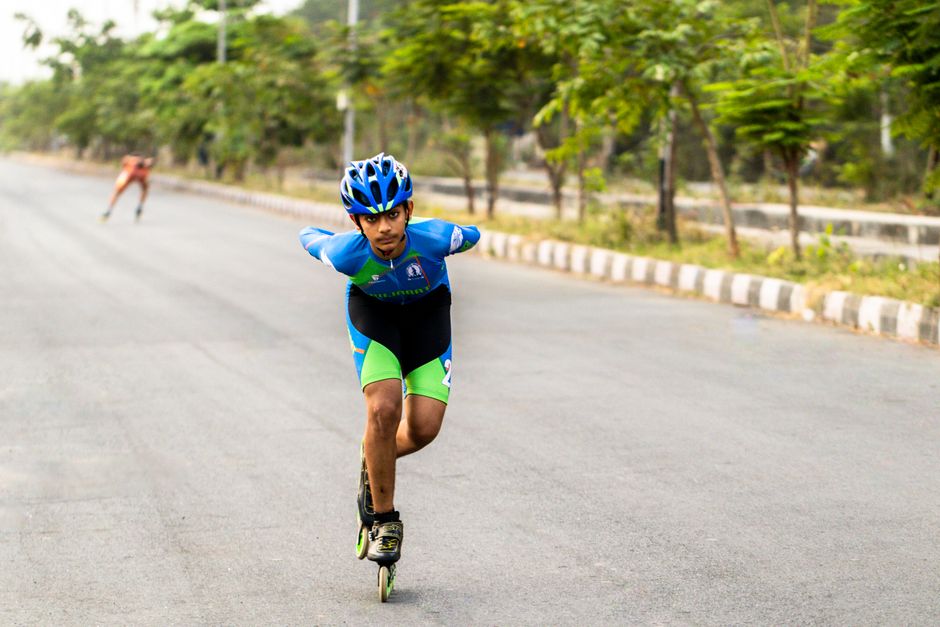
Roller speed skating is raced on quads and inlines, indoors and out. Under the World Skate speed rulebook, tracks are 175 to 200 meters long with banked curves, and road circuits are closed loops through streets or parks. Short-distance races are time trials and sprints; long-distance races are points races (sprints for points at set laps) and elimination races, where the last skater over the line is dropped at set points. The world championships include a 200 m dual time trial, 500 m and 1,000 m sprints, a 5,000 m points race, a 10,000 m elimination race and a 3,000 m relay on the track, and a 100 m sprint, one-lap sprint, 10,000 m points race and 15,000 m elimination race on the road, with the marathon (42.195 km) raced only on the road. Racing skates have no brakes, wheels can be up to 110 mm (125 mm for the marathon), and a certified hard-shell helmet must stay fastened the whole race. See our speed skating section for the ice side of the sport.
USARS also governs rink and inline hockey, and aggressive inline and park skating share skateparks with skateboarding.
Roller skating at every level
Kids and youth
Most kids start at a rink birthday party or on adjustable skates in the driveway. Rinks run learn-to-skate classes, and USARS clubs teach artistic and speed skating very young: USARS says coaches and competitors often start their own children skating as early as 3, and the 2026 national championships had skaters from 3 to 70. World Skate even caps wheel size for young racers (90 mm up to age 12, 100 mm up to 14). The AAP’s rule for kids on wheels: learn to turn, control your speed and stop before anything else. See our kids’ roller skating guide.
High school and college
Roller skating isn’t a high school (NFHS) or NCAA sport, so teens skate through rink clubs and USARS competition. The USARS season runs roughly from December to the following July, moving from local inter-club meets and invitationals to regional championships and nationals.
Elite and international
World Skate, founded in 1924 as the Fédération Internationale de Roller Sports, governs roller sports worldwide. Its speed world championships are held every year in junior (ages 15 to 18) and senior categories, and the minimum age to race a world championship is 15. The showcase is the World Skate Games, with 12 sports and 154 world titles in one event: the 2026 edition runs October 2–18 in Asunción, Paraguay. In the US, USARS holds the national championships: in 2026, indoor speed and artistic in Lincoln, Nebraska, and outdoor nationals and Team USA trials in Hollywood, Florida. Roller sports other than skateboarding aren’t on the Olympic program. More on our associations and competitions page.
Adult and recreational
This is where most skaters live: adult skate nights at the rink, park and trail skating, rhythm and jam sessions, and fitness skating on inlines. Competition is open to grown-ups too: USARS says nearly 45% of competitors at its national championships are 25 or older, and World Skate’s speed rules have masters categories from 30 to 60 and over.
Sports health for roller skaters
Falls come with skating, and the body’s first instinct is to throw out a hand. That’s why wrists dominate the injury lists. This section is general information, not medical advice. If you’re hurt, see a professional.
The most common roller skating injuries
- Wrist and forearm fractures. In a pediatric fracture clinic study, the forearm made up 63.1% of roller-skating fractures, almost all near the wrist. In a US emergency department study of in-line skaters, wrist injuries were the most common, and a quarter of all injuries were wrist fractures.
- Sprains and knee injuries. The AAP lists fractures and sprains, mainly to wrists and ankles, as the usual result of falls.
- Head and face injuries. The AAP says most in-line skaters don’t wear safety gear, and more than 10,000 in-line skaters a year suffer head or face injuries.
- Artistic skaters’ legs. In a small 2026 survey of 50 competitive artistic skaters in Spain, every skater reported at least one injury, mostly to the lower limb; jumps were the most common moment of injury (40%), followed by spins (20%).
Protective gear with evidence behind it
The AAP’s skating advice is a helmet that fits and is certified for safety, plus wrist guards (which it says can reduce injuries by almost 90%), elbow pads (80%) and knee pads (30%). An older but large US study backs it up: in-line skaters who skipped wrist guards had about 10 times the odds of a wrist injury, and those who skipped elbow pads about 9.5 times the odds of an elbow injury. For helmets, the Consumer Product Safety Commission (CPSC) says a CPSC-compliant bike helmet works for recreational roller and in-line skating, while aggressive or trick skating calls for a skateboard-type helmet certified to ASTM F1492. Racers have no choice: World Skate requires a certified hard helmet, fastened, for every race. Our gear page covers fit and picks.
Concussion: recognize and remove
A backward fall on a hard rink floor or pavement can hit the head. The CDC’s HEADS UP program asks skaters, coaches and parents to watch for anyone who looks dazed or confused or is slow to react after a fall, and to listen for headache, dizziness, balance problems, sensitivity to light or noise, or feeling “off.”
- Remove: stop skating for the day. No “shake it off and do one more lap.”
- Get checked by a healthcare provider before skating, training or competing again, and return step by step only once cleared.
- Call 911 for danger signs: a headache that gets worse, repeated vomiting, a seizure, slurred speech, unusual drowsiness or passing out.
Heat and hydration
Summer trail skates, outdoor road races and crowded rinks all get hot. The National Athletic Trainers’ Association (NATA) recommends easing into hot-weather training over 7–14 days. Bring water, take breaks in the shade, and call 911 for confusion or collapse in the heat.
When to see a doctor, physical therapist or athletic trainer
See a professional for a wrist that’s swollen or painful to move after a fall (a broken wrist can feel like a sprain), an ankle you can’t put weight on, a knee that gave way or swelled up, a joint that looks out of shape, pain that doesn’t settle, or any concussion signs. A sports medicine physician manages most injuries without surgery (the American Medical Society for Sports Medicine says about 90% of sports injuries are non-surgical). A physical therapist guides rehab and the return to skating, and athletic trainers are licensed or regulated health care professionals in all 50 states. Our roller skating injuries page goes deeper.
Training and conditioning for roller skating
Skating is a leg-and-hip sport: a low, bent-knee stance, pushes out to the side, and lots of balancing on one skate. Artistic skaters add jumps and spins; speed skaters add sprints, drafting in a pack and long efforts on the road; jam skaters add footwork and lunges. Useful work off skates: squats, lunges and lateral lunges, single-leg balance, hip and glute strength, core work, and intervals. See our roller skating training page and resistance bands for athletes for simple hip work at home.
On a competition day or a long trail skate, eat a carb-based meal of familiar foods 1–4 hours before, as the American College of Sports Medicine’s sports-nutrition position statement recommends, and sip fluids through the day. Many skaters add electrolytes on hot days (see our electrolyte powder guide). Our competition day page has the timeline.
Recovery after skating
Sleep comes first: the CDC, citing the American Academy of Sleep Medicine, recommends 9–12 hours for children 6–12, 8–10 hours for teens and 7 or more for adults. Then food, fluids and an easy day after a big skate. Quads, glutes, hips and feet take the load, so many skaters roll out with a foam roller, use a small massage gun, and slip into soft recovery slides after hours in tight skate boots. They’re about comfort, not treatment; pain or swelling that doesn’t go away needs a professional. See our roller skating recovery page and the recovery tools guide.
Gear for roller skating
Start with skates that fit, then protect the head and the wrists. The Moxi Beach Bunny is a popular high-top quad for rink and outdoor skating, with an aluminum plate, ABEC-5 bearings and soft 58 mm 78A wheels (about $149 in October 2026). For inline fitness skating, the Rollerblade Zetrablade Elite pairs a high cuff with 80 mm/82A wheels (about $149); skaters chasing speed and distance step up to big three-wheel skates like the Rollerblade Macroblade 110 3WD, with 110 mm/85A wheels on an aluminum frame (about $210). The Pro-Tec Classic Certified helmet is certified to the CPSC bike standard, ASTM F1447 for recreational roller skating and ASTM F1492 for trick skating (about $63), and the Triple Eight Saver Series 3-Pack puts knee pads, elbow pads and wrist guards in one box (about $50). After skating, the OOFOS OOahh Slide is an easy pick for tired feet. Full details on our roller skating gear page.
Moxi Beach Bunny Roller Skates
- Aluminum plate, metal trucks
- 58 mm 78A wheels, ABEC-5
- About $149
Rollerblade Zetrablade Elite
- High cuff, monocoque frame
- 80 mm/82A wheels, SG5 bearings
- About $149
Rollerblade Macroblade 110 3WD
- 3 x 110 mm/85A wheels
- 290 mm aluminum frame
- About $210
Pro-Tec Classic Certified Helmet
- CPSC bike, ASTM F1447 and F1492 (maker)
- XS 52-54 to XL 60-62 cm
- About $63
Triple Eight Saver Series 3-Pack
- Knee, elbow pads and wrist guards
- Polycarbonate caps, ABS splints
- About $50
OOFOS OOahh Slide
- OOfoam slide
- APMA Seal of Acceptance
- Machine washable
Roller skating FAQs
Is roller skating good exercise?
Yes. It works the legs, hips and core, builds balance, and can be an easy cruise or a hard interval workout depending on how you skate. The main risk is falling, so learn to stop and wear wrist guards, pads and a helmet.
Are quad skates or inline skates easier for beginners?
Quads feel more stable standing still and suit rinks, rhythm skating and artistic skating; inlines roll more smoothly outdoors and suit fitness and trail skating. Pick the one that matches where and how you’ll skate, and take a lesson either way.
What is artistic roller skating?
Figure skating on wheels: figures, free skating, pairs, solo and team dance, precision and show, judged on technical content and performance. In the US it’s run by USA Roller Sports and is the largest division of competitive roller skating.
What is jam skating?
A style of rhythm skating that blends roller skating with dance, gymnastics and breakdancing. It became popular in the early 1970s and has regional styles such as Chicago’s JB skating.
What is the most common roller skating injury?
Wrist and forearm injuries from falls onto outstretched hands. Wrist guards are the single best piece of protection for them; a wrist that’s swollen or painful after a fall should be checked, since fractures can feel like sprains.
Is roller skating an Olympic sport?
Not as of 2026. Skateboarding, which World Skate also governs, is on the Olympic program, but artistic and roller speed skating compete at World Skate’s own world championships and the World Skate Games.
Roller skating is one of the few sports you can start at a birthday party and still be doing at 60. Keep exploring: our recovery tools guide, knee sleeves for skaters coming back from a knee injury, ankle braces, and the other sports on our sports hub.