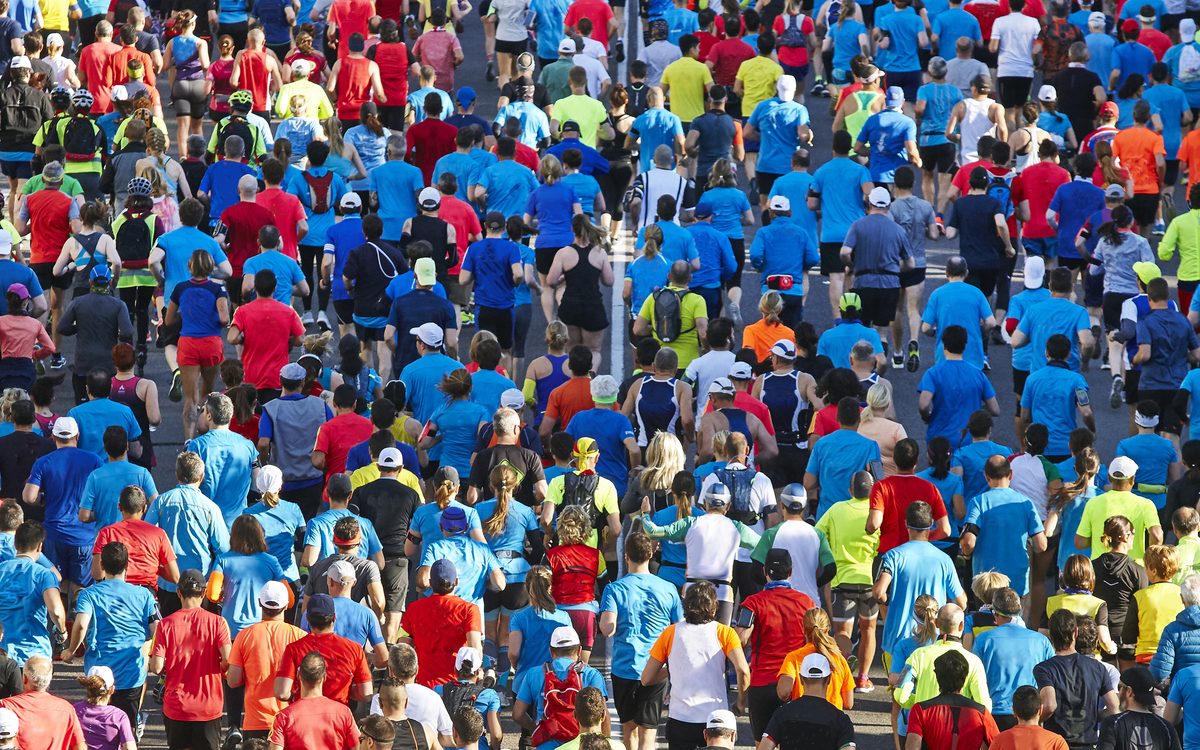
The day after a marathon, most runners discover the stairs. Going down them is a slow, deliberate act. The legs are sore in a way they never were after any long run, and the medal on the kitchen table suddenly looks like a heavy object. Marathon recovery is the process of letting the body repair and adapt after the race and after hard weeks of training. This page covers what happens in the days that follow, what helps and what the evidence does not show.
Quick answer: Expect several days of soreness after a marathon, and know that recovery speed varies a lot from person to person. Sleep, food, easy movement and time off hard running are the basics. Massage and compression show some benefit for soreness and perceived fatigue, but the evidence for most recovery gadgets is weaker than their marketing. See a sports medicine doctor, physical therapist or athletic trainer if pain stays in one spot, wakes you at night or gets worse.
The first days after the race
Marathon running causes muscle damage. In a small 2024 study of 20 trained runners (James and colleagues), a blood marker of muscle-damage-related oxidative stress peaked about two days after the marathon and stayed raised until day five, and the time to recover varied: some runners had recovered by day three, while others took more than seven days. That variety is the point: there is no universal recovery time, and a calendar is not a clearance.
In a 2026 study of 24 amateur runners after a half marathon, thigh-muscle MRI changes recovered to baseline within 72 hours in the rest group, while groups that ran at moderate or high intensity within those days recovered more slowly or not at all. It is a small study of a half marathon, so treat it as a hint: many coaches suggest walking or easy cross-training for the first few days, not hard running.
Sleep
The CDC recommends at least 7 hours of sleep a night for adults. A 2020 expert consensus on sleep and athletes (Walsh and colleagues) notes that elite athletes often sleep fewer than 7 hours, and that in the wider population habitual sleep under 7 hours raises susceptibility to respiratory infection. The consensus recommends an individual approach, not a one-size-fits-all number. The nights before and after a big race are easy to disrupt with nerves and early alarms. See mental training.
Load management between races and in training
A 2018 consensus statement on recovery and performance (Kellmann and colleagues) says continuous high performance needs a balance of stress, including training and life demands, and recovery. It also notes that people respond differently to training and recovery. In practice, that means:
- plan easier weeks, such as the stepback every third week in Hal Higdon’s novice plan;
- take the planned rest days;
- cut back after poor sleep, illness or a bad week at work;
- take extra rest after the race, with a slow return to running.
Mobility and flexibility
Does stretching help? Lauersen and colleagues’ 2014 meta-analysis found no clear injury benefit from stretching alone, though strength and balance work did show benefit. Mobility work is still popular for comfort and range of motion, and some runners enjoy it as a wind-down. The CDC recommends muscle-strengthening at least 2 days a week, which also helps your body cope with training. See the running recovery page and our recovery for runners guide.
What the evidence says about recovery methods
A 2018 systematic review and meta-analysis of 99 studies (Dupuy and colleagues) compared recovery techniques after exercise. It concluded that massage seemed the most effective method for reducing delayed-onset muscle soreness and perceived fatigue, that compression (garments, massage or water immersion) helped perceived fatigue, and that massage and cold exposure were the most powerful techniques for reducing inflammation markers. Studies combining methods were excluded.
Two cautions. First, relief from soreness and a lower inflammation marker are not the same as faster return to performance. Second, many studies are small and short. For gadgets such as massage guns and boots, see our guides to foam rollers, massage guns and compression boots, and keep in mind that recovery tools are for comfort and are not treatment.
Soreness vs injury
Muscle soreness is general, both legs, and eases over a few days. The AAOS describes a stress fracture as pain at a specific spot on a bone that first appears during or after activity, then worsens, and may cause night pain, swelling or bruising. If you have pain like that, see a doctor. Do not run through it. For injury patterns, see marathon injuries.
Refueling
Eating after the race helps many runners feel better; the details of timing and what to eat are on our nutrition page.
Marathon recovery FAQs
How long does it take to recover from a marathon?
It varies. In one small study, markers of muscle stress were raised up to day five, and some runners recovered by day three while others took more than a week. See a professional if pain lingers.
Should I run the day after a marathon?
There is no rule. In a small half-marathon study, runners who rested recovered thigh-muscle changes fastest. Many coaches suggest walking or easy cross-training first.
Do compression socks and massage work?
A 2018 meta-analysis found that massage seemed best for soreness and perceived fatigue, and compression helped perceived fatigue. Neither is proof of faster performance.
Does stretching prevent soreness or injuries?
A 2014 meta-analysis found no clear injury benefit from stretching alone. Stretching can still feel good.
When is soreness a reason to see a doctor?
When pain is in one spot on a bone, wakes you at night, gets worse with walking or does not improve over several days.
Sources
- James et al., thiol-oxidized albumin and recovery from muscle damage after a marathon, 2024
- Zhou et al., quantitative MRI of thigh-muscle recovery after a half marathon, 2026
- Kellmann et al., recovery and performance in sport, consensus statement, 2018
- Walsh et al., sleep and the athlete, 2021 consensus recommendations
- Dupuy et al., recovery strategies after exercise, systematic review and meta-analysis, Front Physiol 2018
- Lauersen et al., exercise interventions to prevent sports injuries, 2014
- CDC, sleep
- CDC, adult physical activity guidelines
- AAOS OrthoInfo, stress fractures
- Hal Higdon, Novice 1 marathon plan
General information for education only, not medical advice. It does not replace a visit with a doctor, physical therapist or athletic trainer. See how we write and check our pages in our editorial policy.