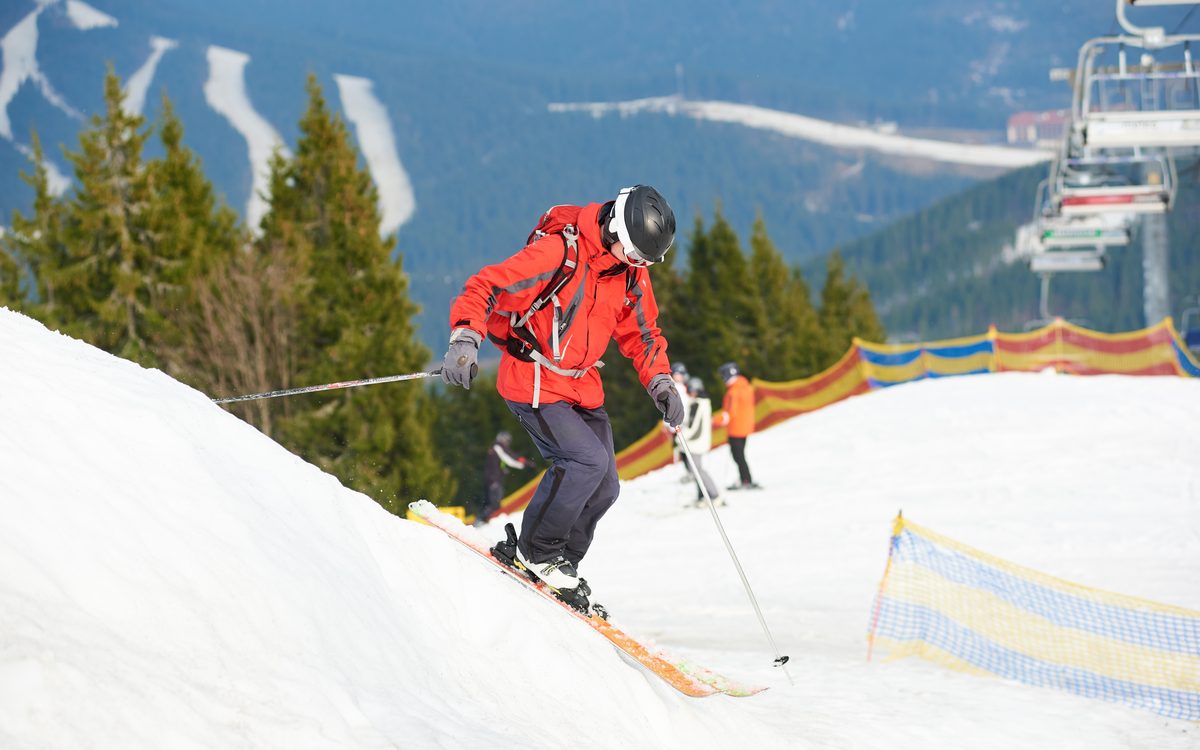
The start gate is a metre away. The wand is in front of the shins, the starter is counting, and the racer’s heart is pounding. She does what she always does: three breaths, a look down the course at the first gates, a tap of the poles. Mental training in alpine skiing is the practice of skills such as focus, imagery, routines and self-talk so that a racer can do on race day what she can do in training. It is about performance and is separate from mental health, which has its own section below. For race logistics see our skiing game-day page, and for the sport overview the alpine skiing hub.
Quick answer: Most mental skills in ski racing are general sport psychology practice: a short pre-start routine, imagery of the course, a few focus cues, and a plan for after a mistake. Published alpine-specific evidence is small: nine skiers in a 2025 guided-imagery study improved on imagery and performance measures, and a 50-skier study linked psychological inflexibility to injury frequency. No technique guarantees results. Anxiety, depression, disordered eating or burnout are health matters to take to a qualified professional; in the US, call or text 988.
General information, not medical advice. This page covers mental performance skills. It is not therapy.
Confidence and self-talk
Confidence in ski racing comes mostly from preparation, so a racer who has done the work trusts it. Coaches often teach short, positive, action-focused cues for the course, such as one word for the top, the flat and the steep. This is common practice in sport psychology rather than the finding of one alpine trial, and young racers do best when cues are simple and chosen by them. A 2026 Frontiers in Psychology paper that built a mental toughness scale for Chinese snow sport athletes names achievement motivation, positive cognition and adaptive coping as its three factors, which gives coaches a vocabulary, though it measures snow sports in general.
Focus and decision-making
A race is one to two minutes of constant decisions: line, edge, balance and the next gate. A 2026 narrative review in the Scandinavian Journal of Medicine & Science in Sports uses alpine skiing as its main example and argues that cognitive skills such as updating working memory in a fast changing environment matter, and suggests sport-specific cognitive training. It is a proposal, not a proven program. In practice racers train focus with drills in which the coach calls changes, with gate training at different speeds, and by learning to narrow attention to the next two or three gates.
Imagery and course inspection
Course inspection is the built-in imagery session: racers slip along the course, study the gates and rehearse it in their heads. A 2025 mixed-methods study (Frontiers in Psychology) reported a six-month guided imagery program with nine alpine skiers whose imagery scores and performance indicators rose, and surveys of 500 athletes in which higher achievers tended to have stronger imagery skills. With nine skiers and no control group described, it supports trying imagery without proving it works. A common coach-led routine is to run the course in the head at race pace with eyes closed and feel each turn, then do it again after the inspection.
Pre-start routines and handling pressure
- A short, repeatable routine. A few breaths, a cue word, one last look down the hill, the same order every time. Practise it at training starts, not just at races.
- Warming up the mind. The 2025 FIS consensus statement on warm-up and cool-down covers both physical and psychological warm-up for competitive skiers, though its authors say the evidence in snow sports is limited.
- Nerves are normal. Many athletes treat the jitters as readiness. A routine gives the mind a job, and a breathing pattern gives the body one.
- Fear and risk. Speed events put racers at a real risk of injury. Accept that caution has a place and talk to the coach about the right level for the day and the snow (general coaching practice).
Setbacks, mistakes and injuries
A missed gate or a bad first run is part of the sport. A simple rule many coaches use is to review what happened after the run, pick one thing to change, and let the rest go before the second run. Injuries are a bigger setback. A 2025 study of 50 professional alpine skiers (Frontiers in Psychology) found neuroticism and psychological inflexibility predicted injury frequency, and depressive symptoms and inflexibility were linked to perceived injury severity; it was cross-sectional, so cause and effect are not shown. A 2026 scoping review of returning to performance after an ACL injury found little evidence on the psychological and social factors involved. Support during injury matters, and a clinician or sport psychologist can help.
Goals and motivation
Goals work best when they are about what a racer can control, such as skiing the plan, staying tight on the line and keeping a calm routine, rather than only a result. Short-term goals for each training week and a longer season goal are common (general practice). For children, enjoyment keeps them in the sport, and our youth skiing page covers the wider picture.
Mental health is not the same as mental performance
The IOC’s 2019 consensus statement on mental health in elite athletes (Reardon and colleagues, British Journal of Sports Medicine) says mental health symptoms and disorders are common among elite athletes and can affect performance, that mental and physical health are closely linked, and that symptoms can raise injury risk and slow recovery. Anxiety, depression, disordered eating, burnout and thoughts of self-harm are health matters, not performance tricks. They need a qualified professional such as a doctor, psychologist or counsellor. In the US, the 988 Suicide & Crisis Lifeline is available by call or text at 988 at any time, and in an emergency call 911. Our nutrition page covers eating and energy.
Frequently asked questions
Does visualization really help skiers?
Some small studies suggest it can, including a 2025 alpine program with nine skiers, but the evidence is early and no technique is guaranteed. It is cheap to try as part of course inspection.
How do I handle nerves before a race?
Use a short routine you have practised: a few breaths, a cue word, a look at the first gates. Nerves are normal and routines give them somewhere to go. If anxiety is constant or affects sleep or school, talk to a doctor or counsellor.
What if I am afraid of speed events?
Fear is normal. Tell your coach, build speed gradually and ski within your plan for the day. If fear is severe or lasting, a sport psychologist or counsellor can help.
What should I do after a bad run?
Many coaches suggest a quick review, one thing to change and then moving on. Do not carry the mistake into the second run.
When is it more than performance anxiety?
If worry, low mood, eating problems or exhaustion last or affect daily life, see a qualified professional. In the US you can call or text 988 at any time for crisis support.
Sources
- Reardon et al., Mental health in elite athletes: IOC consensus statement, Br J Sports Med 2019
- The benefits of guided imagery on athletic performance: a mixed-methods approach, Front Psychol 2025
- Psychological predictors of sports injuries in elite ski athletes, Front Psychol 2025
- Cognitive neuroscience in alpine skiing, Scand J Med Sci Sports 2026
- Mental toughness scale for Chinese snow sports athletes, Front Psychol 2026
- Returning to performance after ACL injury in competitive alpine skiing: scoping review, 2026
- FIS consensus statement on warm-up and cool-down, BMJ Open Sport Exerc Med 2025
- 988 Suicide & Crisis Lifeline
General information for education only, not medical advice. It does not replace a visit with a doctor, physical therapist or athletic trainer. See how we write and check our pages in our editorial policy.