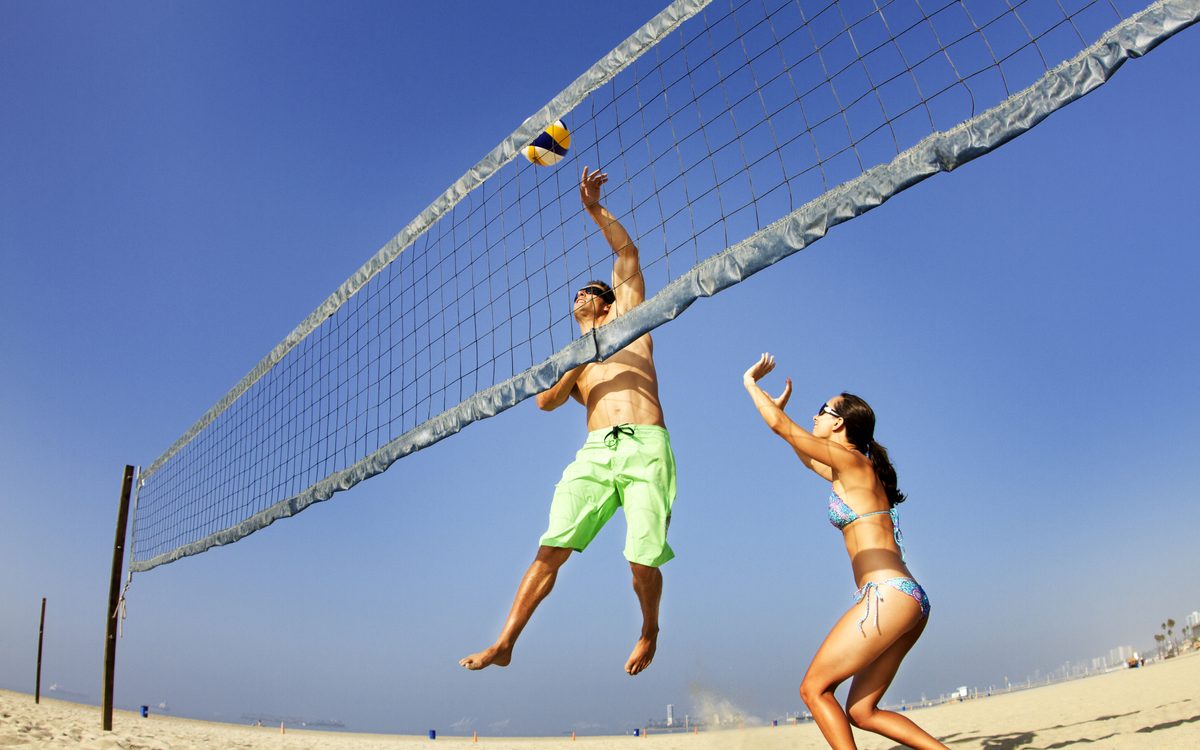
Third set, mid-afternoon, and the sand is hot enough to sting. A player who has served all day feels a dull ache in the hitting shoulder, shrugs it off and swings again. Beach volleyball injury prevention is the set of habits around a player, a warm-up, sensible landings, shoulder and trunk strength, support for a bad ankle, heat and sun care and honest reporting of pain, that aim to lower the chance of getting hurt. They lower the odds. They cannot promise anything. What each injury looks like is on our beach volleyball injuries page, so we do not repeat it here.
Quick answer: A study of pro players found fewer time-loss injuries than in most team sports, but overuse problems in the shoulder, knee and low back are common. The best-supported habits are a warm-up, balance and strength work, bracing or taping an ankle with a sprain history (per the NATA position statement), heat acclimatization, sun protection and a gradual rise in load. Evidence is mostly observational, so treat these as sensible habits, not guarantees. See a sports medicine doctor, physical therapist or athletic trainer if pain stays in one place, shows up at rest or changes how you hit, and call emergency services for heat stroke or head-injury danger signs.
Warm up before the sand
The American Academy of Orthopaedic Surgeons recommends a short warm-up of about 3 to 5 minutes and a cool-down, and says to check outdoor courts for sharp objects, rocks and glass (AAOS OrthoInfo, Volleyball Injury Prevention). We did not find a warm-up program tested in beach volleyball players specifically, so what follows is general practice: jog or skip lightly, add leg swings and lunges, rotate the shoulders with a light band or no ball, then progress to passing, setting and finally hitting and serving at full speed.
Landings and technique
In World Tour video, about one third of beach jumping actions ended on one foot, and beach players landed on both feet more often than indoor players; the authors linked the softer sand and two-footed landings to fewer injuries, though that is an inference (Tilp and colleagues, J Sports Sci Med 2013). A 2026 case series of 175 beach injuries at one sports medicine practice found the leading mechanism was a noncontact twisting knee event while pursuing the ball (26.5 percent), followed by overuse, ball contact while blocking or spiking, and landing from a jump (Trikha and colleagues, Orthop J Sports Med). A coach can help with landing on both feet when possible, bending the hips and knees on contact and cutting down on twisting steps in the sand. Evidence that technique coaching prevents injuries in beach players is limited.
Shoulder, back and knee conditioning
Hitting and serving load the shoulder over and over. In 84 professional players, 30 percent of hitting shoulders showed infraspinatus atrophy, external rotation strength was lower in the hitting shoulder, and pain in the hitting shoulder occurred in 63 percent (Lajtai and colleagues, Am J Sports Med 2009). Among 29 male professionals, 86 percent reported lifetime low back pain, and disc degeneration appeared on MRI in 79 percent, though imaging findings did not match pain (Kulling and colleagues, Orthop J Sports Med 2014). A study of 61 professionals found tendinosis changes in the quadriceps and patellar tendons in roughly a fifth to a third of legs (Pfirrmann and colleagues, Eur Radiol 2008). A structured review lists risk factors and prevention strategies for the ankle, knee and shoulder in volleyball (Reeser and colleagues, Br J Sports Med 2006). None of these studies shows that a given exercise prevents a given injury in beach players. Common practice is to build shoulder rotator cuff and upper-back strength, trunk and hip stability and single-leg control, with a coach or physical therapist choosing the exercises.
Ankles
The National Athletic Trainers’ Association position statement on ankle sprains supports balance and neuromuscular training and, for athletes with a history of sprain, bracing or taping. A Dutch trial of balance-board training found fewer ankle sprains in players with a history of sprain (Verhagen and colleagues, Br J Sports Med 2004) and a Norwegian program reported similar results (Bahr and colleagues, Scand J Med Sci Sports 1997). Both are indoor volleyball studies; we found no beach-only trial. Players play barefoot by rule unless the referee allows otherwise, which limits what you can wear.
Heat, sun and the surface
Beach players are outside for hours. In the FIVB’s heat stress monitoring program, covering 8,530 matches over 11 years, 20 heat-related medical time-outs were recorded, and only three led to forfeits; the authors concluded absolute risk remained low (Racinais and colleagues, Br J Sports Med 2021). The NATA position statement on exertional heat illness recommends gradual acclimatization over 7 to 14 days and treats suspected exertional heat stroke as an emergency: cool first, transport second, call 911. The CDC recommends broad-spectrum sunscreen with SPF 15 or higher, reapplied at least every 2 hours and after sweating or toweling, with shade, a brimmed hat and sunglasses that block UVA and UVB.
The surface is a safety issue too. The FIVB rules require levelled sand free of rocks, shells and anything that can cause cuts, and at FIVB events sand at least 40 cm deep and sifted. At a park or beach, walk the court before play and clear glass and debris. Greek surveys of beach players found skin injuries such as cuts and friction blisters were linked to more daily training hours (Rallis and colleagues, J Clin Med 2024, 785 athletes) and viral skin infections such as warts were also reported (Tertipi and colleagues, Viruses 2021, 549 athletes). Clean cuts, cover wounds and do not share towels.
Protective equipment: standards versus maker claims
The FIVB rules allow compression pads worn for protection or support, glasses or lenses at the player’s own risk, and a hat or head covering. No rule or study we found says any pad prevents a specific injury in beach volleyball, so any maker claim about injury prevention should be treated as a claim. See our gear page.
Youth specifics and load
The American Academy of Pediatrics statement on sports specialization recommends at least one day off a week and breaks from the sport (Brenner, Pediatrics 2016). The IOC consensus on load in sport says rapid rises in training load are linked to injury (Soligard and colleagues, Br J Sports Med 2016). Rules of thumb with fixed percentages are not supported by the sources we read. Our training page covers load.
What prevention can’t do
Injuries happen even when everything is done right: a twisted knee chasing a ball, a collision with a partner or a ball to the face. In the FIVB’s four-year surveillance, the time-loss injury rate in matches was 3.8 per 1,000 player hours (Bere and colleagues, Br J Sports Med 2015). Low risk is not no risk. Per the CDC HEADS UP guidance, concussion danger signs such as repeated vomiting, seizure or a worsening headache mean call 911.
When to see a professional
See a sports medicine doctor, physical therapist or athletic trainer if pain lasts more than a few days, wakes you at night, changes how you serve or hit, or comes with swelling, numbness, a cold or pale fingertip or a knee that gives way. Digital symptoms deserve attention: in a survey of 60 elite players, 38 percent reported cold or pale fingers on the hitting hand (Van De Pol and colleagues, J Sports Sci 2016), and the player should mention it to a clinician.
Beach volleyball injury prevention FAQs
Does beach volleyball cause more injuries than indoor volleyball?
Research disagrees on rates. A 1997 study of 295 players recorded 4.9 injuries per 1,000 hours on sand and 4.2 indoors (Aagaard and colleagues), while a 2021 study of NCAA Division I women found 1.8 per 1,000 hours on sand and 5.3 indoors (Juhan and colleagues). Different groups and methods explain some of the gap.
Should I wear an ankle brace on sand?
The NATA statement recommends a brace or tape for athletes with a history of sprain. Ask a clinician what suits your ankle. The FIVB rules require barefoot play unless the referee authorizes socks or shoes, so check the event rules.
How do I protect my shoulder for serving and hitting?
Build shoulder and upper-back strength, warm up before hitting, raise serving and hitting volume gradually, and report pain early. A physical therapist can pick exercises for you.
Is sunscreen enough for a day on the sand?
It helps, and CDC guidance adds reapplication every 2 hours, shade between matches, a brimmed hat and UV-blocking sunglasses.
Can heat make me sick even if I feel fine?
Yes. Heat illness can progress quickly. The FIVB data shows it is uncommon but real; know the signs and act early. Heat stroke is an emergency.
Sources
- AAOS OrthoInfo, Volleyball Injury Prevention
- Tilp et al., landing techniques in beach volleyball, 2013 (PMID 24149150)
- Trikha et al., musculoskeletal injuries in beach volleyball, 2026 (PMID 42719380)
- Lajtai et al., shoulders of professional beach volleyball players, 2009 (PMID 19359418)
- Kulling et al., lumbar spine in professional beach volleyball players, 2014 (PMID 26535316)
- Pfirrmann et al., quadriceps and patellar tendinosis, 2008 (PMID 18386014)
- Reeser et al., strategies for prevention of volleyball injuries, 2006 (PMID 16799111)
- NATA position statement on ankle sprains (Kaminski 2013)
- Verhagen et al., balance board, 2004 (PMID 15310562)
- Bahr et al., ankle sprain prevention program, 1997 (PMID 9200322)
- Racinais et al., heat stress monitoring, FIVB, BJSM 2021 (PMID 33046452)
- NATA position statement, exertional heat illnesses, 2015 (PMID 26381473)
- CDC, Sun safety
- FIVB Official Beach Volleyball Rules 2025-2028 (PDF)
- Rallis et al., skin injuries, J Clin Med 2024 (PMID 38610879)
- Tertipi et al., viral skin infections, Viruses 2021 (PMID 34834914)
- Brenner, Pediatrics 2016 (PMID 27573090)
- Soligard et al., IOC consensus on load, 2016 (PMID 27535989)
- Bahr and Reeser, injuries among world-class professional beach volleyball players, 2003 (PMID 12531768)
- Bere et al., FIVB injury surveillance, BJSM 2015 (PMID 26194501)
- Van De Pol et al., digital ischaemia, 2016 (PMID 26436960)
- Aagaard et al., injuries in indoor and beach volleyball, 1997 (PMID 9187978)
- Juhan et al., NCAA D1 indoor versus beach, 2021 (PMID 33997071)
- CDC HEADS UP, signs and symptoms
General information for education only, not medical advice. It does not replace a visit with a sports medicine doctor, physical therapist or athletic trainer. See how we write and check our pages in our editorial policy.