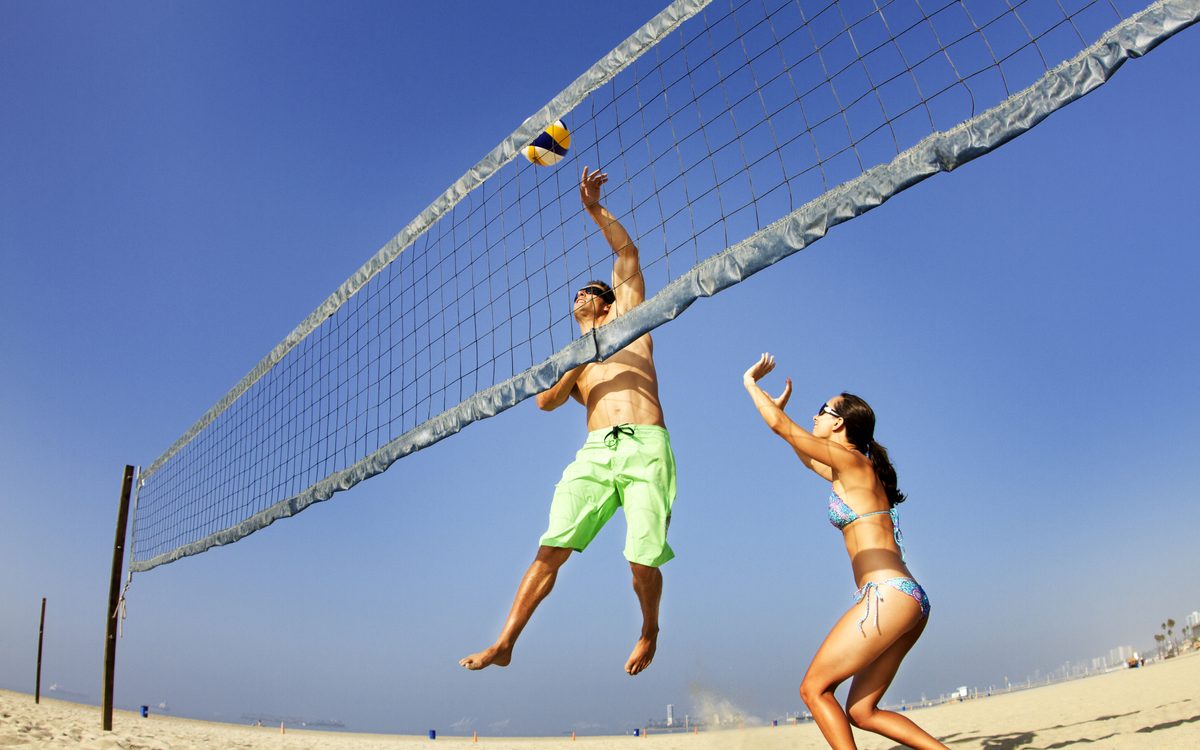
The ball floats late, the player steps hard into the sand to reach it, and the knee turns while the foot stays planted. Or there is no single moment at all: the shoulder simply aches a little more each week of the summer. Beach volleyball injuries fall into two groups, sudden injuries from a twist, a landing or a collision, and overuse problems that build up from thousands of serves, hits and jumps. This page summarizes what published studies found, how they differ, and general principles of rehabilitation. It is general information, not medical advice; for prevention habits see injury prevention.
Quick answer: In the FIVB’s four-year surveillance of major events, the time-loss injury rate in matches was 3.8 per 1,000 player hours; the ankle was the most common site (25.9 percent), then the knee, fingers and low back. Overuse shoulder, knee and low back problems are also common in professionals. Studies disagree on rates because groups and methods differ. A clinician should diagnose and manage any injury; see a sports medicine doctor, physical therapist or athletic trainer, and call 911 for concussion danger signs or suspected heat stroke.
What the studies show
FIVB match surveillance. Over four years (2010 to 2014) at 32 major events, the incidence of time-loss injuries in match play was 3.8 per 1,000 player hours. The ankle accounted for 25.9 percent of injuries, the knee 15.2 percent, the fingers and thumb 10.7 percent and the lower back 8.9 percent. Senior players had a higher risk than juniors (relative risk 2.04), men and women did not differ, and center players had the highest incidence (Bere and colleagues, Br J Sports Med 2015).
The 2001 World Championships. Among 178 of 188 players, acute injuries that cost time occurred at 3.1 per 1,000 competition hours, and knee (30 percent), ankle (17 percent) and finger (17 percent) injuries made up more than half. Overuse problems, mostly low back pain (19 percent), knee pain (12 percent) and shoulder pain (10 percent), were important sources of lost performance (Bahr and Reeser, Am J Sports Med 2003).
A university comparison. In 161 NCAA Division I women’s players across 2003 to 2020, the injury rate was 1.8 per 1,000 hours on sand and 5.3 indoors; indoor players had more knee injuries (16.7 percent versus 7.6 percent), while beach players had more abdominal muscle injuries (11.8 percent versus 4.7 percent) and lost more time for knee, low back and shoulder injuries (Juhan and colleagues, Orthop J Sports Med 2021). An older study of 295 players found 4.9 injuries per 1,000 hours in beach and 4.2 indoors, with shoulder overuse the main beach problem (Aagaard and colleagues, Int J Sports Med 1997).
A treatment-center view. A 2026 case series of 175 injuries in 160 patients at one center found the knee in 42.3 percent, wrist and hand in 16.6 percent and shoulder in 14.3 percent. The leading cause was a noncontact twisting knee event while pursuing the ball (26.5 percent), and 35.1 percent of injuries with treatment data needed surgery, most often ACL reconstruction or meniscal surgery (Trikha and colleagues, Orthop J Sports Med). Because these patients came to a specialist, the share needing surgery is not the rate in everyday players.
Shoulder, back, knee and hand
- Shoulder. In 84 professionals, 30 percent of hitting shoulders showed infraspinatus atrophy, external rotation strength was lower in the hitting shoulder and 63 percent had pain there (Lajtai and colleagues, Am J Sports Med 2009). A smaller study of 18 Austrian players found no nerve lesion in the infraspinatus and proposed a biomechanical explanation for symptoms (Pieber and colleagues, Wien Klin Wochenschr 2014), so causes are still debated.
- Low back. Among 29 male professionals, 86 percent reported lifetime low back pain and 79 percent had disc degeneration on MRI, but imaging findings did not correlate with pain (Kulling and colleagues, Orthop J Sports Med 2014).
- Knee. In 61 professionals, tendinosis of the quadriceps or patellar tendon appeared on ultrasound in about a fifth to a third of legs, and tendon thickness was associated with anterior knee pain (Pfirrmann and colleagues, Eur Radiol 2008).
- Fingers and hands. In a survey of 60 elite players, 38 percent reported cold or pale dominant-hand fingers; longer playing history and female sex were linked to symptoms (Van De Pol and colleagues, J Sports Sci 2016).
Skin, infection and heat
In 785 Greek beach players, superficial and deep wounds and friction blisters were linked to more daily training hours (Rallis and colleagues, J Clin Med 2024). In 549 players, warts, molluscum contagiosum and herpes simplex were linked to age, years of training and daily hours (Tertipi and colleagues, Viruses 2021). Heat illness is uncommon at the elite level: 20 heat-related medical time-outs in 8,530 matches over 11 years (Racinais and colleagues, Br J Sports Med 2021). Suspected exertional heat stroke is an emergency, per the NATA statement: cool first, transport second, call 911.
Concussion
Concussion can happen from a collision with a partner, a fall or a hard-hit ball. The CDC HEADS UP guidance lists symptoms such as headache, dizziness, balance problems, confusion and light or noise sensitivity, and says to call 911 or go to an emergency department for danger signs: seizures, repeated vomiting, slurred speech, one pupil larger than the other, a headache that worsens, or loss of consciousness. Recognize the signs, take the player out of play and have a healthcare provider decide when they may return. The FIVB rulebook gives an injured player up to 5 minutes of recovery time and says in extreme cases the competition doctor can oppose the return of an injured player; it also says only the player can judge fitness to play, which is not a substitute for a clinician’s decision.
General rehabilitation principles
The NATA position statement on ankle sprains supports balance and neuromuscular training and, for athletes with a history of sprain, bracing or taping. Beyond that, we found no beach-specific rehabilitation guideline from a federation. General sports medicine practice (not a beach-specific guideline) includes getting a diagnosis first, restoring motion and strength gradually, working on the whole chain (for the hitting shoulder this means shoulder blade, trunk and hip as well as the rotator cuff), and returning to sport in steps as a clinician directs. Five elite players interviewed after a serious shoulder injury (at least 28 days out) named self-motivation, a clear goal and support from the community as helping their return, though five is a very small sample (Bele and colleagues, J Exerc Rehabil 2015). We do not give recovery times, because they depend on the injury, the person and the clinician’s plan.
When to see a professional
See a sports medicine doctor, physical therapist or athletic trainer for pain that lasts, swelling, a knee that locks or gives way, numbness, a weak or “dead” shoulder, a cold or pale finger, or any head injury. Do not play through them. This page does not diagnose, and no page can clear you to play again.
More: training, recovery, gear, the beach volleyball hub and the volleyball hub.
Beach volleyball injuries FAQs
What is the most common beach volleyball injury?
It depends on the study. In FIVB match surveillance the ankle was most common (25.9 percent), in the 2001 world championships the knee led acute injuries (30 percent), and low back, knee and shoulder led overuse. Treatment-center data point to the knee.
Why do beach volleyball players get shoulder pain?
Hitting and serving load the shoulder thousands of times a season. Studies found weaker external rotation and infraspinatus changes in the hitting shoulder of professionals, but the causes are debated. A physical therapist can assess you.
Is sand easier on the joints than a hard court?
Some studies suggest fewer injuries on sand, such as 1.8 versus 5.3 per 1,000 hours in one college group, but beach players lost more time for knee, low back and shoulder injuries in that study, and other studies show different rates. Sand is softer but less stable.
Can I play on after a head knock?
No. Per CDC HEADS UP, take the player out of play and have a healthcare provider decide when to return. Call 911 for danger signs.
How long does recovery take?
It depends on the injury and the person, so we do not give universal times. A clinician can set expectations after assessing you.
Sources
- Bere et al., Br J Sports Med 2015 (PMID 26194501)
- Bahr and Reeser, Am J Sports Med 2003 (PMID 12531768)
- Juhan et al., Orthop J Sports Med 2021 (PMID 33997071)
- Aagaard et al., Int J Sports Med 1997 (PMID 9187978)
- Trikha et al., Orthop J Sports Med 2026 (PMID 42719380)
- Lajtai et al., Am J Sports Med 2009 (PMID 19359418)
- Pieber et al., Wien Klin Wochenschr 2014 (PMID 25193481)
- Kulling et al., Orthop J Sports Med 2014 (PMID 26535316)
- Pfirrmann et al., Eur Radiol 2008 (PMID 18386014)
- Van De Pol et al., J Sports Sci 2016 (PMID 26436960)
- Rallis et al., J Clin Med 2024 (PMID 38610879)
- Tertipi et al., Viruses 2021 (PMID 34834914)
- Racinais et al., Br J Sports Med 2021 (PMID 33046452)
- NATA position statement, exertional heat illnesses (PMID 26381473)
- NATA position statement, ankle sprains (Kaminski 2013)
- Bele et al., return to elite beach volleyball after shoulder injury, 2015 (PMID 26331135)
- CDC HEADS UP, signs and symptoms
- CDC HEADS UP, response
- FIVB Official Beach Volleyball Rules 2025-2028 (PDF)
General information for education only, not medical advice. It does not replace a visit with a sports medicine doctor, physical therapist or athletic trainer. See how we write and check our pages in our editorial policy.