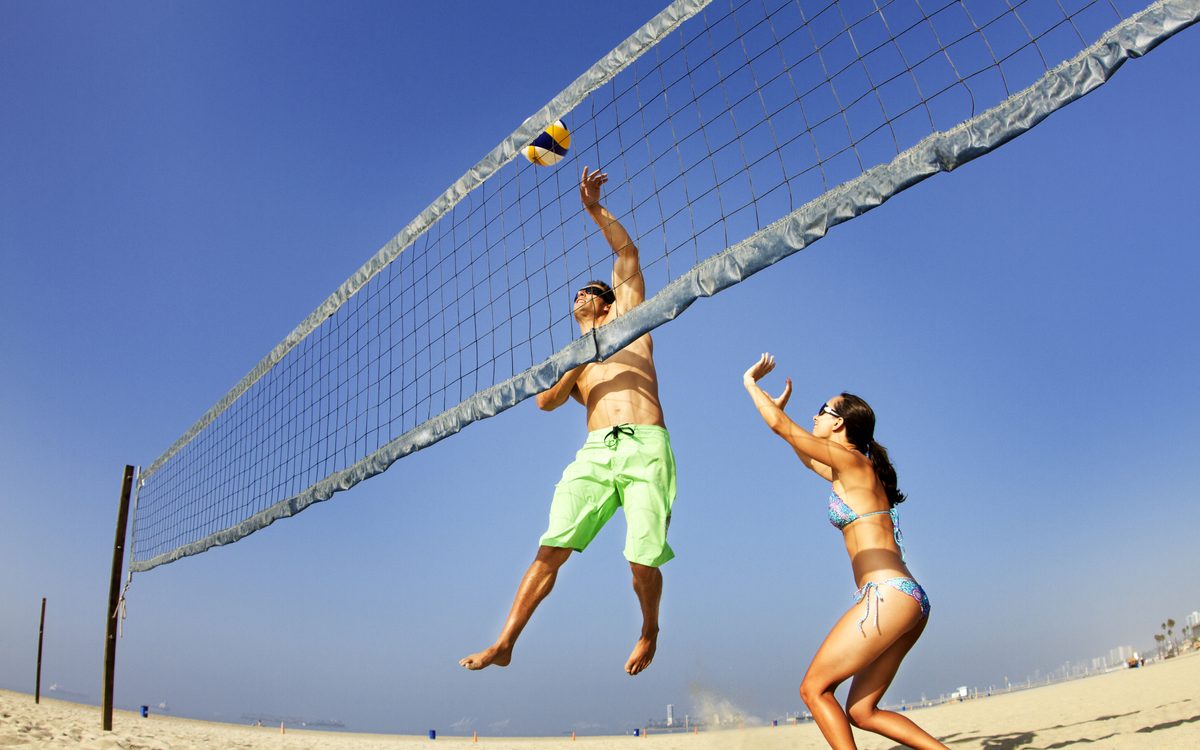
Sunday, final match, and the legs that felt fine on Friday now feel like wet sand. A pair that played two or three matches a day for two days has used up more than energy: sleep was short in a rented room, the sun took its share, and the muscles that jump and dive have not had a full day off. Beach volleyball recovery means the sleep, food, easy movement and rest that let a player repeat hard efforts without breaking down. This page covers what research shows for beach players and where the evidence is weak. For fuel see nutrition and athlete health; for the load side see training.
Quick answer: Sleep is the best-supported recovery tool: the 2021 expert consensus on sleep and athletes covers how sleep affects performance and health, and a small study found that sleep restriction slowed reaction times in young beach players. For soreness, a large meta-analysis found massage was among the most effective methods, but it was not volleyball-specific and evidence for many gadgets is mixed. Normal soreness fades in a day or two; pain that is sharp, one-sided, swelling, or lasting longer should be checked by a sports medicine doctor, physical therapist or athletic trainer.
Sleep first
The consensus statement on sleep and the athlete (Walsh and colleagues, Br J Sports Med, 2021 recommendations) reviews how poor sleep affects performance and health and offers practical advice for athletes. The CDC recommends at least 7 hours of sleep for adults and 8 to 10 hours for teenagers. In a small crossover study of 14 trained athletes (mean age 17.9) from beach volleyball, mental fatigue and sleep restriction, alone or together, slowed reaction times in tests of defense and blocking: in the defense test the control averaged 1,727 ms against 1,874 ms after sleep restriction and 1,906 ms for both conditions combined (Barbosa and colleagues, Front Psychol 2025). Tournament weeks often mean early starts and unfamiliar beds, so plan lights-out around the first match, not around the party.
What a hard match does to the body
After a three-set match, 16 elite men had knee extensor strength down about 19 percent and knee flexor strength down 17 percent, with sprint time slowed by about 3 percent; strength recovered by 3 hours while sprint time was still slower (Magalhaes and colleagues, J Sports Med Phys Fitness 2011). In an exploratory study of two Olympic-medal female players during a simulated two-match day, blood markers of muscle damage rose 20 to 60 percent and did not fully recover after a day of rest, and the authors linked the pattern to central fatigue (Muniz-Santos and colleagues, Nutrients 2025). Two athletes is a tiny sample, so read it as a hint, not a rule.
Rest time can matter. In ten NCAA Division I women, jump performance was higher after 24 hours of recovery and agility after 48 hours, while drill and match performance were not affected (Holtgeerts and colleagues, J Strength Cond Res 2022). In 17 Brazilian players across a tournament, higher accumulated match load went with lower heart rate variability the next night (r = -0.54), and the younger group showed larger night-to-night swings (Nakamura and colleagues, J Strength Cond Res 2022). These are small studies.
Load management across the season
The IOC consensus on load in sport (Soligard and colleagues, 2016) supports raising load gradually and balancing it with recovery. Practical choices are general coaching practice: a lighter day after a tournament, a day off each week for young players (as the American Academy of Pediatrics advises in its 2016 statement on sports specialization), and a break between seasons. On a tournament day, keep warm between matches in the shade, eat and drink, and avoid sitting on hot sand for long stretches.
Heat and cooling
Hot sand and sun add strain. In 11 male collegiate players in simulated matches in the heat, an ice vest, ice slurry before play and ice slurry during breaks reduced the rise in estimated core temperature and lowered thermal sensation, while jump and agility results after the match did not differ significantly (Hu and colleagues, Int J Sports Physiol Perform 2026). Shade, a wet towel and fluids between matches are common practice; see our injury prevention page for heat illness.
Mobility and flexibility
We did not find a trial of stretching or mobility routines in beach volleyball players, so this section is general practice. Dynamic movement before play and easy mobility work after it are common. Shoulders, hips, hamstrings and the lower back are the areas players most often work on, because they take the hitting, jumping and bending load. If a joint feels restricted, a physical therapist can check whether the problem is stiffness, strength or something else.
What the evidence says about recovery methods
A 2018 systematic review and meta-analysis of 99 studies (Dupuy and colleagues, Front Physiol) found that several recovery methods reduced delayed-onset muscle soreness (effect sizes from -2.26 to -0.40), and that massage was the most effective for soreness and fatigue; creatine kinase, interleukin-6 and C-reactive protein also fell on average. The review was not specific to volleyball, and results varied by method. Cold exposure and compression showed benefits for some outcomes in that review, while others had little or no effect. In plain terms: massage, sleep and rest have the best support; cold baths, compression boots, vibration guns and other gadgets have mixed or limited evidence, and none replaces sleep and food. Our guides to recovery tools have more on specific gear.
Soreness versus injury
Delayed-onset muscle soreness is a dull, widespread ache in muscles that were worked hard, usually peaking a day or two after a new or heavy effort. It tends to ease with gentle movement. Injury pain is more often sharp, local, one-sided, painful at rest or at night, or paired with swelling, a pop or giving way, numbness or a change in how you move. That is general sports medicine practice; when in doubt, ask a professional. Concussion danger signs and suspected heat stroke are emergencies: call 911.
Next: the beach volleyball hub, injuries, mental training and the volleyball hub.
Beach volleyball recovery FAQs
How much sleep do beach volleyball players need?
The CDC recommends at least 7 hours for adults and 8 to 10 for teens. A small study found reaction times slowed in young beach players after sleep restriction. Individual needs vary.
Does an ice bath help after a tournament?
The evidence is mixed. A large review found cold exposure helped some markers and soreness in some studies, while massage ranked higher for soreness and fatigue. It is not volleyball-specific, so treat it as optional.
Should I stretch after playing?
We found no beach-volleyball trial on stretching. Easy mobility work after play is common practice. Stop if it causes sharp pain.
How long should I rest between tournament days?
There is no standard. One study of ten college players found jumps were higher after 24 hours and agility after 48 hours of rest. A day off each week is advised for young players.
How do I know if soreness is an injury?
Soreness is dull and eases with movement. Sharp, one-sided or persistent pain, swelling, numbness or instability needs a professional’s opinion.
Sources
- Walsh et al., sleep and the athlete, Br J Sports Med 2020 (PMID 33144349)
- CDC, About sleep
- Barbosa et al., mental fatigue and sleep restriction, Front Psychol 2025 (PMID 40417017)
- Magalhaes et al., physiological and neuromuscular impact, 2011 (PMID 21297565)
- Muniz-Santos et al., competition day loads, Nutrients 2025 (PMID 40507193)
- Holtgeerts et al., recovery time and performance, 2022 (PMID 32826832)
- Nakamura et al., heart rate variability, 2022 (PMID 35622114)
- Soligard et al., IOC consensus on load, 2016 (PMID 27535989)
- Brenner, Pediatrics 2016 (PMID 27573090)
- Hu et al., combined cooling, 2026 (PMID 42061827)
- Dupuy et al., post-exercise recovery techniques, Front Physiol 2018 (PMID 29755363)
General information for education only, not medical advice. It does not replace a visit with a sports medicine doctor, physical therapist or athletic trainer. See how we write and check our pages in our editorial policy.