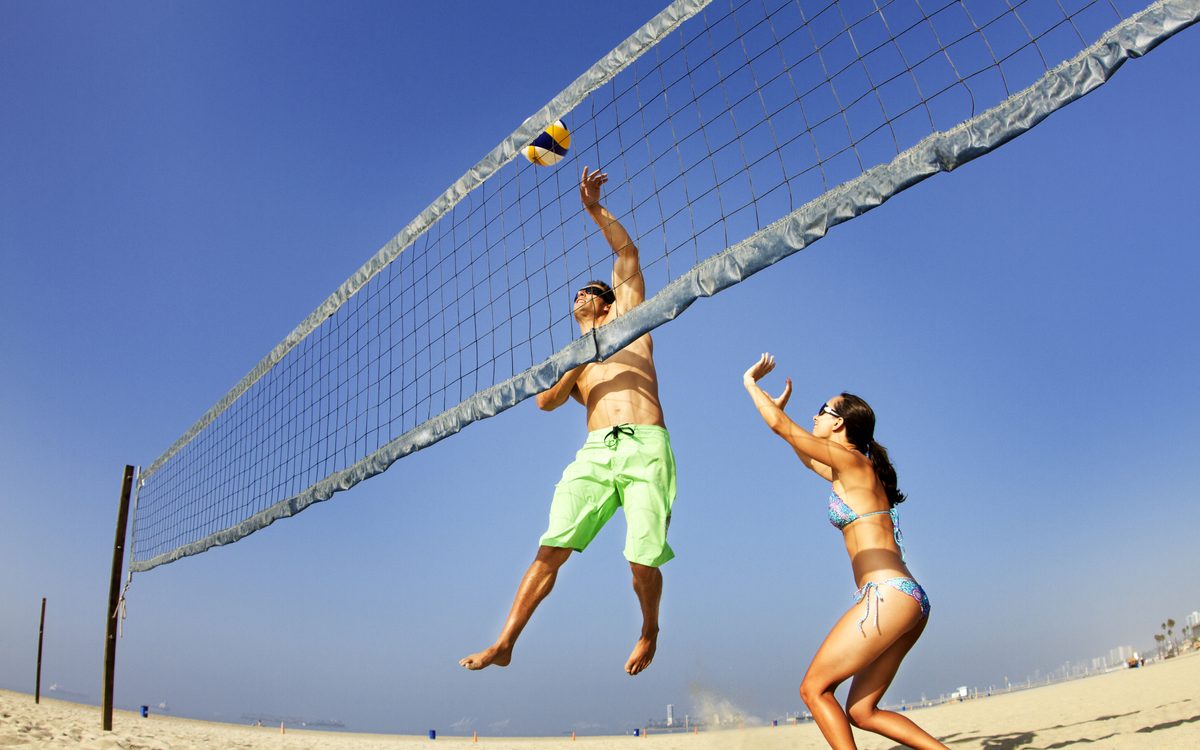
Down 18-20 in the third set, a player shanks a serve receive into the next court. Her partner turns and says something supportive, which comes out as a lecture. The next two points go the same way. Beach volleyball mental training is the set of skills, attention, routines, communication and emotional control, that help two players perform with each other under pressure. It is not a promise of better results, and it is separate from mental health, which gets its own section below. For rules, see Skills, Rules and Getting Started.
Quick answer: In a two-person sport, the partnership is part of the mental game. Research on junior elite beach teams found one player’s failure often raised pressure on the partner and that well-meant support was often unhelpful, so the authors recommend a structured teammate talk before competition. Routines, imagery and goal setting are common sport psychology practice, but the one beach study on pre-serve routines found no clear effect under pressure. Anxiety, depression, disordered eating and burnout are health matters: take them to a qualified professional, and in the US call or text 988 in a crisis.
Confidence and anxiety
In 66 male beach players, the direction of anxiety, whether the player read it as helping or hurting, and self-confidence together explained 42 percent of the variation in skill ratings, while the raw intensity of anxiety did not predict performance (Kais and colleagues, Percept Mot Skills 2004). That fits a common coaching idea: feeling nervous is normal, and how you interpret it matters. One correlational study cannot show that changing how you read nerves improves play.
Focus and mental fatigue
Attention is trainable by practice, but it also runs down. In 14 trained young players, mental fatigue and sleep restriction both slowed reaction times in defense and block tests (Barbosa and colleagues, Front Psychol 2025). In 12 young male players who spent 30 minutes on social media before playing, a low dose of caffeine did not improve attack decision-making compared with placebo (Costa and colleagues, BMC Sports Sci Med Rehabil 2025). Practical points, from general practice: rest before matches, put the phone away, and use simple cues between points, such as a breath, a word or a glance at your partner.
Motivation and goal setting
We did not find a beach-specific trial of goal setting or motivation programs. Common sport psychology practice separates outcome goals (win the bracket) from process goals (side out on the first serve, call every ball) and prefers goals that are specific and in your control. Five elite beach players interviewed after a severe shoulder injury named self-motivation, a clear goal and community support as helping their return to play (Bele and colleagues, J Exerc Rehabil 2015); this is a very small sample.
Imagery and pre-serve routines
Imagery, picturing a serve or defensive read before you do it, and short pre-performance routines are widely used. The one beach volleyball study we found tested pre-performance routine interventions in 54 players serving under induced pressure and found no differences between the routine groups and a control group; the authors suggested the pressure manipulation may have been ineffective (Wergin and colleagues, PLoS One 2020). So routines are a sensible habit, but we cannot say they work. If you try one, keep it short, such as two breaths, a target and a bounce, and practice it in training.
Pressure, setbacks and the partnership
In interviews with 23 junior elite players, one athlete’s failure often shifted the partner’s attention and raised pressure, leading to a later decline; helpers tended to offer the kind of support they wanted themselves, which partners often found intrusive. Ineffective regulation let an early point loss turn into lost sets and matches. The authors recommend a structured teammate talk before competition (Wergin and colleagues, Psychol Sport Exerc 2026). In 82 elite players, successful athletes scored higher on warmth, liveliness and emotional stability, and members of the same team did not differ significantly in personality (Klatt and colleagues, Front Psychol 2021). The practical lesson is to agree beforehand what each of you wants from the other after an error: space, a short word or a reset sign.
Decisions and tactics
Beach volleyball is full of choices: who serves where, which shot, whether to take the line or the angle. In a three-part study using Tokyo Olympic data, national coaches strongly believed in the hot hand, the idea that a player on a streak should get the ball, but the elite players recognized base-rate differences more accurately than changes, and the authors concluded players and coaches lack a shared understanding of how to use streak information (Ittlinger and colleagues, J Sport Exerc Psychol 2024). Talk through your serve targets and block signals in practice so that decisions in the match are quick and shared.
Preparing for competition
Prepare the day before: know your match times, bring what you need for sun and heat, and agree on your plan and your signals with your partner. Our rules page covers warm-up time at the net, time-outs and the toss, and the gear page covers equipment. At FIVB events players may not receive outside coaching during a match, so the plan has to live in the two of you. Nutrition and recovery habits also shape mood and focus: see nutrition and recovery.
Youth considerations
Our sources on youth beach players are limited. A 2022 pilot of Brazilian players found under-17 players showed larger night-to-night changes in heart rate variability and well-being than seniors across a tournament (Nakamura and colleagues, J Strength Cond Res), which suggests rest matters for young players. The American Academy of Pediatrics advises a day off each week and breaks from a sport (Brenner, Pediatrics 2016). Keep it fun, and do not push a young partner to cover your own nerves.
Mental health is not mental performance
Performance skills help you play; they do not treat anxiety, depression, disordered eating or burnout. In a 2026 study of 52 female professional players in the FIVB top 200, 67.3 percent were above a trait-anxiety cutoff and 71.2 percent above a depressive-symptom threshold; poor team communication and financial insecurity predicted higher distress, and ranking did not (Niering and colleagues, Discover Mental Health). It is one small cross-sectional study, but it is a reminder that elite beach players struggle too. The 2019 IOC consensus statement on mental health in elite athletes covers recognition and care (Reardon and colleagues, Br J Sports Med). If you or a teammate feel persistently low, anxious, hopeless, unable to sleep or are cutting back on food, talk to a doctor, therapist or counselor. In the US, call or text 988 for the Suicide and Crisis Lifeline, 24 hours a day. NCAA schools must make mental health services available under the NCAA’s Mental Health Best Practices.
Next: the beach volleyball hub, injuries and the volleyball hub.
Beach volleyball mental training FAQs
How do I stay calm when I make a mistake?
Common coaching advice is to use a short reset between points, such as a breath, a word or a look at your partner, and to agree beforehand how you want to be supported. Research on junior pairs found well-meant help often backfired, so talk it through before matches.
Does visualization work in beach volleyball?
Imagery is widely used in sport, but we found no beach trial showing it improves results. The one beach study of pre-serve routines found no clear effect under pressure. Treat it as an optional habit.
How should partners talk to each other during a match?
Decide before the match what each of you wants after an error. Studies of junior elite pairs suggest unplanned support can add pressure. A structured pre-match talk is recommended by the authors.
Is nervousness bad for performance?
Not necessarily. In one study of 66 players, how the player interpreted anxiety predicted performance better than how strong it was. That is a correlation, not proof that changing your view will change results.
When should I talk to a professional instead of a coach?
If low mood, anxiety, sleep or eating problems or thoughts of self-harm persist, see a doctor or mental health professional. In the US, call or text 988 in a crisis.
Sources
- Kais et al., anxiety and self-confidence in beach volleyball, 2004 (PMID 15141908)
- Barbosa et al., mental fatigue and sleep restriction, 2025 (PMID 40417017)
- Costa et al., caffeine and attack decision-making, 2025 (PMID 40474216)
- Bele et al., return after shoulder injury, 2015 (PMID 26331135)
- Wergin et al., pre-performance routines in serving, PLoS One 2020 (PMID 31968003)
- Wergin et al., dealing with failure in junior elite teams, 2026 (PMID 42055179)
- Klatt et al., personality and emotion regulation of beach volleyball dyads, 2021 (PMID 34744882)
- Ittlinger et al., sequential decision making, 2024 (PMID 39265984)
- Nakamura et al., HRV in Brazilian players, 2022 (PMID 35622114)
- Brenner, Pediatrics 2016 (PMID 27573090)
- Niering et al., depression and anxiety in elite female beach volleyball players, 2026 (PMID 41579268)
- Reardon et al., IOC consensus statement on mental health in elite athletes, 2019 (PMID 31097450)
- 988 Suicide and Crisis Lifeline
- NCAA Mental Health Best Practices
- FIVB Official Beach Volleyball Rules 2025-2028 (PDF)
General information for education only, not medical advice. It does not replace a visit with a sports medicine doctor, physical therapist or athletic trainer. See how we write and check our pages in our editorial policy.