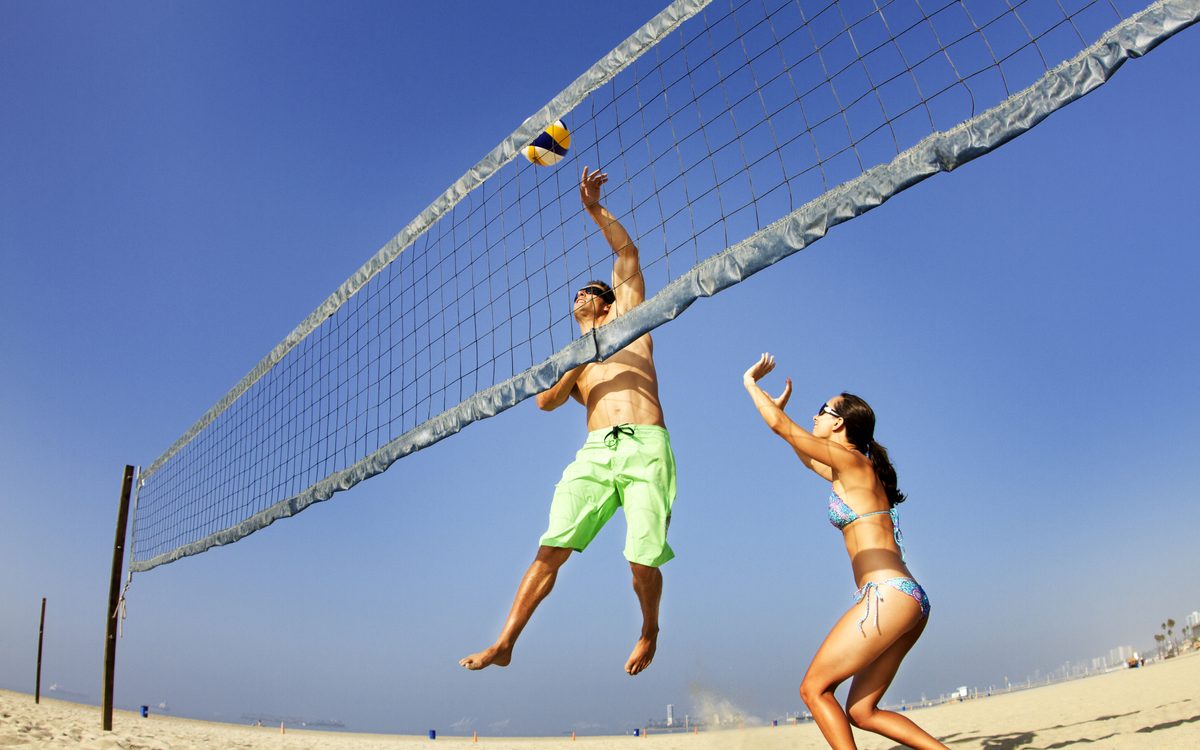
Two players stand on a 16 by 8 meter patch of sand. One crouches at the net with a hand tucked behind her back, a signal to her partner about what she plans to block, while the server eyes the gap between them. There are no substitutes and, at top-level events, no coach to shout advice. Beach volleyball is the two-a-side version of volleyball played on sand, and its rules are short enough to learn in an afternoon. (The hand signal is a common player convention, not a rule.) This page follows the FIVB Official Beach Volleyball Rules 2025-2028, then covers beginner skills and where to play. Start at the beach volleyball hub for the whole sport or the volleyball hub for the indoor game.
Quick answer: A beach team is exactly two players with no substitutions. Every rally scores a point; a set goes to 21 and must be won by two, a match is the best of three sets, and a deciding third set goes to 15. Teams switch ends every 7 points in sets one and two and every 5 in a third set, and players are barefoot unless the referee allows otherwise. Beginners usually start at a park court, a local league or a club, and juniors can find tournaments through USA Volleyball’s Beach Tour.
How a match is scored and played
The FIVB rulebook uses rally scoring: whoever wins a rally gets the point, whether they served or not. If the serving team wins the rally it scores and the same player serves again. If the receiving team wins, it scores and wins the right to serve, and the partner who did not serve last takes the ball. In other words, the serve alternates between the two partners each time the serve changes hands.
A set is won by the first team to 21 points with a two-point lead, so a 20-20 tie plays on until someone is two ahead. A match is won by the team that wins two sets. If the match is 1-1, the deciding third set is played to 15, again with a two-point lead. Teams change sides every 7 points in the first two sets and every 5 points in the third set, which evens out sun, wind and glare. Each team may request one time-out per set, and only the captain may ask for it. The match starts with a toss, and teams that have not warmed up on another court get 5 minutes at the net (3 minutes if they have).
At FIVB, World and Official competitions, players may not receive outside coaching during a match, and there are no substitutions. A hurt player gets a maximum of 5 minutes of recovery time; if the player cannot continue, the team is declared incomplete. Only the captain may speak to the referees about a ruling.
Court, net and ball
| Court | 16 x 8 meters, no center line, lines 5 cm wide in a color that contrasts with the sand |
|---|---|
| Sand | Level, free of rocks and shells; at FIVB events at least 40 cm deep, fine and loosely compacted |
| Net height | 2.43 m for men, 2.24 m for women. Age groups: 16 and under 2.24 m, 14 and under 2.12 m, 12 and under 2.00 m |
| Ball | 66 to 68 cm around, 260 to 280 g, inside pressure 0.175 to 0.225 kg per square cm, light in color |
| Team | Exactly two players, one of whom is captain |
The weather rule is simple: the weather must not present a danger of injury to the players. Local leagues and parks may use their own rules, for example four-a-side or co-ed formats, so ask the organizer before you play. More on equipment is on our gear page.
Hitting rules that trip beginners up
- Three hits per side. A block touch counts as one of the three. The same player may touch the ball twice in a row only in certain situations, such as a block followed by a hit; read the rulebook section on ball contact if you are unsure.
- No positions. The players are free to stand anywhere; there are no rotation or positional faults.
- Open-hand tips are faults. The rulebook says an attack hit with an open-handed finger action, or with finger tips that are not rigid and together, is a fault. Beach players use knuckles or the heel of a stiff hand to place shots softly.
- Overhand attacks. An attack with an overhand pass whose path is not perpendicular to the line of the shoulders is a fault, unless the player is trying to set to the partner.
- Serve. An attack hit on the opponent’s serve is a fault when the ball is entirely higher than the top of the net.
- Barefoot by rule. Players play barefoot unless the first referee authorizes socks or shoes.
Basic skills a beginner works on first
This is general coaching practice, not a ruling from any federation. With only two players, everyone has to do everything.
- Forearm pass (bump). Serve receive and defense start with a stable platform and small quick steps to the ball.
- Set. An overhand set from the fingertips, or a forearm set when the pass is low.
- Serve. A reliable serve in beats an error; float and topspin serves come later.
- Attack. A hard hit, a roll shot or a shot around the block. Shot choice matters more than force.
- Block and defense. The blocker takes part of the court away and the defender covers the rest; pairs agree this with a signal.
- Communication. Call “mine,” “line” or “cross,” and talk between points.
Movement in sand takes more effort than on a hard floor, so first sessions often feel tiring for reasons that have nothing to do with skill. Our training page covers the physical demands.
Levels and how a beginner starts
Parks and clubs. Most players start at a public court, a summer league or a beach club. Ask your parks department, a volleyball club or your regional volleyball association about clinics and leagues.
Juniors. USA Volleyball’s Beach Tour is for junior players and is run with its regions. All players and coaches at a Beach Tour tournament must be USA Volleyball members. National divisions are 12U, 14U, 16U and 18U, based on high school graduation year, and some tournaments award bids to the national championship held each summer. We did not find 2026 dates on the page we read, so check the site.
College and pro. Beach volleyball is an NCAA sport for women. In the US, the AVP runs professional tournaments, and internationally Volleyball World runs the Beach Pro Tour (Futures, Challenge and Elite16 events and a season-ending Finals). Olympics. Beach volleyball has been an Olympic sport since Atlanta 1996. For Los Angeles 2028, the FIVB says 48 teams (24 men and 24 women) will qualify, with each national Olympic committee limited to two teams per gender; the Games run July 14 to 30, 2028, with beach volleyball at Alamitos Beach in Long Beach. Check the official programme for the current schedule. The Paralympic volleyball sport is sitting volleyball: see our sitting volleyball hub.
Where to read the official rules
The full text is the FIVB Official Beach Volleyball Rules 2025-2028. USA Volleyball publishes domestic rules and tour manuals, and a local league may modify either, so the event organizer decides which applies.
Next: the beach volleyball hub, training, injury prevention, gear and mental training, plus the parent volleyball hub and the all-sports index.
Beach volleyball rules FAQs
How many players are on a beach volleyball team?
Two. The FIVB rules say a team is composed exclusively of two players, and there are no substitutions during a match. Casual games sometimes use more players, but that is a local choice.
How do you win a beach volleyball set?
By scoring 21 points with a two-point lead. A deciding third set, if needed, goes to 15 points, again with a two-point lead. Every rally scores a point.
Why are beach volleyball players barefoot?
The rulebook says players must play barefoot unless the first referee authorizes socks or shoes. Some players ask to wear sand socks on very hot sand.
What is the difference between indoor and beach volleyball rules?
Two players instead of six, no substitutions, no positional order, a 16 by 8 meter court, a softer ball, switching sides every 7 points and sets to 21 instead of 25. The finger-action rule on open-hand attacks is also strict in the beach book.
Do beginners need a partner to start?
Not at first. Many parks and clubs run drop-in games or clinics where you can rotate partners.
Sources
- FIVB Official Beach Volleyball Rules 2025-2028 (PDF)
- FIVB, volleyball and beach volleyball qualification systems for LA28
- USA Volleyball Beach Tour
- USA Volleyball beach page
- USA Volleyball, volleyball and beach volleyball venues confirmed for LA28
- FIVB, Beach volleyball marks 30 years as an Olympic sport
- NCAA membership and sport sponsorship
General information for education only, not medical advice. It does not replace a visit with a sports medicine doctor, physical therapist or athletic trainer. See how we write and check our pages in our editorial policy.