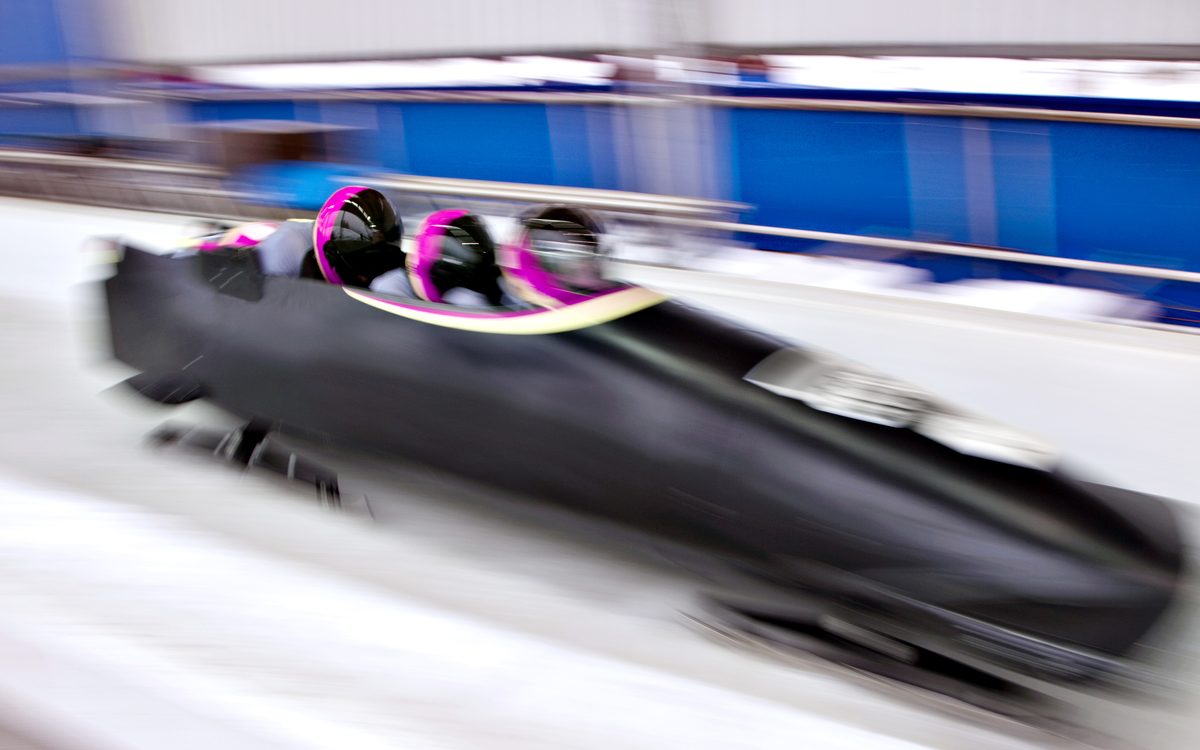
A lifting platform at 6 a.m., a sled on a weighted line, then an ice track later in the week when the schedule allows. A push athlete’s season looks less like a sliding sport and more like a sprinter’s, because the research says the start is where the race is built. Bobsleigh training is the work that gets a crew fast and strong off the block and keeps them in one piece on the ice. This page covers the physical demands, what research says to train, and how a sensible week is put together.
Quick answer: Bobsleigh push training is sprint and power training: acceleration, maximal leg and hip strength, and jumping. Pilots add driving practice and the ability to stay stable at high speed. Published research gives tests and traits that separate stronger crews, but it does not give a standard weekly plan, so any plan should come from a qualified coach and be built around your health. See a sports medicine doctor, physical therapist or athletic trainer before big increases in load or if pain persists.
General information, not medical advice. Related pages: injury prevention, recovery and the skills and rules page. Sprint training basics are on the track and field hub.
What the sport asks of the body
A 2026 narrative review of Olympic ice sports places bobsleigh, skeleton and luge in an “exposure-driven gravity” group where the race is overwhelmingly decided by start velocity, with the first 15 to 65 metres counting for a lot. It says bobsleigh and skeleton training mirrors sprint athletes and emphasises lower-body power, while luge needs explosive upper-body strength. A companion 2026 review of endurance training in winter sports places sliding sports in a “feeder” category, where aerobic fitness mostly supports recovery, training tolerance and resilience rather than deciding the race.
The push itself is hip-dominant: in a 2025 study of 15 elite men, early propulsion came mainly from the hip extensors, and the athletes relied more on hip than on ankle work than in free sprinting. A 2026 analysis of 28 elite men found that strong hip extensors and a whole-body forward lean were linked to better acceleration. Together these studies point to the posterior chain (glutes, hamstrings, back) as the engine of the push.
What separates stronger push athletes
A 2020 study of USA Bobsled and Skeleton combine data from 75 athletes across two Olympic qualification years (2009 and 2013) asked which tests best sorted Olympians from non-Olympians. The 11 variables were 15, 30 and 60-metre sprints, a flying 30-metre sprint, a standing broad jump, a shot toss, a squat, a power clean, body mass, and dry-land brake and side pushes. Using all 11, the model misclassified 9.33% of Olympians versus non-Olympians; some smaller sets of tests did nearly as well. The study shows what the federation tests, not a recipe for training.
A 2022 study of Korean national bobsleigh and skeleton athletes compared five medallists from the 2018 Games with 11 teammates and found medallists had higher squat ability, abdominal strength and leg curl strength, particularly hamstring strength. The group is small, so read it as a hint, not a rule.
A sensible shape for a week
No published source we found gives a standard weekly schedule for bobsleigh, so what follows is the general logic that follows from the research above, not a prescription:
- Acceleration days: short sprints and resisted pushes with full rest between reps, so each rep is fast. Technique matters more than volume here.
- Strength days: heavy lower-body and hip work (squat and hip-hinge patterns, power cleans and jumps if a coach has taught them), plus trunk training.
- Skill days: sled pushes on a track or push cart, and on-ice runs when the track is available. On-ice time is limited by access, which is why many athletes do much of their start work in a gym.
- Easy days and rest: low-intensity aerobic work, mobility and full days off; see the recovery page.
Periodisation, in plain words, means the year has phases: a build phase with more general strength and fitness, a phase where work becomes more specific and powerful, and a competition phase where fewer hard sessions are kept sharp. Sliding sports have a winter competition season on refrigerated tracks, and the published research does not give phase lengths, so ask your coach and federation staff.
Warm-up and the cold
A 2013 study of six Olympic-level bob-skeleton athletes compared five warm-ups before sled-pull sprints. Higher-intensity warm-ups done close to the sprint made the 20-metre sprint 0.1 to 0.25 seconds faster, and wearing a light survival coat for heat retention improved it further. The authors said the findings were adopted on the World Cup circuit and at the 2010 Olympics. It is a tiny study, but it shows why athletes keep warm and keep moving between runs. For cold-weather safety, see the CDC’s hypothermia and frostbite guidance, linked below.
Speed and mass: what we could not confirm
Reference summaries say the rules cap the combined weight of sled and crew (check the IBSF rulebook for the numbers). We did not find a published training or body-mass guideline for bobsleigh, and there are no weight classes in the Olympic events. Any change to body weight should be planned with a registered dietitian who knows sport; see the nutrition page.
Pilots and driving
USA Bobsled and Skeleton says pilots are evaluated on driving skill and race results as well as speed. Driving is learned on the ice, with the track and sled, and cannot be replaced by gym work. A 2025 clinical commentary on sliding athletes notes that visualisation and mental imagery are part of how athletes prepare for the technical start and the slide; see our mental training page.
Bobsleigh training FAQs
Is bobsleigh training like sprint training?
Largely yes. A 2026 narrative review says bobsleigh and skeleton training mirrors that of sprint athletes, with lower-body power first.
How strong do I need to be?
No published number applies to everyone. The USA Bobsled and Skeleton combine tested a squat and a power clean in past years and its 2026 series tests a 40-yard sprint, agility shuttle, power ball toss, prowler push and vertical jump. Your coach should set targets.
Does bobsleigh need endurance training?
A 2026 narrative review describes aerobic fitness in sliding sports as a feeder capacity: it supports recovery and training tolerance more than it decides the race.
Can I train for bobsleigh without a track?
Many start-phase skills (sprinting, jumping, heavy lifting, sled pushes on a cart or turf) are trained off the ice. Driving and on-ice technique need the track.
How often should I train?
No source gives a universal answer. A coach should set it from your current fitness, injury history, sleep and the season. See the injury prevention page for how to build load slowly.
Sources
- Olympic ice sports: a narrative review toward Milano-Cortina 2026, Scand J Med Sci Sports
- Endurance training in Olympic winter sports: a narrative review (2026)
- Biomechanics of the bobsleigh push phase, J Sports Sci 2025
- Biomechanical performance predictors of the bobsleigh push phase, J Sports Sci 2026
- Predicting bobsled pushing ability from combine testing events, J Strength Cond Res 2020
- Body composition and fitness of Korean bobsleigh and skeleton athletes, 2022
- Designing a warm-up protocol for elite bob-skeleton athletes, Int J Sports Physiol Perform 2013
- Interdisciplinary health and performance management of the sliding athlete, Int J Sports Phys Ther 2025
- USA Bobsled and Skeleton: recruitment
- USA Bobsled and Skeleton: 2026 recruitment series
- CDC: preventing hypothermia and frostbite
General information for education only, not medical advice. It does not replace a sports medicine doctor, physical therapist, athletic trainer, licensed mental health professional or qualified coach. See our editorial policy for how we research and write.