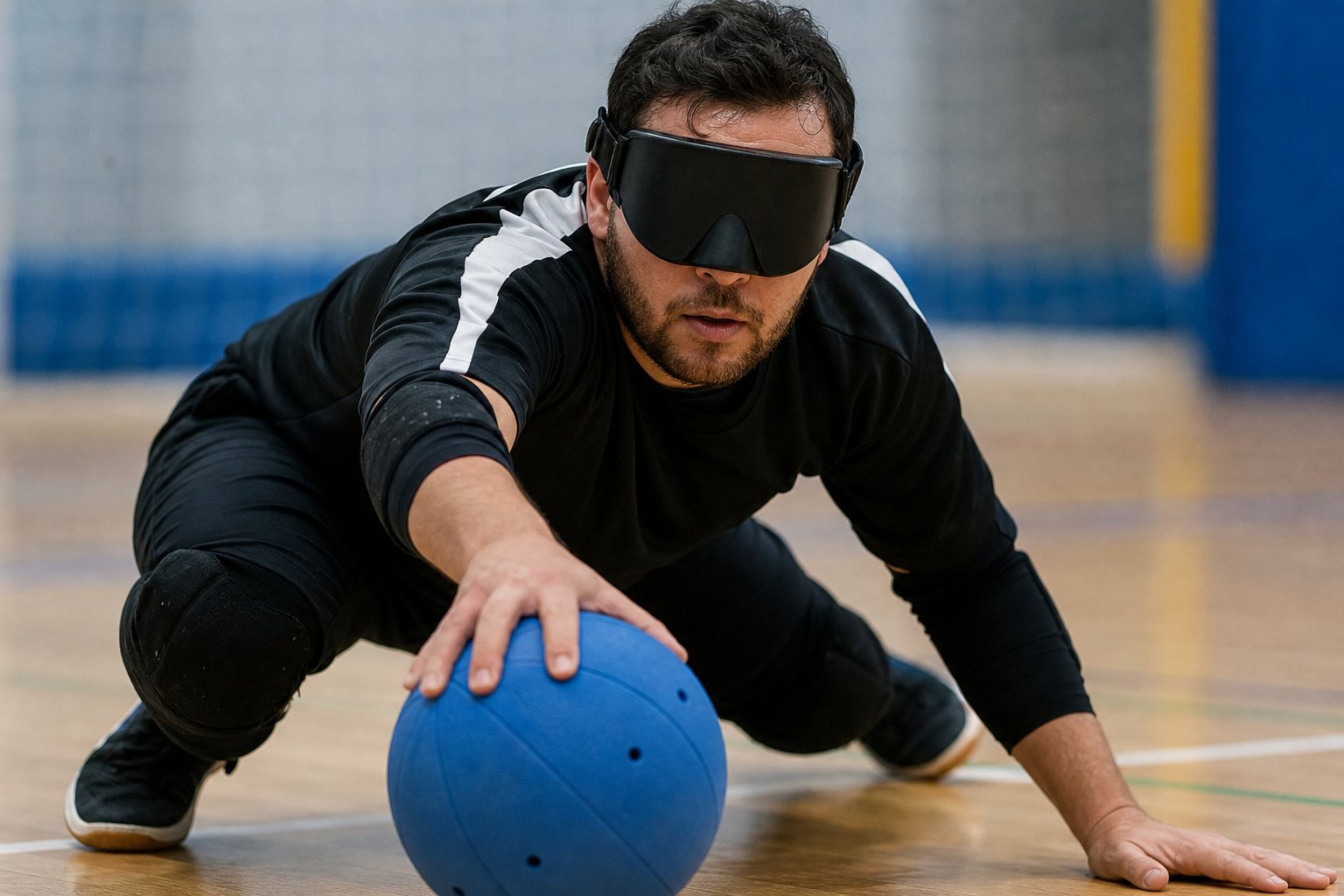
The referee calls “quiet please,” a full gym goes still, and three players in blackout eyeshades crouch on a court whose lines they can feel under their hands. The whistle sounds three times, the referee calls “play,” and a heavy ball with bells inside starts to roll. Goalball rules are written around sound and touch: they decide how the ball may be thrown, how the defenders may block it, and how an athlete who cannot see the markings knows where they are standing.
Quick answer: Goalball is three players against three on an 18 m by 9 m court. Each team rolls a bell-filled ball along the floor toward a goal that spans the whole end, while the other side blocks with their bodies. A game is two 12-minute halves, everyone wears eyeshades, and international players are classified B1, B2 or B3. To start, the USOPC suggests a local adaptive sports organization or a USABA goalball club. Rules can differ in local leagues, so ask your coach which rulebook applies.
This page covers rules, basic skills and ways in. For training see our goalball training page; for the sport as a whole, start at the goalball hub.
The court and the ball in plain words
The IBSA rulebook (2025 edition) describes an 18 m by 9 m gym court split into two halves by a centre line, with a goal across the full 9 m width at each end. The court is also divided every 3 m into six areas. In front of each goal is a 6 m deep Team Area, split into an Orientation Area next to the goal and a Landing Area behind it, and the middle 6 m is the Neutral Area. Every line is marked with 5 cm tape with string under it, so a player can find a boundary by touch.
The ball is hard rubber, 75.5 to 78.5 cm around, 1.25 kg give or take 50 g, with two bells and sound holes so it can be heard. Each team may have six players, three on court and up to three substitutes, plus up to three staff on the bench.
How a game runs
The referee asks for phones to be switched off and quiet while the ball is in play, then throws the ball to the team that starts. The coin-toss winner chooses whether to throw or defend first. A game is two 12-minute halves with a 5-minute half time. Each team gets four 45-second time-outs and four substitutions in regulation, with at least one of each used in the first half or it is lost. The referee may also call a medical time-out of up to 45 seconds.
If the score is tied when a winner is needed, the rulebook calls for one 6-minute overtime in which the first goal wins. If it is still tied, teams go to extra throws, one player at a time, and then sudden-death extra throws. Separately, the game ends at once if one team leads by 10 goals (rule 14.5).
The rules that decide most whistles
- High ball and long ball. A throw has to touch the floor at least once on or before the 6 m high-ball line in front of the thrower, and at least once more in the Neutral Area. Miss either and the thrower is penalized.
- Short ball. If the ball stays on the court but stops moving forward before it reaches the defending Team Area, the thrower is penalized.
- Illegal defence. The first defensive touch must come from a player who has at least part of their body in their Team Area.
- Ten seconds. A team has 10 seconds after gaining control to get the ball back over the centre line.
- Eyeshades. Intentionally touching your own or another player’s eyeshades without the referee’s permission is a personal penalty.
- Noise. The rulebook lists noise as both a personal and a team penalty, which is why spectators are asked to stay quiet while the ball is in play.
When a personal penalty is called, the penalized player defends alone against a single throw. Penalties matter: a study of 122 elite men’s matches at two Paralympic Games and a world championship (Furtado and colleagues, Adapted Physical Activity Quarterly, 2021) found penalties made up about 25% of all goals.
Basic skills a beginner meets first
Goalball skills are taught on court by a coach, and we do not try to replace that. The building blocks, drawn from the rulebook and sport overviews, are: finding your position from the tape lines and the string beneath them, a low throw that bounces early enough to be legal, defending by getting your whole body across the ball’s path, and talking to teammates so the three of you cover the goal. The USOPC says elite throws can top 40 miles per hour.
Two throwing styles come up often, a traditional straight throw and a spin throw. In a 2024 study of 15 sub-elite players (Goksen and colleagues, BMC Sports Science, Medicine and Rehabilitation), ball velocity was related to the strength of the arm’s flexor muscles and did not differ between the two techniques or between eyes-open and eyes-covered conditions. It is a small study.
Classification and eyeshades
IBSA says an athlete is classified in two steps: first, eligibility (an impairment that meets the minimum requirements), then a sport class from test results and medical evidence. For international play the classes are B1, B2 and B3. The IPC describes B1 as very low vision or no light perception, B2 as better acuity and/or a visual field under 5 degrees, and B3 as the least severe impairment eligible, with the highest acuity and/or a field under 20 degrees. IBSA says it is researching a goalball-specific classification system.
Because everyone wears opaque eyeshades, classes play together. A 2024 study of results from the 2016 and 2020 Paralympics (Martin and colleagues, Journal of Sports Sciences) found no significant performance differences between classes. At IBSA and IPC events, players’ eyes are also covered with patches and glasses, contact lenses and hearing aids are not allowed on court.
How a beginner starts
- Ask for a club. USABA keeps a list of goalball clubs on its site, and the USOPC suggests local adaptive sports organizations as a first call.
- Ask about classification. You need an official sport class for national and international events; ask the club what it needs for practice.
- Wear what the coach says. Knee and elbow pads are the usual gear (see our gear page), and our injury prevention page is worth reading before your first dive.
USABA has run youth national team and development programs, and a 2026 interview study of nine goalball coaches in the US and Canada (De Luna Vazquez and colleagues) looked at how coaches involve young players. Dates change, so check usaba.org.
Levels: from a club gym to the Paralympics
Beyond clubs, USABA is the national governing body and IBSA runs world championships between Paralympic Games. Goalball is confirmed for LA28 with two medal events, men and women, eight teams each, according to the IPC. We did not find a US school or college goalball league. For related adaptive sports, see blind football and boccia.
Goalball rules: FAQs
How many players are on a goalball team?
Six can be registered: three on court and up to three substitutes. Up to three staff may sit on the bench, and the bench area holds at most nine people in all.
What is a high ball in goalball?
A throw that does not touch the floor at least once on or before the 6 m high-ball line in front of the thrower. It is a personal penalty, and the thrower then defends alone against the penalty throw.
Can I play goalball if I am not blind?
International competition needs an IBSA sport class of B1, B2 or B3. Some clubs run sessions for others; ask yours, because we did not find an official rule on this.
How long is a goalball game?
Two 12-minute halves with a 5-minute break. A tied game that needs a winner goes to a 6-minute overtime, then extra throws.
Where can I find the official rules?
The IBSA Goalball Rules and Regulations 2025 are linked in our sources below. Local leagues may adapt them, so ask your club which edition they follow.
Sources
- IBSA, Goalball Rules and Regulations 2025 (copy hosted by the Japan Goalball Association)
- USOPC, Sport overview: goalball
- IPC, Introduction to goalball
- IPC, Sport week: classification in goalball
- IBSA, Goalball classification
- IPC, LA28 medal event programme and athlete quotas
- United States Association of Blind Athletes
- USABA, sports clubs
- Furtado et al., factors associated with penalty outcome in male elite goalball, Adapt Phys Activ Q 2021
- Martin et al., impairment and performance in goalball, J Sports Sci 2024
- Goksen et al., EMG of traditional and spin throws in goalball, BMC Sports Sci Med Rehabil 2024
- De Luna Vazquez et al., goalball coaches and athlete-centered coaching, Front Sports Act Living 2026
General information for education only, not medical advice. It does not replace a visit with a doctor, physical therapist or athletic trainer. See how we write and check our pages in our editorial policy.