On a summer afternoon a group of kids lies back on wheeled sleds, feet first, rolling down a paved slope while a coach watches their body position. No ice, no speed, and no brakes either, because a luge sled has none. That is where many sliders begin. Luge rules are short: get the sled moving, lie back, steer with your body, and finish with the lowest total time. This page explains the skills, how a race is decided, the age classes, and how a beginner can find a way in.
Quick answer: Luge is won by the lowest combined time over the runs, measured to the thousandth of a second. A slider pulls off the start handles, lies back feet first, and steers with the calves and shoulders. There are no brakes. Beginners do not go straight to a fast track: in the US, USA Luge’s youth recruiting route begins with Slider Search events (ages 10 to 13 on its current page) and local clubs. Ask USA Luge or a club what is open now.
General information. For injury and safety detail see the injury prevention page and the injuries page; the whole topic starts at the luge hub.
How a run works
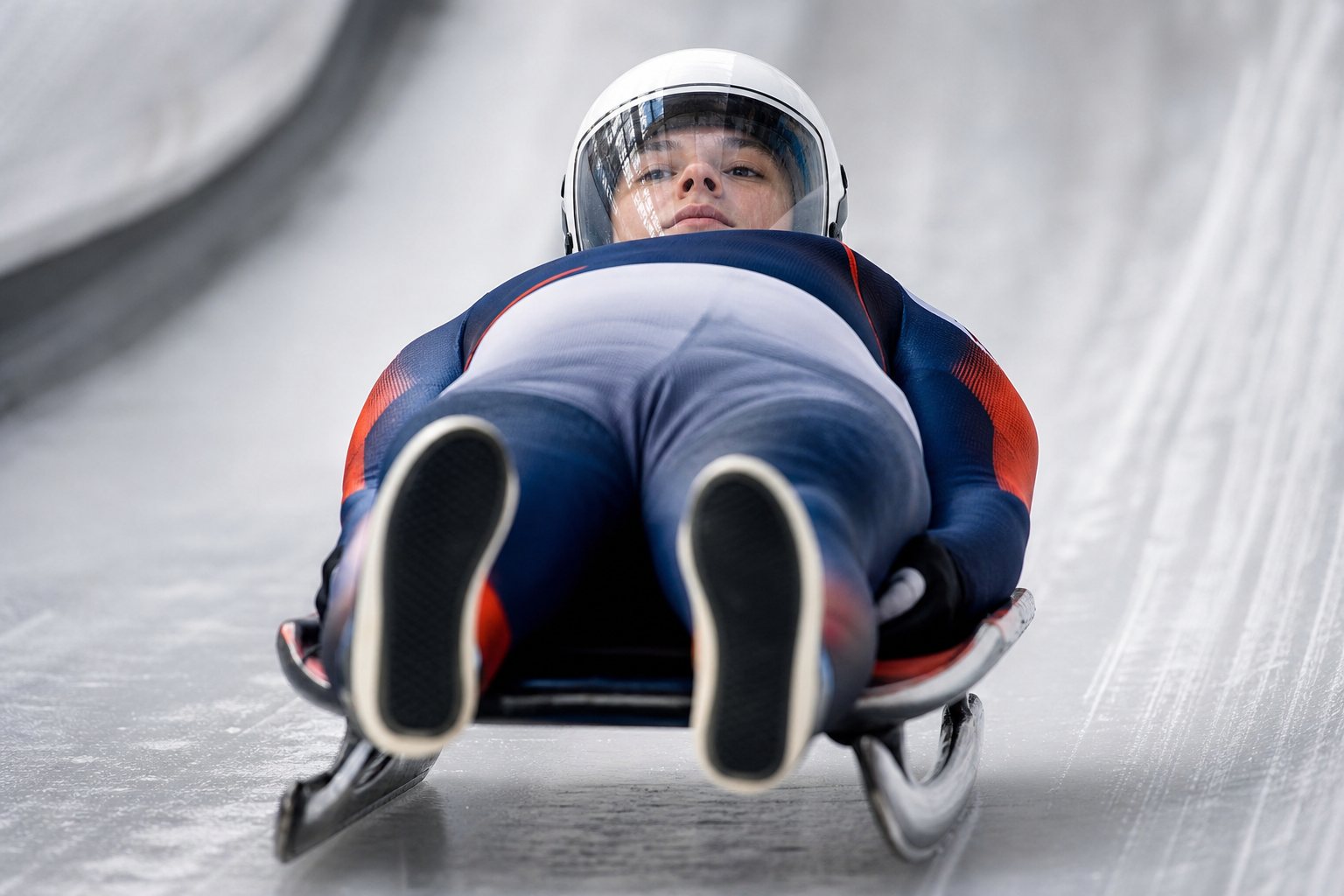
According to NBC Olympics’ explainer, a slider starts seated on the sled, holding handles, rocks back and forth to build momentum, then paddles with spiked gloves on the ice. After that the athlete lies back and steers by pressing the calves against the runners and shifting the shoulders. The same explainer says Olympic sleds can top 145 km/h (90 mph). The International Luge Federation (FIL) describes the sled as two runners, two steels, a seat mat or shell and two bridges, which are the parts that make steering possible.
Basic skills a beginner learns
- The start. Rocking, pulling on the handles and paddling are the first moves of every run. A 2026 review of Olympic ice sports (Olympic Ice Sports: A Narrative Review, 2026) says sliding results depend heavily on start speed, with the first 15 to 65 metres counting for more than their share of the final time, and that luge in particular calls for explosive upper-body strength.
- Lying position. Feet first, on the back, head up enough to see the track. FIL requires tight race suits because they reduce air resistance, so a relaxed, still body is part of the sport.
- Steering. Small pressure from the calves and shoulders turns the sled. NBC Olympics notes there are no brakes or steering wheel, so a beginner’s job is smooth, small corrections rather than big ones.
- Learning the track. Each track is different. Starting on wheeled sleds in summer and then moving to ice at a sanctioned track is the pathway USA Luge describes; ask the coach how the progression is set for your age.
How a race is decided
Singles and doubles are contested over several runs, and the total time across the runs sets the order, FIL says. At the Olympics a singles event is four runs over two days and doubles is two runs in one day. Men start higher up the track than women, NBC Olympics says. As an example of the scale, Max Langenhan won the Olympic men’s singles in 3:31.191 across four runs (FIL), which works out, by our arithmetic, to about 53 seconds a run.
Events
- Singles for men and women: one athlete per sled.
- Doubles for men and women: two athletes on one sled. Women’s doubles made its Olympic debut in 2026, with Italy’s Andrea Voetter and Marion Oberhofer taking gold.
- Team relay: four sleds per country in a set order. Each finisher hits a touch pad to open the next start gate while the team clock keeps running (NBC Olympics).
Rules that matter at every level
- Equipment must meet FIL rules. FIL requires protective helmets, tight-fitting suits and spiked gloves for the start. It publishes separate helmet guidelines, so check with your coach before buying a helmet.
- Sled weight depends on age group and discipline, FIL says. The exact numbers are in the FIL International Luge Regulations, which we did not read in full, so we give none here.
- Disqualification. FIL lists leaving the sled before the finish line and unsportsmanlike behavior as examples of violations that can lead to disqualification.
Levels and age classes
FIL groups artificial-track athletes into youth B, youth A, junior and general classes. The age limits are in the full regulations and are not on the summary page we read. Natural-track luge, on snow-covered roads, and alpine luge are separate branches of the sport. We found no NCAA or high school luge championship, so most athletes progress through clubs and national programs, which is an absence we could not prove.
How to get started
- Slider Search. USA Luge describes it as its official nationwide athlete recruitment tour, aimed on its current page at ages 10 to 13, to find young athletes for its junior development team.
- Luge Challenge events and screening camps. Coaches scout events and invite some young athletes to screening camps at USA Luge facilities in Lake Placid, New York, or Park City, Utah.
- Fantasy camp and facility tours. USA Luge also lists a fantasy camp led by Olympic and World Cup medal winners and a tour with a ride on the indoor start ramp in Lake Placid. These are tastes of the sport, not a training route.
- Clubs. The Adirondack Luge Club (Lake Placid), the Wasatch Luge Club (Park City) and the Upper Peninsula Luge Club (Negaunee, Michigan) are listed by USA Luge. Dates change, so check the site.
- Outside the US. Start with your national luge federation, which you can find through FIL.
Where to read the rules: the FIL artificial-track rules page and the International Luge Regulations it links, and USA Luge’s “Luge 101” page for the US route. Both are in the sources below.
Olympic and Paralympic status
Luge had five events at Milano Cortina 2026, held at the Cortina Sliding Centre. FIL has said the French Alps 2030 sliding events are planned for La Plagne, but we could not confirm the 2030 luge event list, so check the official programme for the current Games. We did not find luge on the Paralympic Winter Games program; check paralympic.org. The other sliding sports on the same tracks are bobsleigh and skeleton.
Luge FAQs
Do luge sleds have brakes?
No. NBC Olympics says there are no brakes and no steering wheel; the slider steers with the calves and shoulders.
How is a luge race scored?
By total time over the runs. FIL says the combined time decides the ranking, and Olympic singles are four runs over two days.
How old do you have to be to start luge?
It depends on the program. USA Luge’s current Slider Search page lists ages 10 to 13, and FIL has youth, junior and general classes. Check the club or USA Luge for current ages.
What is the difference between luge and skeleton?
In luge you lie on your back, feet first. In skeleton you lie on your stomach, head first.
Where can I try luge in the US?
USA Luge lists tracks and facilities in Lake Placid and Park City and clubs in Lake Placid, Park City and Negaunee, plus events like Luge Challenge. Dates change, so check usaluge.org.
Sources
- NBC Olympics: how Olympic luge works
- FIL: artificial track rules
- USA Luge: Luge 101
- FIL: Max Langenhan wins Olympic gold in Cortina
- FIL: La Plagne for the 2030 sliding events
- Olympic Ice Sports: A Narrative Review and Perspectives Toward Milano-Cortina 2026 (2026)
- Women’s doubles gold, Voetter and Oberhofer
- International Paralympic Committee
General information for education only, not medical advice. It does not replace a visit with a doctor, physical therapist or athletic trainer. See how we write and check our pages in our editorial policy.