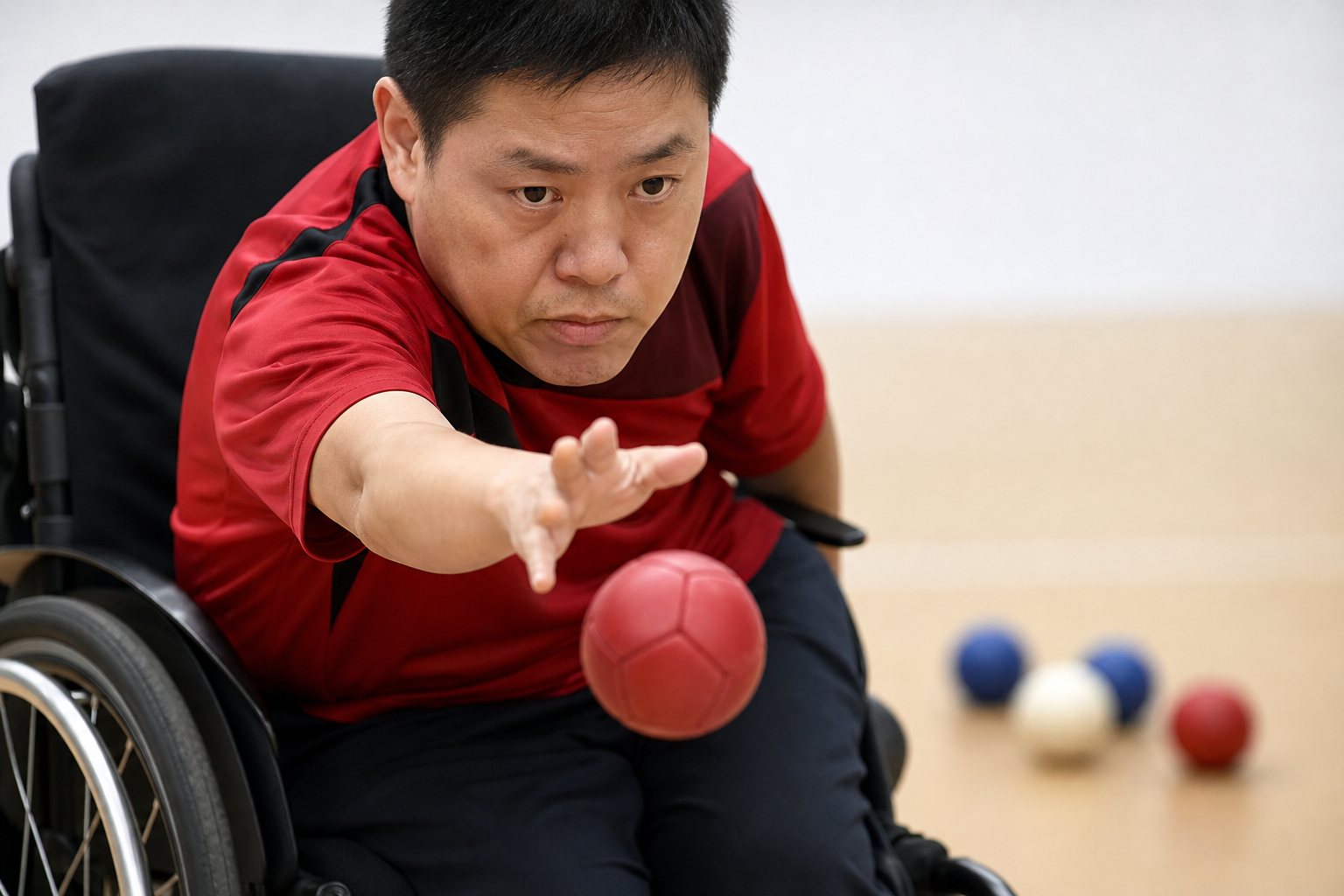
At a boccia tournament the room goes quiet in a way few sports manage. A player settles the chair, an assistant steps back to the line, the timer starts, and one red leather ball rolls slowly across a flat court toward a white jack. Everyone in the room is measuring the same small gap. Boccia (pronounced “BOTCH-ee-ah”) is a seated precision ball sport for athletes with impairments that affect movement, and this page is your plain-language guide to its skills, rules and how a beginner gets started.
Quick answer: Boccia is played one-on-one, in pairs or in teams of three. Each side tries to land coloured balls closer to a white jack than the opponent’s best ball, and a side scores one point for every ball closer than the opponent’s nearest. The simplest way to start is to contact a local adaptive sports organisation or boccia club, and to ask about classification before you plan to compete. If you have questions about positioning, equipment or health, ask a doctor, physical therapist or occupational therapist who works with para athletes.
This is the skills, rules and getting-started page. Back to the boccia hub. Training, injuries and the rest are linked from the hub: training, injury prevention, gear.
The court, the balls and the basic idea
World Boccia (BISFed), the international federation, describes boccia as a precision ball game related to bocce and petanque. Players throw leather balls toward a white target ball, the jack. Balls are coloured red or blue, a coin toss decides which side gets which colour, and each side has six balls per end. The international court is 12.5 m by 6 m with 2 m of clear space around it. A V-shaped line marks where the jack must cross for a throw to be valid, and athletes must stay inside their throwing boxes. World Boccia lists the balls at about 275 g with a 270 mm circumference. As Boccia UK notes, the balls are leather with plastic granules inside, so they roll but do not bounce.
How an end is played
The format below follows the IPC and the USOPC sport overview, with World Boccia for the match structure.
- Opening the end: the red side throws the jack first, then the same player throws the first red ball, trying to bring it close.
- Taking turns: the blue side throws next. The side whose ball is *not* closest to the jack keeps throwing until it gets closer or runs out of balls. Then the other side throws.
- Scoring: when all balls are played, the referee awards one point for each ball of a side that is closer than the opponent’s closest ball. Only one side scores in an end.
- Tied match: World Boccia says a tied game is settled by one extra end.
- Time: every throw is timed. The USOPC lists five minutes per end for BC1, four for BC2 and BC4, six for BC3 and for teams, seven for BC3 pairs and five for BC4 pairs.
Individual, pairs and team matches
- Individual: 4 ends, with 6 balls per player per end.
- Pairs: 4 ends, with 6 balls per pair per end (3 each).
- Teams of three: 6 ends, with 6 balls per team per end (2 each).
World Boccia says pairs and teams may name a reserve, who can replace a player between ends. Only one substitution is allowed per game. In the Paralympic format, BC1 and BC2 athletes play individual events and form the three-player teams (Boccia UK says at least one must be BC1), while BC3 and BC4 athletes play individually and in pairs.
Basic skills
Coaches and players usually talk about these skills.
- Jack placement: where the red side puts the jack decides what kind of end it will be. A short jack rewards a soft touch; a far jack rewards a controlled, longer roll.
- Draw (placing a ball): rolling the ball to stop near the jack. This is the most common shot and needs a repeatable release.
- Hit or push: using a faster ball to move the jack or an opposing ball. Experienced players choose this when a draw cannot get close enough.
- Release and delivery: how the ball leaves the hand, foot or ramp. For BC1 and BC2 this is a throw or kick; for BC3 it is the way the athlete uses the ramp and, if allowed, an assistant.
The four classes in plain words
Classification exists so that athletes compete against others whose impairment affects the sport in a similar way. It is not about ability or effort. The IPC position stand on the background and scientific principles of classification in Paralympic sport describes the idea; the exact wording for each class comes from World Boccia and the USOPC.
- BC1: the athlete throws with the hand or foot. An assistant may stay outside the playing box to steady or adjust the chair and pass balls on request.
- BC2: the athlete throws by hand and plays without an assistant.
- BC3: the athlete has very severe movement limits in all four limbs and no sustained grasp or release, and uses an assistive device such as a ramp. An assistant may help but sits with their back to the court and eyes averted from play.
- BC4: the athlete has severe movement limits in all four limbs and poor trunk control, with enough dexterity to throw the ball onto the court. No assistance is allowed.
World Boccia says every athlete who wants to compete in one of its events must be allocated a sport class by a BISFed-approved international classifier. Its classification panels include a physiotherapist, a technical classifier and a medical doctor. For national events in the US, the USOPC says national classification is required once you want to compete regionally or nationally.
How a beginner starts
1. Find a place to try it. The USOPC suggests contacting a local adaptive sports organisation or a boccia club, and its directory is at uspara.us/findaclub. USA Boccia (usaboccia.org) handles membership and tournaments for athletes, coaches, sport assistants and referees.
2. Start with the basics. Many beginners play with club or loaned equipment. You do not need to buy a ramp or a chair before you know what works for you; see our gear page.
3. Talk to your care team. A doctor, physical therapist or occupational therapist can advise on seating, positioning and safe ways to work on strength, and our injury prevention page gives general ideas to bring to them.
4. Ask about classification early if you want to compete. The process and who runs it depend on the country and level.
5. Read the rules together. World Boccia lists the English 2025-2028 rulebook (version 1.2.1, updated 23 April 2026) as the final copy for disputes and appeals.
Levels and where boccia is played
The IPC says boccia was designed for people with cerebral palsy and became a Paralympic sport at New York 1984; today it welcomes athletes with a range of impairments that affect motor skills. Levels run from recreational and club play to national events and World Boccia competitions such as the World Boccia Cup. We could not confirm a national youth, school or college programme in the US, so ask USA Boccia or your nearest club. Paralympic status is by edition: boccia has been contested since 1984, and the IPC confirms it for LA28 (15 to 27 August 2028) with 11 medal events. For anything later, check the official programme for the current Games.
If you like the idea of a precision sport, you may also enjoy para archery and goalball, the other Paralympic sport with no Olympic counterpart.
Boccia FAQs
Is boccia only for people with cerebral palsy?
No. It was designed for people with cerebral palsy, but World Boccia and the USOPC say it is open to athletes with impairments that affect motor skills. BC4 covers athletes whose severe movement limits come from causes other than cerebral palsy; Boccia UK gives muscular dystrophy and tetraplegia as examples.
How long does a boccia match last?
It depends on the format and class. Individual and pairs matches have four ends, teams have six, and each end is timed. The USOPC lists per-end times of four to seven minutes, depending on class and format. A tied game is settled by one extra end, according to World Boccia.
Do I need my own ramp to start?
Not necessarily. Many beginners try the sport with club equipment. Ramps and other assistive devices are fitted to the athlete and class, so get advice from a coach, therapist or occupational therapist before buying anything.
What does the assistant do?
It depends on the class. In BC1 the assistant stays outside the playing box and may steady or adjust the chair and pass balls on request. In BC3 the assistant may help but must keep their back to the court and eyes averted from play. BC2 and BC4 play without assistance.
Sources
- World Boccia: about boccia
- World Boccia: rules
- World Boccia: classifiers
- IPC: Introduction to boccia
- USOPC: Sport overview, boccia
- Team USA: boccia classification
- Boccia UK: about boccia
- IPC: LA28 medal event programme and athlete quotas
- IPC position stand on classification (PubMed)
- USA Boccia
General information for education only, not medical advice. It does not replace a doctor, physical therapist, athletic trainer or classifier who knows you. See our editorial policy for how we write and source our pages.