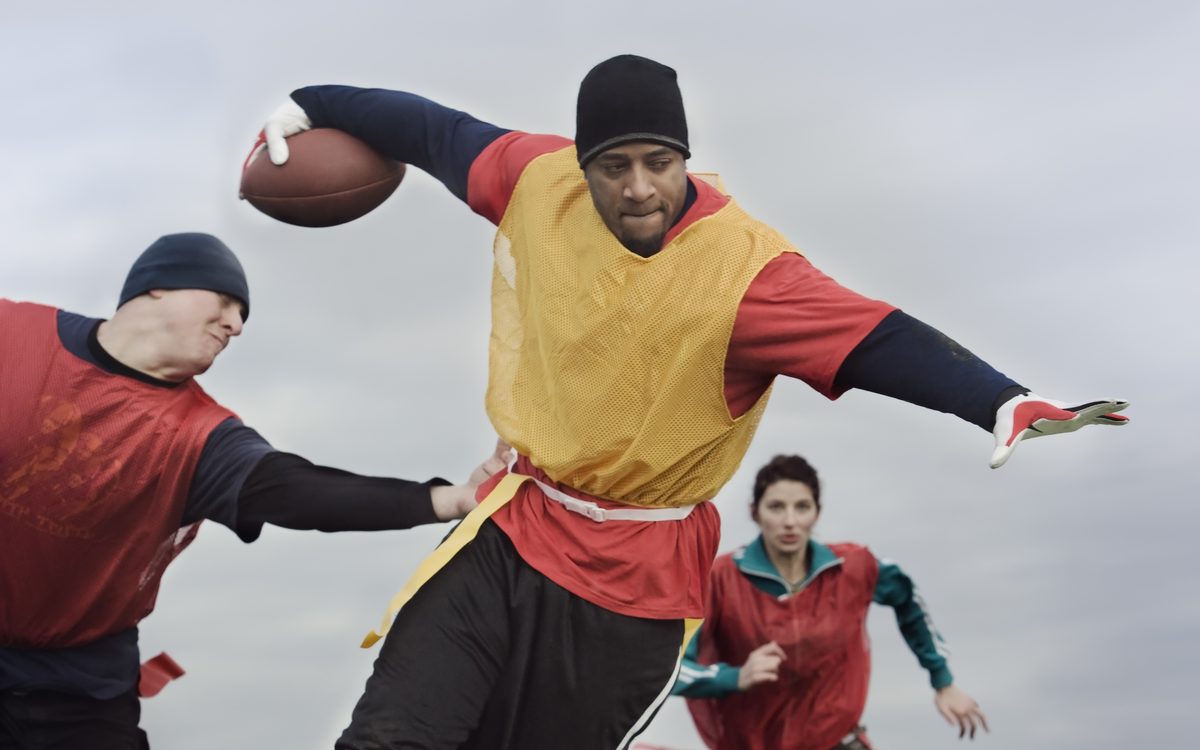
Down by a touchdown with the clock running, the quarterback drops back, sees two rushers coming from the 7-yard line and has about two seconds to decide. Meanwhile the defender covering the star receiver has just been beaten on the last play. Mental training for flag football is the practice of preparing your attention, confidence and decisions for moments like these: routines before the snap, a plan for mistakes, clear goals, and teammates who talk. It is mental performance, which is different from mental health, and this page keeps the two apart.
Quick answer: Flag football is fast and open: players decide quickly, mistakes happen every game and the next play starts in seconds. Simple tools, such as a pre-snap routine, a reset after a mistake, small goals and clear communication, are common practice in coaching. We found no flag-specific research on them, and no technique guarantees results. Anxiety, depression, disordered eating or burnout are health matters for a qualified professional. In the US, call or text 988 in a crisis.
For game-day logistics, check your league’s schedule and our rules page. Physical preparation is on training. Hub: flag football. The ideas below are general coaching and sport psychology practice, not flag-specific research.
What flag football asks of your mind
- Fast decisions. With a short rush clock for the quarterback (NFL FLAG lets two defenders rush from a 7-yard line), reads and throws happen quickly.
- Short memory. Games are short, and a dropped ball or a missed flag is followed by another play almost at once.
- Teamwork. Five-on-five means everyone touches the game: route timing, coverage calls and spacing depend on talking.
- Pressure moments. Conversion tries, fourth downs and tournament knockout games.
Confidence and self-talk
Confidence is mostly built by preparation and by how you speak to yourself. Coaches often suggest short, specific phrases such as “eyes up” or “next play” instead of general statements like “don’t mess up.” Keep a list of things you did well in practice. Treat confidence as something that follows good habits, not a feeling you need before you can play.
Focus and a pre-snap routine
A routine is a short, repeatable sequence: breathe, check the situation, name one job, go. Quarterbacks might scan the rush line and their first read. Receivers might name their route and picture the spot where the ball arrives. Defenders might check the receiver’s alignment and the flag belt. The goal is to give attention one place to go. Practice the routine in drills, so it is automatic in games.
Goal setting
Mix result goals (win the tournament) with process goals you control: clean routes, soft hands, pulling flags without lunging, communicating on every snap. Write two or three for the week. Process goals are useful because a bad bounce cannot take them away. Keep them small and review them after games.
Visualization
Mental rehearsal means picturing a play, the route, the catch, the reaction, in as much detail as you can, before practice or a game. Coaches and sport psychologists use it widely. A 1985 study of 59 figure skaters found no imagery effect compared with a control group (Mumford and Hall), so results are mixed, and we found no flag-specific research. Try it as a supplement to practice and not as a substitute.
Pressure, mistakes and setbacks
- Reset ritual. After a mistake, take one breath, say your reset phrase, touch your belt or wristband, and let the play go. Then do your pre-snap routine.
- Name the controllable. You cannot undo the dropped pass. You can choose your next route.
- Review later. Save analysis for the sideline or after the game, not for the next snap.
- Expect nerves. Feeling keyed up before a big game is common. Slow breathing and a familiar warm-up can help you settle.
Decision-making, tactics and teamwork
Because the game is five-on-five, tactics are simple and talk matters. Teams can agree on a small playbook, call coverage out loud, and review what the defence showed. Quarterbacks learn to check down to the open receiver when the rush is close, and defenders learn to read the quarterback’s eyes. Practise decisions under time pressure in drills, and let players make mistakes in practice, where they cost nothing. Positive team talk, such as encouraging a teammate who just dropped a ball, keeps everyone ready for the next play.
Preparing for competition
A tournament calls for steady habits: know your game times, pack in advance, warm up the same way each time, and plan your fuel and fluids. See nutrition and athlete health and recovery. We have no flag-specific game-day logistics page, so use your league’s schedule and rules.
Youth and injury considerations
Children playing flag are often at their first team sport. We did not find flag-specific research on youth mental training. In general, coaches and parents can emphasise effort and fun over winning and let kids try positions. After an injury, time away can be hard: ask a clinician about how to stay part of the team, for example by helping with drills while you heal. See injuries.
Mental health is different from mental performance
Routines and goal setting are performance tools. They are not treatment. Anxiety that will not go away, low mood, panic, thoughts of self-harm, disordered eating or burnout are health matters, and a doctor, therapist or counsellor is the right person. The International Olympic Committee published a consensus statement on mental health in elite athletes in 2026 (British Journal of Sports Medicine), and the Association for Applied Sport Psychology lists resources for finding a qualified professional. In the US, the 988 Suicide and Crisis Lifeline is available by call or text. If you are worried about eating, ANAD has a helpline. We did not find NCAA mental health resources to cite here.
Flag football mental training FAQs
How do I stay calm before a big flag football game?
Use a familiar warm-up, slow breathing and a short pre-snap routine. These are common coaching tools, not guaranteed fixes. Talk to a professional if nerves feel overwhelming.
How do I bounce back after a dropped pass?
Many coaches teach a reset ritual: one breath, a phrase, then focus on the next play. Review the mistake on the sideline later.
Does visualization work?
Athletes and coaches use it widely, but the research is mixed and we found nothing specific to flag football. Treat it as a complement to practice.
What mental skills matter most for quarterbacks?
Quick reads, composure under rush and the habit of checking down. These are coaching ideas rather than research findings.
When should I see a professional about my mental health?
If anxiety, low mood, eating worries or burnout last or interfere with daily life, see a doctor or therapist. In the US, call or text 988 in a crisis.
Sources
- NFL FLAG, flag football rules
- Mumford and Hall, imagery in figure skaters, Can J Appl Sport Sci 1985
- IOC consensus on mental health in elite athletes, Br J Sports Med 2026 (PMID 42580854)
- Association for Applied Sport Psychology, resources
- 988 Suicide and Crisis Lifeline
- ANAD eating disorders helpline
General information for education only, not medical advice. See a sports medicine doctor, physical therapist or athletic trainer about your own situation. How we write and check our pages is in our editorial policy.