
This article contains affiliate links: if you buy through them we may earn a commission, at no extra cost to you. Read our affiliate disclosure.
A new player jogs onto the field for her first game, belt clipped on, and asks the question every beginner asks: “What happens if I get my flag pulled?” The answer is simple. The play ends, and the ball goes back to the huddle. Flag football rules keep that simplicity on purpose. There is no tackling, no blocking and no diving, so almost anyone can start. This guide explains how a game works under NFL FLAG’s youth rules, the basic skills a beginner needs, the levels of play, where rule sets differ, and where to find the official rulebooks. Flag is scheduled to be an Olympic sport in 2028, so many new players are asking.
Quick answer: Flag football is five-on-five, non-contact football. In NFL FLAG leagues the field is 70 by 30 yards, games are two halves of 15 to 25 minutes, and a touchdown is worth 6 points. Pulling the ball carrier’s flag ends the play. Rules vary by league, age group and level, so ask your league for its rulebook before the first game. New players can start with a local league, school team or city recreation program.
This page is about the rules and getting started. For the sport overall, see the flag football hub. Injuries are on our injuries page.
How a flag football game works
According to NFL FLAG’s rules, five players per team are on the field, and a team’s roster can have up to 10 players. The field is 70 yards long and 30 yards wide with two 10-yard end zones. A game has two halves of 15 to 25 minutes, and each team gets one 60-second timeout per half. There is no kickoff. A coin toss decides who gets the ball first, and the offense starts on its own 5-yard line.
The offense has four downs to cross midfield. After that it gets three downs to score a touchdown. The defense stops the play by pulling a flag from the belt of the ball carrier. Because nobody can block, the offense depends on speed, quick throws and route running instead of power.
Scoring
- Touchdown: 6 points.
- Extra point: after a touchdown the team chooses a 1-point try from the 5-yard line or a 2-point try from the 10-yard line.
- Winning: the team with more points at the end of the second half wins. We did not find a single national tie-break rule, so ask your league how it handles tied games.
Rules that make flag different from tackle football
- No contact. NFL FLAG says there is no blocking, screening or tackling. Offensive players need to stay clear of defenders instead of running into them.
- The quarterback cannot run across the line. The quarterback may hand off or pitch backward, and then may catch a forward pass, but may not carry the ball across the line of scrimmage.
- Limited rush. Up to two designated defenders may rush the quarterback, and they start from a 7-yard rush line. That gives the passer time to throw. After a handoff or a backward pass, every defender may rush.
- Equipment is limited. A mouthguard is required, and NFL FLAG says it is the only protective gear players wear. Shorts must not have pockets, and metal cleats are not allowed in most leagues. Gloves are optional.
Beyond these, penalties, the exact flag-guarding rules and overtime differ between leagues. We read the NFL FLAG youth rules page, not every league’s book, so we do not list penalties here. Your league’s rulebook is the final word.
The basic skills a beginner learns
Flag football is built from a handful of skills that you can practice in a park with a friend and a ball.
- Flag pulling. Defenders learn to stay square, get close, and pull the flag without grabbing the player’s clothing or arm. Leagues have their own rules on how flags may be pulled, so coaches teach this first.
- Dodging. Ball carriers use quick feet and body angle to keep defenders off the belt, within their league’s flag-guarding rules.
- Throwing and catching. A quick, accurate short throw matters more than a long one when rushers are close. Receivers learn to catch with their hands away from the body and to turn up the field.
- Routes and spacing. Simple routes such as a slant, an out and a hitch.
- Defense in space. With no blocking, defenders cover receivers one-on-one or in zones and stay between the receiver and the end zone.
Levels, from first league to the Olympics
NFL FLAG says it serves more than 830,000 youth athletes, ages 4 to 17, in over 2,000 leagues across all 50 states. The National Federation of State High School Associations (NFHS) published its first national flag football rules book for the 2025-26 school year, and it counted 68,847 girls playing high school flag football in 2024-25, up 60% in a year. In January 2026 all three NCAA divisions added women’s flag football to the Emerging Sports for Women program, and the NAIA already sponsors it. Check the NCAA’s news page for the current championship status. Adult recreation and coed leagues are common in many cities.
Internationally, the International Federation of American Football (IFAF) governs the game and is recognised by the International Olympic Committee. Flag football is scheduled for the Los Angeles 2028 Olympic Games, with six men’s and six women’s teams of 10 players playing five-on-five, according to NFL.com. We could not confirm the dates, venue or field size on olympics.com, so check the official LA28 pages. Flag football is not a Paralympic sport that we could confirm. The Olympic rules come from IFAF and can differ from the NFL FLAG youth rules above.
How a beginner starts
- Pick a path. Kids can join a youth league (NFL FLAG leagues start young), a school or club team, or a city recreation program. Adults can look for recreation, coed and company leagues.
- Ask for the rules. Ask what rule set the league uses (NFL FLAG, NFHS, IFAF or its own), the game length, roster size and whether it is coed.
- Get the basics. A mouthguard, sneakers or non-metal cleats, shorts without pockets, and a belt from the league. Our gear guide has details.
- Warm up and build up. If you are returning after years away, start gradually. See training and injury prevention.
To practice at home, a flag set and a ball sized for the player are enough. Two options we have seen, based on their listings only: the Franklin Sports flag football set for a five-on-five game and the Wilson NFL Super Grip football in junior size, which Wilson lists for ages 9 to 12. We have not tested either.
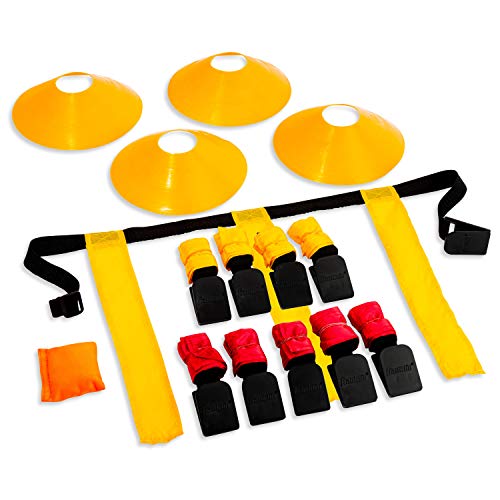
Franklin Sports Flag Football Set (10 Player)
- 10 belts, up to 46 in waist
- 4 cones + field marker
- Carry bag

Wilson NFL Super Grip Football (Junior)
- Junior size, ages 9-12 (maker)
- Composite cover
- Butyl rubber bladder
Where to find the official rules
- NFL FLAG flag football rules, the youth rules summarised above.
- NFHS announcement of its high school flag football rules book, for school teams.
- The International Federation of American Football (IFAF) for international and Olympic rules. We did not read the IFAF flag rulebook for this page.
Related reading: the tackle game’s rules are on the football hub, and similar running-and-throwing field sports include ultimate. Everything is on the sports hub.
Flag football rules FAQs
How many players are on a flag football team?
Five on the field. NFL FLAG rosters can have up to 10 players, and the Olympic teams have 10 players, according to NFL.com. Some leagues play 7-on-7 or 9-on-9 with different rules.
Can the quarterback run in flag football?
Under NFL FLAG rules, the quarterback may not run across the line of scrimmage with the ball. The quarterback can hand off or pitch backward and then catch a forward pass.
How do you score in flag football?
A touchdown is 6 points. Afterward the team can try for 1 point from the 5-yard line or 2 points from the 10-yard line, according to NFL FLAG.
Is there blocking or tackling in flag football?
No. NFL FLAG rules are non-contact, with no blocking, screening or tackling. A play ends when a defender pulls the ball carrier’s flag.
Do I need special equipment to play?
A mouthguard is required in NFL FLAG leagues, along with shorts without pockets and non-metal cleats in most leagues. The league usually provides belts and flags. Check your league’s rules.
Sources
- NFL FLAG, flag football rules
- NFL FLAG, about
- NFHS, first national flag football rules book
- NFHS, 2024-25 participation survey
- NCAA, flag football and championship status
- NFL.com, LA28 flag football and NFL players
General information for education only, not medical advice. See a sports medicine doctor, physical therapist or athletic trainer about your own situation. How we write and check our pages is in our editorial policy.