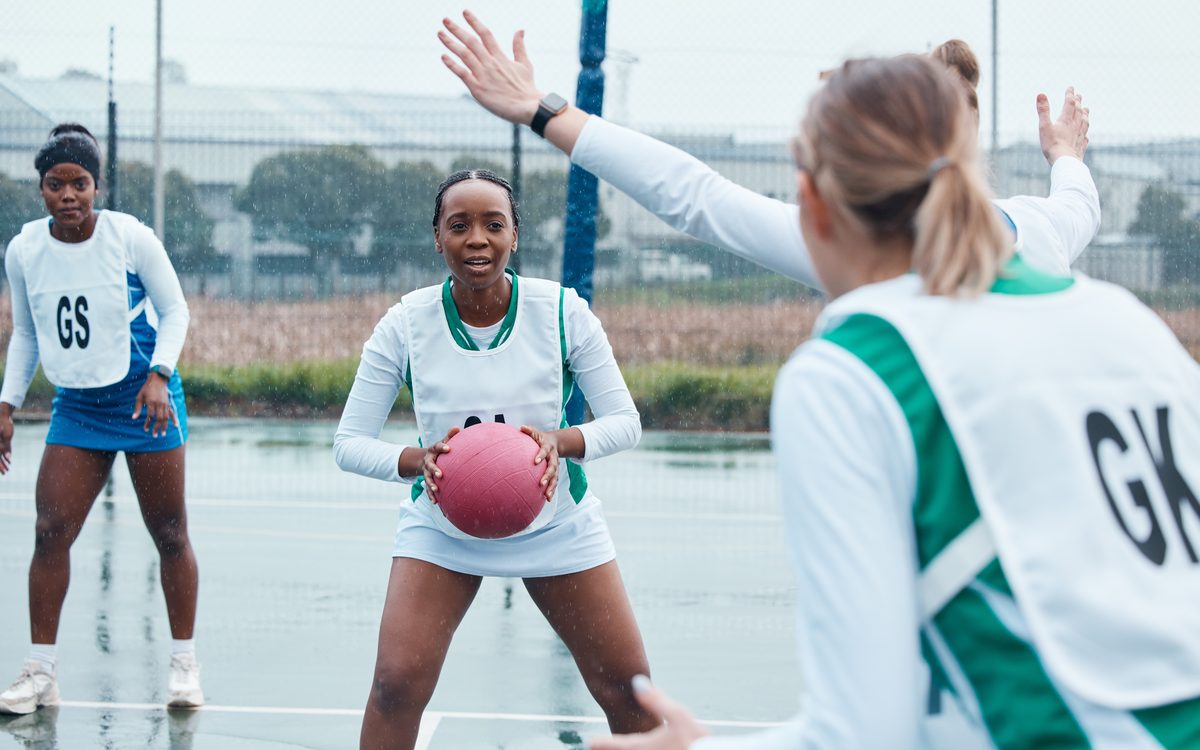
It is the last minute of a close game and a player comes down from an interception, rolls her ankle, and sits up holding it. Within seconds the umpire has stopped play. Netball injuries are mostly injuries to the legs, and in the surveillance studies the ankle and knee come up first. This page puts numbers on that, explains the main injuries in plain language and sets out how rehabilitation works in general. It does not diagnose anything, and it cannot tell you when to return to play.
Quick answer: Studies of netball injuries keep finding the ankle and knee at the top of the list, most often from landings, collisions and falls. Children have more upper-limb injuries such as fractures, adults more ankle and knee sprains and strains. Rehabilitation generally moves from protecting the joint, to restoring movement, to strength, balance and then agility, but timing and return to play must come from the clinician treating you. See a sports medicine doctor, physical therapist or athletic trainer for any injury that is painful, swollen, unstable or not settling, and call emergency services after a head injury with danger signs.
General information, not medical advice. How to lower the risk is on our injury prevention page. For the sport as a whole, see the netball hub.
What the surveillance numbers say
Injury figures vary a lot between studies because they count different things in different groups. Four sources give the range:
- Systematic review. The 2021 review of 46 studies (Downs and colleagues, Sports Medicine – Open) found ankle and knee injuries the most common, with ankle injuries 13% to 84% of injuries and knee injuries 8% to 50% depending on the study. Only 26% of the studies used qualified health professionals to collect data at the court, and definitions of injury differed, so the numbers are rough guides.
- Professional players. Surveillance of 119 Suncorp Super Netball players over three seasons (Toohey and colleagues, Journal of Science and Medicine in Sport, 2022) recorded 866 medical-attention injuries and 393 time-loss injuries. The ankle accounted for 20.9% of injuries, the knee 15.7% and the foot 11.3%. Knee joint injuries were the most burdensome in-season, ankle tendon injuries before the season.
- Youth championships. At the 2018 Australian under-17 and under-19 national championships (Smyth and colleagues, 2020), 103 medical-attention injuries in 192 athletes worked out at 89.4 per 1,000 player hours. The most common diagnoses were lateral ankle ligament sprain (13.6%), foot blisters (10.7%) and lower back pain (9.7%). Ankle sprains, ACL ruptures and concussions caused the most time out.
- Community club. A study of 269 players aged 7 to 42 at one Australian club (Franettovich Smith and colleagues, Physical Therapy in Sport, 2020) recorded 169 injuries, 13.8 per 1,000 hours. Sixty percent were in the lower limb, the leading causes were collisions (28%) and awkward landings (27%), and half of the injuries stopped the player from continuing.
Rates are not comparable across these studies, because tournaments, seasons and definitions differ. What is consistent is the pattern: lower limb, landing and collision.
Ankle sprains
The American Academy of Orthopaedic Surgeons (AAOS) says most ankle sprains happen when the foot rolls inward and stretches or tears ligaments on the outer side of the ankle, often in sports with cutting, jumping or quick changes of direction. Risk factors it lists include poor balance, loose ligaments, slippery or unsupportive shoes and a previous sprain. It says to see a medical professional if you have trouble putting weight on the ankle, or if swelling or pain lasts for weeks despite home care, because a severe sprain can look like a broken bone. In a study of 94 club netballers (Attenborough and colleagues, 2017) there were 11 sprains, 1.74 per 1,000 hours of play.
Knee injuries and the ACL
The AAOS says a torn ACL often brings a pop, swelling within about a day and a feeling that the knee gives way, and that female athletes have been reported to have ACL injury rates two to eight times higher than male athletes. Video studies of elite netball (Stuelcken and colleagues, 2016, 16 injuries; Belcher and colleagues, 2024, 21 injuries) found most ACL injuries on landing after jumping for a pass, often with the player off balance. A knee that pops, swells, locks or gives way needs a professional, not another quarter. Treatment can be non-surgical or surgical, and that decision is a conversation with an orthopaedic surgeon about your goals.
Other common injuries
- Foot and lower leg. The foot was the third most common site in the professional study at 11.3% of injuries, and foot blisters were 10.7% of injuries at the youth championships. Good-fitting shoes help; see our gear page.
- Back. Lower back pain was 9.7% of injuries at the youth championships. Back pain that is severe, follows a fall or comes with numbness needs assessment.
- Upper limb. Children have more upper-limb injuries such as fractures, according to the Downs review.
- Muscle strains. The Downs review says adults have more lower-limb sprains and strains, but we did not find a netball-specific breakdown by muscle we could cite with confidence.
Concussion
Concussion is less common than ankle and knee injuries in the studies above but it is serious. The CDC’s HEADS UP programme says to take an athlete out of play at once if concussion is suspected, keep them out of sport until a health care provider clears them, and go to the emergency department if danger signs appear. It also says the return-to-sport decision is medical and not for a coach or parent, and that it is a step-by-step process that typically takes a week or more. Symptoms lasting more than 2 to 4 weeks call for a specialist experienced in brain injuries.
How rehabilitation generally works
We cannot give you a rehab plan or a timeline. What the AAOS pages describe, in general terms, is a sequence:
- Protect and calm it down early. For a sprain, that means resting the joint, using ice, compression and elevation as advised, and sometimes a brace or boot for a short time. Anti-inflammatory medicines are a question for a doctor or pharmacist.
- Restore movement early. Gentle, controlled movement helps prevent stiffness.
- Rebuild strength and balance. Physical therapy progresses from range of motion to strengthening, balance (such as standing on one leg) and later agility work. For the knee, the AAOS highlights quadriceps strength and confidence in the knee.
- Finish the programme. The AAOS says incomplete rehab is a common reason for repeated sprains. In the community study, a previous injury raised the odds of another lower-limb injury about seven-fold.
- Return gradually and by decision of the clinician. Timelines vary with the injury and the person, and a swollen or unstable joint is not ready for full games.
We do not give recovery times: sprains, ligament tears and concussions all vary. See our recovery page for general recovery habits between games, and the training page for load.
When to see a professional
- Emergency now: a head injury with danger signs, neck pain after a fall, numbness, or a joint that looks out of place.
- Soon: trouble putting weight on a joint, a knee that pops or gives way, swelling that returns, pain at rest or at night, or pain that does not settle.
Netball injuries: FAQs
What is the most common injury in netball?
Ankle and knee injuries lead most studies, according to the 2021 systematic review, but the share varies widely: 13% to 84% for the ankle and 8% to 50% for the knee. In Super Netball players, the ankle was 20.9% of injuries and the knee 15.7%.
How do netball players tear their ACL?
In 21 elite cases studied on video, 17 happened on a jump landing, often after jumping for a high pass and landing off balance with the knee nearly straight (Belcher and colleagues, 2024).
Can I play on a sprained ankle?
That is a question for a sports medicine doctor, physical therapist or athletic trainer. The AAOS advises seeing someone if you cannot put weight on the ankle or if pain or swelling lasts for weeks.
Are netball injuries more common in children or adults?
Children have more upper-limb injuries such as fractures, adults more ankle and knee sprains and strains (Downs and colleagues). Rates are not directly comparable between studies.
When can a player return after a concussion?
Only when a health care provider says so, according to the CDC. It is a step-by-step process.
Sources
- Downs et al., Injuries in Netball: A Systematic Review, 2021
- Toohey et al., injuries in professional Australian netball, 2022
- Smyth et al., health problems at the 2018 Australian National Netball Championships, 2020
- Franettovich Smith et al., injury surveillance of a community netball club, 2020
- Attenborough et al., risk factors for ankle sprains in netball, 2017
- Stuelcken et al., ACL injuries in elite netball, 2016
- Belcher et al., 21 ACL injuries in elite netball, 2024
- AAOS OrthoInfo: Sprained Ankle
- AAOS OrthoInfo: ACL Injuries
- CDC HEADS UP: Concussion response
- CDC HEADS UP: Signs and symptoms
General information for education only, not medical advice. It does not replace a visit with a doctor, physical therapist or athletic trainer. See how we write and check our pages in our editorial policy.