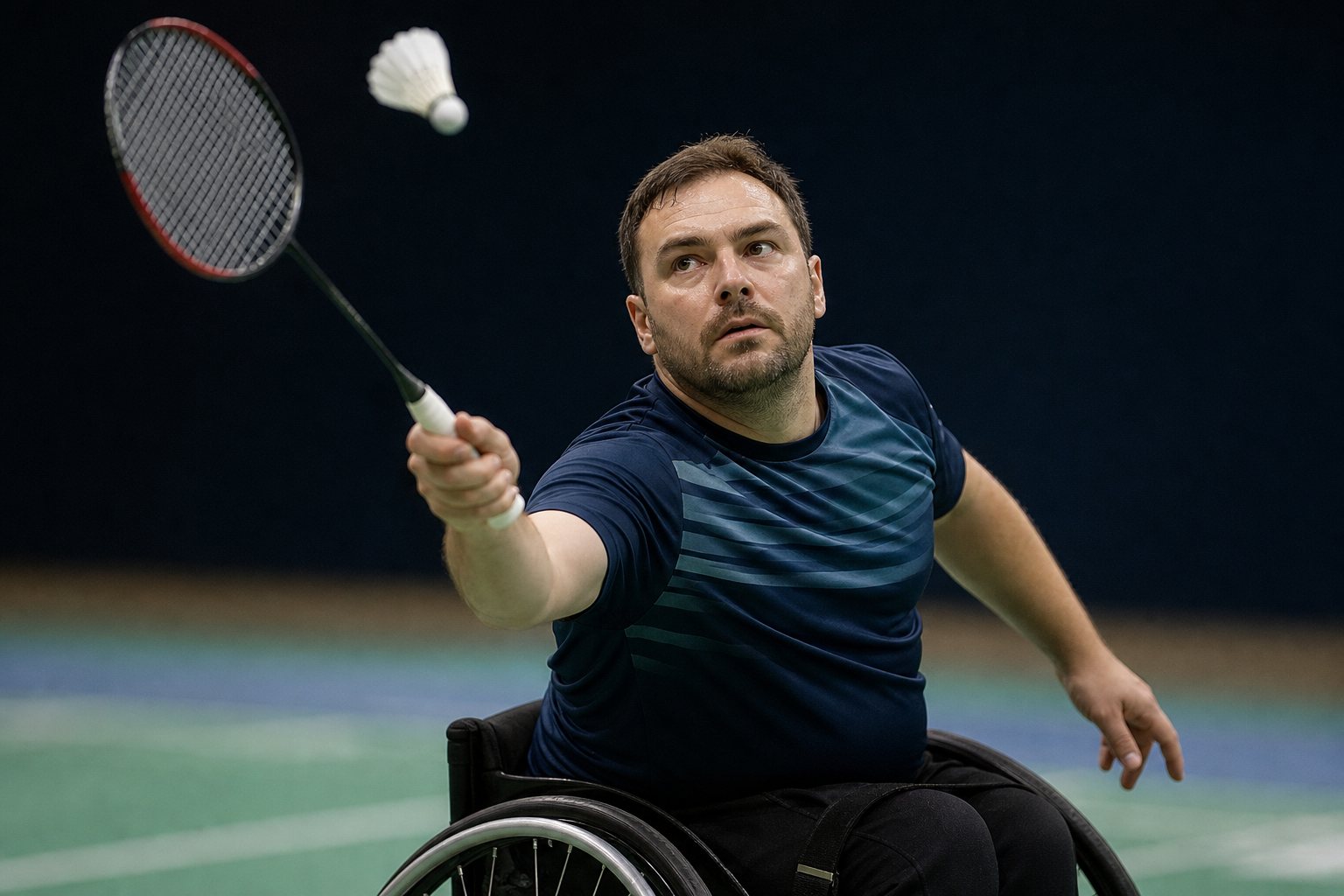
The first time a new player rolls onto a para badminton court, the surprise is how familiar it looks: same net, same lines, same shuttle drifting down from the roof. The differences are small and sensible, a half court here, a strap on a chair there. Para badminton (also written parabadminton) is badminton for athletes with a physical impairment, and this page covers the practical part: how rallies are won, what the rules change, what the six sport classes mean, and how a beginner gets from the sofa to a first session.
Quick answer: Para badminton follows standard badminton scoring: best of three games to 21 points, with a two-point lead needed at 19-all (IPC). Players compete in six classes (WH1, WH2, SL3, SL4, SU5, SH6). Wheelchair singles and standing SL3 singles use half the court. To compete in USA Badminton Para events you must be a member and be classified; to start playing, you only need a racket and a club or adaptive sports program that will have you.
General information, not medical advice. For the parent sport see badminton, and for this sport as a whole start at the para badminton hub.
How a rally and a match work
The rally is the same as in standard badminton: serve diagonally, keep the shuttle in the air, and win the rally when it lands in your opponent’s court or they cannot return it. According to the IPC, a match is the best of three games to 21 points, and at 19-all a player or pair needs a two-point lead. USA Badminton also describes all Para matches as best of three to 21 under standard BWF scoring.
The BWF members approved a new three-games-to-15 system in 2026, due from 4 January 2027 for badminton. We could not confirm from an official source whether it applies to Para badminton or from when, so check the BWF Para regulations before a tournament.
Events are men’s and women’s singles, men’s and women’s doubles and mixed doubles (IPC).
The court and what changes for each class
The court is the standard badminton court, 13.4 m long and 6.1 m wide, with the net at 1.55 m for every class (IPC). What changes is how much of it you use. USA Badminton describes it this way:
- Wheelchair singles: half court.
- Wheelchair doubles: full court.
- Standing singles: half or full court depending on the impairment (the IPC lists SL3 as the standing class on half court).
- Standing doubles: always full court.
- Short stature (SH6): the standard full court for all events.
The six classes in plain words
Classification groups athletes so that they play others with a similar level of activity limitation. The IPC describes the six classes this way, and USA Badminton lists typical examples:
- WH1: wheelchair players who usually have impairment in both legs and in trunk function. USA Badminton gives a spinal injury affecting the trunk as a typical example.
- WH2: wheelchair players with impairment in one or both legs and minimal or no trunk impairment. Multiple sclerosis is one example USA Badminton gives.
- SL3: standing players with impairment in one or both legs and poor balance when moving, for example a single above-knee amputation, two below-knee amputations or cerebral palsy.
- SL4: standing players with a milder leg impairment, for example a single below-knee amputation or hip dysplasia.
- SU5: standing players with an upper-limb impairment, for example an arm amputation or a brachial plexus injury.
- SH6: standing players of short stature, for example achondroplasia.
USA Badminton lists eight eligible impairment types, among them limb loss or deficiency, impaired muscle power, impaired range of movement, limb-length difference, short stature, hypertonia, ataxia and athetosis. These are general descriptions, not the eligibility rules, which the BWF writes and enforces.
Equipment rules that shape play
USA Badminton’s equipment page says standard badminton equipment applies, with these changes for Para play:
- Wheelchair players may be strapped to the chair at the waist, across the thighs or both, and their feet must be fixed to the footrest.
- When striking the shuttle, part of the trunk and the legs must touch the seat.
- A rear supporting wheel is allowed, and the chair may have no electric or other device that helps movement or steering.
- Standing players with an amputation may use a crutch, which must not be longer than their natural armpit-to-ground measurement.
- Prosthetic limbs are allowed in SL3, SL4 and the wheelchair classes, but not in SU5, and must match the length of the existing limb.
Our gear page covers rackets, shuttles and chair set-up questions.
Basic skills a beginner learns first
The shots are the ones every badminton player learns: the serve, the clear, the drop, the smash, the net shot and the drive. Our sources do not rank skills for beginners, so the order below is common coaching practice rather than a research finding.
- Grip and racket control. Most players start with a forehand grip and learn to relax the hand between strokes.
- Serve and return. Rallies begin here, and a reliable serve gives a beginner confidence.
- Movement. Standing players learn footwork to their own balance; wheelchair players learn chair control, turning and braking to reach the shuttle.
- Overhead shots. Clears, drops and smashes come next, built on a good trunk and shoulder position (see our training page).
How a beginner starts
USA Badminton suggests connecting with a local adaptive sports organization that offers badminton, or a local badminton club. You do not need to be classified to play for fun; classification is needed for sanctioned Para tournaments. For those aiming to compete, USA Badminton says training requires planning and a minimum of five days a week with a coach or training group, and it plans to share warm-ups and routines for each class.
Levels run from casual club play to the national circuit, the BWF international circuit and the Paralympic Games. Para badminton debuted at Tokyo 2020, and the IPC lists it among the sports for LA28 in August 2028; check the official programme for the current Games.
How classification works in the United States
According to USA Badminton, a new Para athlete must be a member and be classified by a Para National classifier. For athletes with a physical impairment the page lists three steps:
- Send the National Medical Diagnosis Form to the USA Badminton Classification Manager before attending an evaluation. It identifies the eligible impairment, with supporting documents, and is completed by the athlete’s physician.
- Register for an international event that has a classification panel.
- Attend the evaluation, held one or two days before competition. It includes a physical assessment by a medical classifier, a technical assessment of playing ability, a provisional sport class and observation during competition that confirms or changes it.
Steps change, so confirm them with USA Badminton before you plan.
Official rule and classification links
The BWF Para-Badminton classification and calendar pages and the IPC Classification Code are linked from USA Badminton and are the places to read the current regulations. We list them in the sources below.
Para badminton rules FAQs
Is the net lower for wheelchair players?
No. The net is 1.55 m for every class (IPC).
Do I have to be classified to play?
Not to try the sport or play in a club. USA Badminton says you must be a member and be classified to compete in its Para events.
Can I use a prosthesis or crutch?
Yes in the classes where the rules allow it: prostheses in SL3, SL4 and the wheelchair classes, a crutch for standing players with an amputation, and neither beyond the limits above. SU5 players may not use a prosthesis (USA Badminton).
Is Para badminton scored differently from badminton?
The IPC and USA Badminton describe best of three to 21. A 3×15 system is due in badminton from January 2027; whether it applies to Para badminton is unconfirmed.
Where can I find a program near me?
Start with USA Badminton’s Para pages, your local adaptive sports organization and nearby badminton clubs. Coaching locations were still being listed on the USA Para-Badminton site when we checked.
Sources
- IPC: Para badminton
- IPC: Classification in Para badminton
- USA Badminton: Para athletes overview
- USA Badminton: classifications
- USA Badminton: equipment
- BWF Para-Badminton classification
- BWF Para-Badminton calendar
- IPC Classification Code
- BWF: members approve 3×15 scoring system
- IPC: LA28 initial sport programme
General information for education only, not medical advice. It does not replace a visit with a doctor, physical therapist or athletic trainer. See how we write and check our pages in our editorial policy. More: the sports hub and Para table tennis.