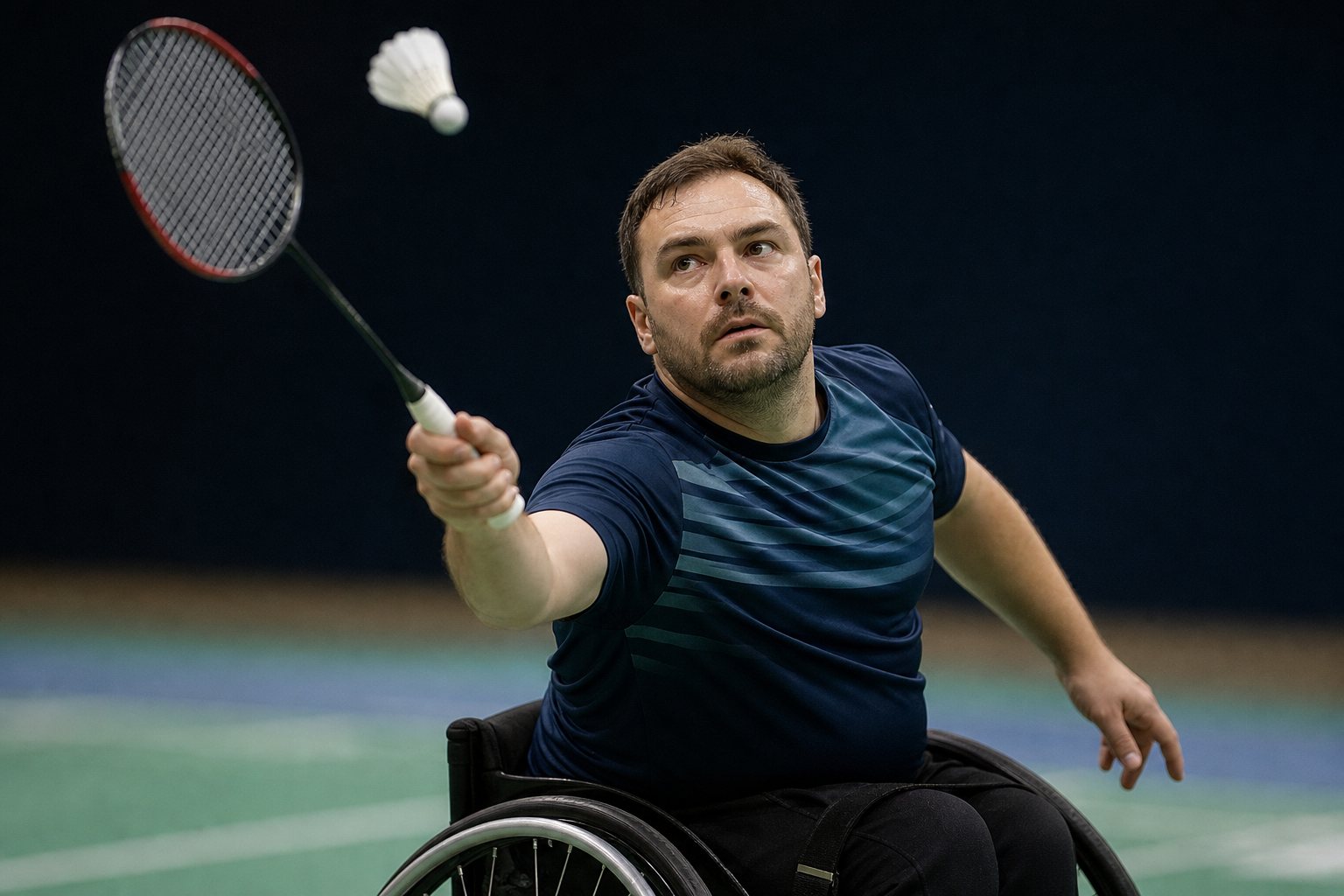
The match ends, the chair is parked, and the shoulders feel as if they have been wrung out. The tempting plan is to grab a gadget and call it recovery. For Para badminton recovery the plan is plainer: sleep, food, a week that alternates hard and easy, and mobility work that suits your body. This page covers those basics and says honestly where the evidence is thin.
Quick answer: The best-supported recovery tools are the unglamorous ones: enough sleep (the CDC recommends at least 7 hours for adults and 8 to 10 for teens), a training load with real rest days and sensible food and fluids. We found no Para badminton study of recovery gadgets, and general evidence for many of them is mixed, so treat them as optional comfort. Soreness that fades in a day or two is expected; pain that persists, swells or changes your stroke should be seen by a sports medicine doctor, physical therapist or athletic trainer.
General information, not medical advice. Training layout is on our training page, fuel and fluids on the nutrition page, and injuries on the injuries page.
Sleep comes first
The CDC says adults need at least 7 hours of sleep a night and teens 8 to 10. We did not find a study of sleep in Para badminton players, and some impairments make sleep harder (pain, spasms, a need to change position). If sleep is a problem, say so to your doctor rather than relying on a product.
Manage the load
Recovery starts before the session ends, in how you plan the week. USA Badminton says competitors should train at least five days a week and that training needs planning. The practical meaning, general coaching practice rather than a finding, is to put a hard session next to an easier one, include at least one full rest day, and give the shoulders a break from overhead work after a heavy block. Since the shoulder complex carried the greatest injury burden in a one-year study of 102 Para athletes, the upper body is the first place to ease off when fatigue builds.
Signs that load is too high are ordinary ones: stroke quality falling off, heavy arms at the start of a session, mood or sleep slipping. If they persist, talk to your coach and your clinician.
Mobility and flexibility
Mobility work helps you move through the range you need for the stroke. For a badminton player, that means shoulders, upper back and trunk, wrists and forearms, hips and ankles, adapted to the impairment: a wheelchair player may focus on chest, shoulder and trunk range, and a standing player on the hips, knees and ankles of both legs or the residual limb and joints around a prosthesis. The Advanced Throwers Ten program, reviewed in a 2026 narrative review of 19 studies in standard badminton, is designed to promote muscular coordination, balance and dynamic stabilization of the shoulder, and the authors say it may support the return from rehabilitation to competition. It was not tested in Para players, so ask a physical therapist before copying it.
Easy movement after play, such as gentle chair pushing or walking, followed by light mobility, is common practice. The research evidence for stretching as a recovery method is not strong enough for us to promise results.
Recovery methods: what we can and cannot say
We found no trial of any recovery method in Para badminton. Our judgement:
- Foam rolling, massage and percussion tools: many athletes use them for comfort; they are optional, and the evidence for faster recovery is limited. Skip a tool on skin without normal feeling or over areas your clinician has told you to avoid.
- Cold water and ice: popular, but we have no Para badminton evidence and cold exposure is not suitable for everyone. Ask your doctor, especially with a spinal cord injury, circulation issues or reduced sensation.
- Compression and heat: people report that they feel good; check skin, circulation and sensation first.
- Wearables: can show sleep and load patterns but do not diagnose anything. Check with the maker whether a model supports wheelchair or prosthesis use.
If you try something new, change one thing at a time and stop if it hurts or the skin reacts.
Heat and fluid after training
A 2024 study of 15 elite athletes with a spinal cord injury found lower sweat rates in athletes with tetraplegia, and six of the 15 were dehydrated before exercise, by a urine measure. That makes cooling down and re-fuelling part of recovery for some players. Our nutrition page covers this.
Soreness versus injury
A general guide, not a diagnosis:
- Likely soreness: achy, tired muscles on both sides or all over, which ease with gentle movement and fade within a day or two.
- See a professional: pain in one spot that is sharp, grows during the stroke or push, wakes you at night, comes with swelling, a pop, instability, numbness or tingling, a new skin sore or a head knock. For athletes with a spinal cord injury at or above T6, a sudden severe headache with a blood-pressure spike can be autonomic dysreflexia, which can be life-threatening (2022 review): use your emergency plan.
Para badminton recovery FAQs
How much rest does a Para badminton player need?
We found no sourced number. Include at least one full rest day, vary hard and easy days and ask your coach and clinician to adjust to your class and impairment.
Do recovery boots, massage guns or ice baths work?
Many athletes use them for comfort, but we found no Para badminton evidence and general evidence is limited. They are optional and not suitable for everyone.
Is stretching enough?
Easy mobility helps movement, but sleep, rest days and fuel matter more. A physical therapist can pick exercises for your body.
How do I know if I am overtraining?
Persisting heavy fatigue, falling stroke quality and mood or sleep changes are signs to ease off and talk to a clinician.
Does sleep affect Para badminton performance?
We found no Para badminton study. The CDC recommends at least 7 hours for adults and 8 to 10 for teens.
Sources
- CDC: sleep
- USA Badminton: Para athletes overview
- Madaleno et al., one-year study of 102 Para athletes, 2025 (PubMed)
- Advanced Throwers Ten program in badminton, narrative review 2026 (PubMed)
- How elite athletes with a spinal cord injury sweat during exercise, 2024 (PubMed)
- Autonomic dysreflexia following spinal cord injury, 2022 (PubMed)
General information for education only, not medical advice. It does not replace a visit with a doctor, physical therapist or athletic trainer. See how we write and check our pages in our editorial policy. Back to the Para badminton hub and the sports hub.