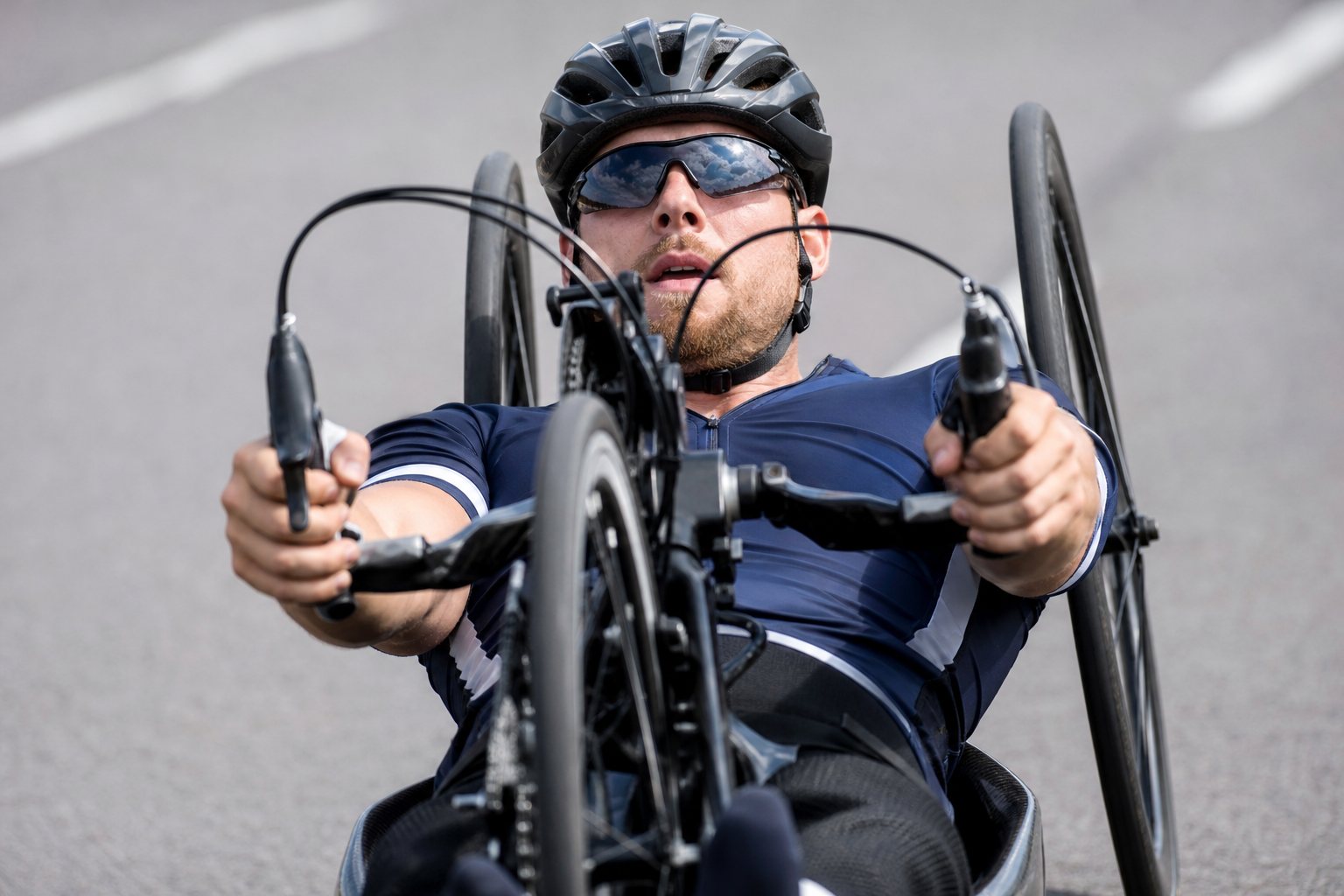
Three hours into a club ride, a tandem pair stops at a cafe. The pilot is starving and the stoker has hardly eaten since breakfast, because she was worried about gaining weight. Nutrition for Para cycling is eating and drinking enough, at the right times, to support training, health and recovery for the way your body works, which can differ in energy needs, sweating and bone health depending on the impairment.
Quick answer: Fuel the ride with enough carbohydrate and fluid, eat enough overall, and ask a sports dietitian who works with Para athletes about your needs. Athletes with spinal cord injury can have lower energy needs yet still under-eat, and may be at risk of low energy availability. Supplements are optional, a few have good evidence, and any you use should be third-party tested for banned substances.
General information, not medical advice or a diet plan. Sport overview: Para cycling. Related: training, recovery, standard cycling nutrition.
Fuel for riding
The joint position of the Academy of Nutrition and Dietetics, Dietitians of Canada and the American College of Sports Medicine (2016) says that performance is supported by food, fluids and supplements chosen to match the sport and the person, and a summary of the paper gives carbohydrate recommendations in a range of 3 to 10 g per kg of body weight per day, depending on training load, and about 30 to 60 g an hour during exercise that lasts longer than about an hour. These figures were written for athletes generally; for Para athletes the 2025 review in Frontiers in Nutrition says there is a dearth of studies, so the numbers are a starting point to adjust with a dietitian. Practical general habits: eat a meal with carbohydrate and some protein a few hours before long rides, take food and drink on rides over an hour, and eat again after hard sessions.
Energy needs differ
Energy needs vary by impairment. A 2018 review in Nutrients (Figel and colleagues) found that athletes with spinal cord injury usually need less energy than able-bodied athletes, yet many still eat too little: intakes among male Para athletes ranged widely, from 23 to 64 kcal per kg per day, and food records often under-report intake. The review concluded that these athletes may be at increased risk of low energy availability, although direct research is lacking. A 2025 Frontiers in Nutrition review of Paralympic athletes notes that more than half of Para athletes have low bone mineral density.
RED-S awareness
Relative energy deficiency in sport (RED-S, or REDs) is a state of low energy availability that can affect bone, hormones, immunity, metabolism, mood and performance. The IOC’s 2023 consensus statement (PMID 37752011) covers female and male athletes and stresses education and avoiding an emphasis on weight and leanness. Warning signs include losing weight unintentionally, frequent illness or injury, constant fatigue, missed or absent periods in women, stress fractures and preoccupation with food. If you notice them, talk to a doctor or a sports dietitian. If disordered eating is a concern, see the section on mental health on our mental training page. We did not find Para-cycling-specific RED-S rates, so we give none.
Hydration, heat and spinal cord injury
Athletes with spinal cord injury can have impaired sweating and heat loss, depending on the lesion, according to a 2024 study of elite athletes and to cooling research in athletes with tetraplegia. That can make heat harder to manage even when sweat loss is lower. Practical steps: ride in cooler parts of the day, drink regularly on rides, use shade and cooling as agreed with your clinician, and do not rely on thirst alone. If bladder management limits what you can drink, ask your doctor or dietitian how to plan. A drink mix with sodium can help on long, hot rides; the label tells you what is in it.
Supplements
Supplements are not required, and food comes first. The IOC’s 2018 consensus statement on dietary supplements says that only a few products have good evidence of benefit, such as caffeine, creatine, buffering agents and nitrate, that performance supplements should be trialled in training before competition, that expert advice is strongly advised, and that accidental intake of banned substances is a known risk. Our rules at athleterx:
- Talk first. See a doctor or sports dietitian, especially with a spinal cord injury, a heart or blood pressure condition, a kidney problem, medicines, or pregnancy.
- Third-party testing. Look for NSF Certified for Sport or Informed Sport on the product. Testing lowers the risk but cannot remove it.
- Banned substances. If you compete under anti-doping rules, you are responsible for what you take. Check the WADA Prohibited List and your federation’s anti-doping body. The IPC also bans deliberately inducing autonomic dysreflexia (“boosting”).
- Caffeine. Not for everyone (sensitivity, heart conditions, pregnancy, and it can affect sleep and bladder symptoms); read the amount on the label.
- No dosage advice here. Follow the label and professional advice.
Cautions
Heat illness is serious. Comments about body weight can be harmful in any sport; focus on fuelling, not leanness. If you tire easily, lose weight without trying, or have skin problems that do not heal, see a doctor.
Para cycling nutrition FAQs
What should I eat before a ride?
A meal with carbohydrate and some protein a few hours before, and a small carbohydrate snack in the last hour if it suits you. A dietitian can tailor it.
Do I need sports drinks?
For rides over about an hour or in the heat, a drink with carbohydrate and sodium can help. Water is fine for short, easy rides.
Are supplements safe for Para athletes?
Some are well studied; none are risk-free, and research in Para athletes is limited. Ask a doctor or dietitian and choose third-party tested products.
Do athletes with spinal cord injury need fewer calories?
Often yes, but under-eating is common, so work with a sports dietitian.
What is RED-S?
Relative energy deficiency in sport: not eating enough for the energy you use, with effects on health and performance. See a professional if you suspect it.
Sources
- Figel et al. 2018, Energy and nutrient issues in athletes with spinal cord injury (Nutrients)
- Frontiers in Nutrition 2025: nutrition for Paralympic athletes (review)
- Academy of Nutrition and Dietetics, Dietitians of Canada, ACSM: Nutrition and Athletic Performance, 2016 (PMID 26891166)
- IOC consensus statement: dietary supplements and the high-performance athlete (PMID 29540367)
- IOC consensus statement on REDs, 2023 (PMID 37752011)
- Sweat and thermal responses in athletes with SCI (PMID 38535744)
- IPC ban on boosting (PMID 41082173)
This page is general information for education only, not medical advice. See our editorial policy. More: all sports.