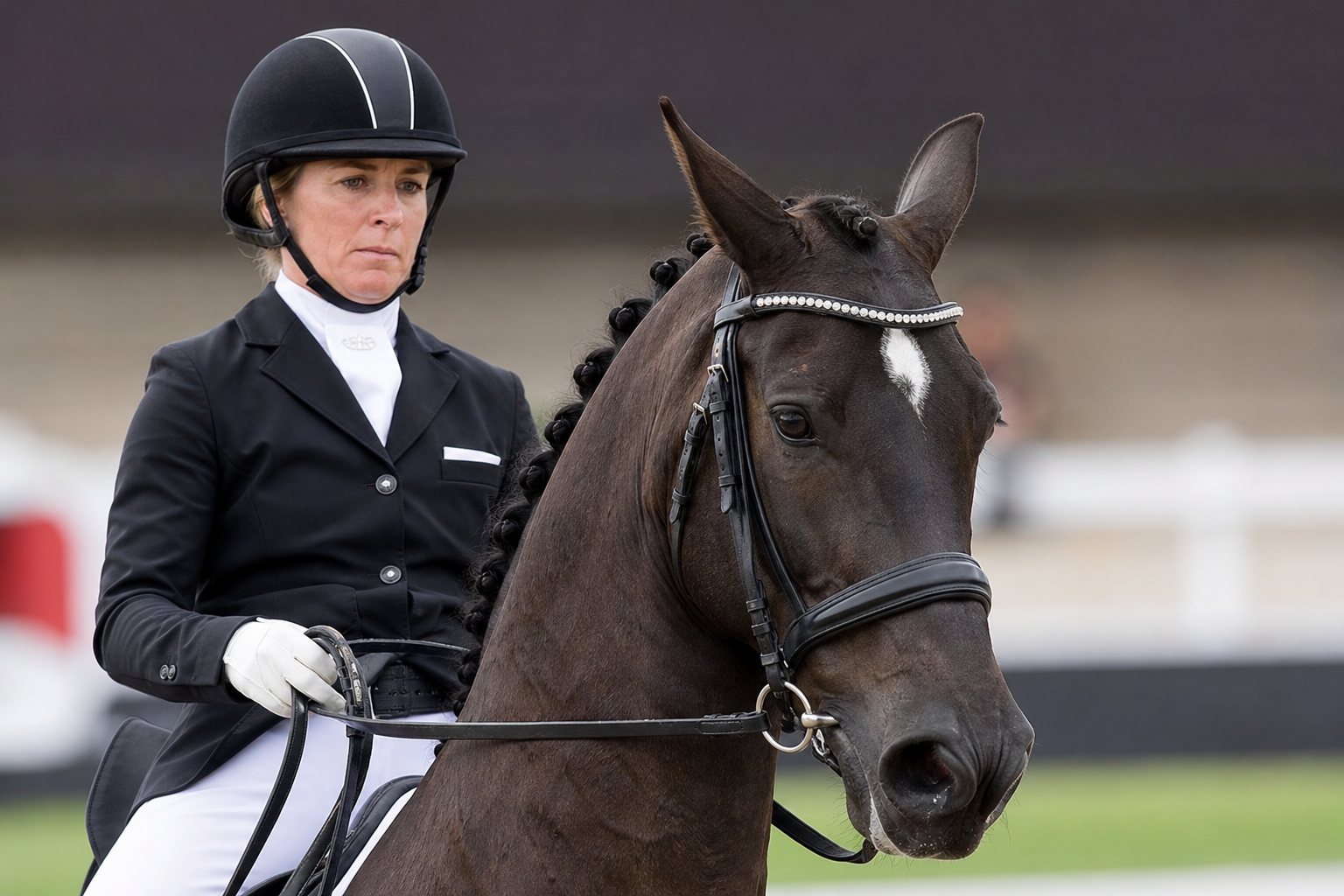
At the end of a good lesson the rider’s face is calm, the horse is soft, and the rider’s legs are shaking. Riding well looks quiet from the rail, but it asks for constant small adjustments of balance, timing and breathing. Para dressage training adds a second layer: working with an impairment, with classification limits, and with a horse who is a full partner in every session. This page covers what the sport demands, a sensible weekly shape, off-horse work and how a season can be planned. Rules and classification are on our rules page, and the overview is on the para equestrian hub.
Quick answer: Most of the training is time in the saddle with a coach, plus off-horse core, balance and endurance work built around your impairment. A small German study of 11 young para riders found riding mostly in the aerobic range, and riders who did more complementary training reported lower effort on the same task. These are not universal prescriptions. See a physical therapist or sports medicine doctor who understands your impairment before changing your load.
What para dressage asks of the body
Riders have to keep the pelvis and trunk following the horse’s movement while the hands stay steady and the aids stay clear. In a study by von Lewinski and colleagues in The Veterinary Journal (2013), riders’ heart rates rose from about 91 to about 150 beats per minute in a public performance, more than their horses’, which suggests nerves add to physical effort. That study had six horse-rider pairs and was not about para riders, so treat it as a clue and not a rule.
For para riders there is some direct data. A 2025 exploratory study in the International Journal of Sports Physiology and Performance followed 11 athletes from the German national youth squad and talent pool, using a standard 40-minute training session at the start and end of the 2023 season. Athletes were mostly in the aerobic range: the highest blood lactate averaged 4.14 mmol/L at the first test and 5.91 mmol/L at the second, heart rate climbed as more gaits were ridden, and those who noticeably increased their complementary training (such as endurance and strength training) rated the same riding task as less hard by the end of the season. It is a small, exploratory study without a control group, so it shows a pattern worth discussing with your coach, not proof that a program works.
Age matters too. Two analyses of the Paris 2024 Paralympic Games, published in Frontiers in Sports and Active Living, found para equestrian to have the highest median age of the 13 individual disciplines studied, at 38 years, with para swimming at 25 years. Riders often compete for many years, so durable habits count for more than short bursts of effort.
A sensible weekly shape
The following is general coaching practice, not a prescription from a study, and every rider’s plan depends on classification, health and horse access.
- Two to five mounted sessions with the horse, varying between schooling, test practice and easy hacking or walking. Hard sessions for the horse and rider should not all fall on the same days.
- Two short off-horse sessions for core, balance and the muscles you rely on to stay symmetrical.
- One easy aerobic session that suits your impairment (for example, hand cycling, swimming or brisk wheeling or walking), if your clinician agrees.
- At least one rest day, because tired riders lose balance and make poorer decisions with the horse.
For a general baseline for adults, the CDC advises 150 minutes of moderate activity or 75 minutes of vigorous activity a week plus muscle strengthening on at least two days.
Skills and mounted work
Work on one skill at a time: a steady rhythm in each gait, accurate transitions, straightness and a consistent contact. Your coach may suggest riding without stirrups or with lunge help where your classification and safety allow. Learn the test from memory and ride it in sections, because errors of course are scored. If you use a commander at shows, practise with the same commander, who is permitted to read each movement once or twice from the official text under FEI rules. If you have a visual impairment, a caller may call only the letters.
Symmetry is a lifelong project. In a 2022 study in Animals, Baragli and colleagues measured stirrup force in 147 riders and found 99.3% pushed asymmetrically in sitting trot, so crookedness is normal. Video and regular lessons with a coach who knows para riding help you see it.
Strength, mobility and conditioning
Off-horse work should serve the seat. Common choices are:
- trunk stability work (such as a supported dead bug, bird dog or side plank, adapted as needed);
- balance work, seated or standing, matched to your function;
- upper-body strength for the reins and for transfers;
- hip and hamstring mobility within the range you have;
- light endurance work.
A 2025 study of 75 people aged 15 to 30 found sport riders had better core stability than recreational riders, and non-riders had the lowest, which is consistent with riding itself building the trunk (Skwierawska and colleagues, Folia Medica Cracoviensia). Weeks and colleagues (Journal of Sports Medicine and Physical Fitness, 2024) found that nine equestrians with chronic low back pain all improved pain and riding function after an eight-week exercise program, though the group was small and had no control group. Ask a physical therapist to tailor exercises to your impairment, spasticity or fatigue.
Periodisation basics
Periodisation just means planning harder and easier periods on purpose. For a rider, a simple year may have a base period (more fitness and schooling, fewer shows), a build period before the main competitions, a short peak around the target event and an easier break afterward. This is a general coaching structure, and the FEI’s calendar of CPEDIs and championships will set your peaks. Watch the horse as well as yourself: the FEI Code of Conduct for the Welfare of the Horse says the frequency of competitions and other risk factors should be examined, so a heavy show schedule affects both partners.
When to adjust or stop
Back off and talk to a clinician when pain is sharp, shows up at rest, or changes how you ride, or when fatigue, spasms or dizziness are new. If you have a spinal cord injury, learn the warning signs of autonomic dysreflexia and heat strain with your doctor, and read injury prevention for more.
Para equestrian training FAQs
How many days a week should I ride?
There is no single number. General coaching practice is two to five mounted sessions depending on your horse, health and goals, with at least one rest day. Ask your coach and clinician.
Do para dressage riders need to do cardio?
Studies of riding show moderate heart rates, and the German study above found that more endurance and strength work went with less perceived effort. The CDC’s general adult activity guidelines are a baseline to discuss with your clinician.
What is the best exercise for riders?
No single exercise is proven best. Core stability and balance work are common choices, and evidence that sport riders have better core stability than non-riders supports building the trunk.
Does riding without stirrups help?
It is a common coaching tool for seat and balance, but we did not find a study that tests it in para riders, and it may not suit every impairment. Ask your classifier and coach.
How should I plan the year around shows?
Work backward from the main event. Plan a build period, a short taper and an easy break, and check the FEI calendar and your national federation for dates.
Sources
- Complementary training and metabolic load in para equestrian youth squad athletes, Int J Sports Physiol Perform 2025 (PubMed 41468194)
- von Lewinski M et al., Vet J 2013 (PubMed 23380228)
- Age distributions in Paralympic Games Paris 2024, Front Sports Act Living (PubMed 41660058)
- Baragli P et al., Animals 2022 (PubMed 36496885)
- Skwierawska Z et al., Folia Med Cracov 2025 (PubMed 41404685)
- Weeks RA et al., J Sports Med Phys Fitness 2024 (PubMed 39017581)
- CDC, Adult activity guidelines
- FEI Para Dressage Rules 2026
General information for education only, not medical advice or a training plan for your impairment. Please see a sports medicine doctor, physical therapist or athletic trainer before changing your program. How we write our pages is in our editorial policy. Related: injury prevention, recovery, the para equestrian hub and horseback riding.