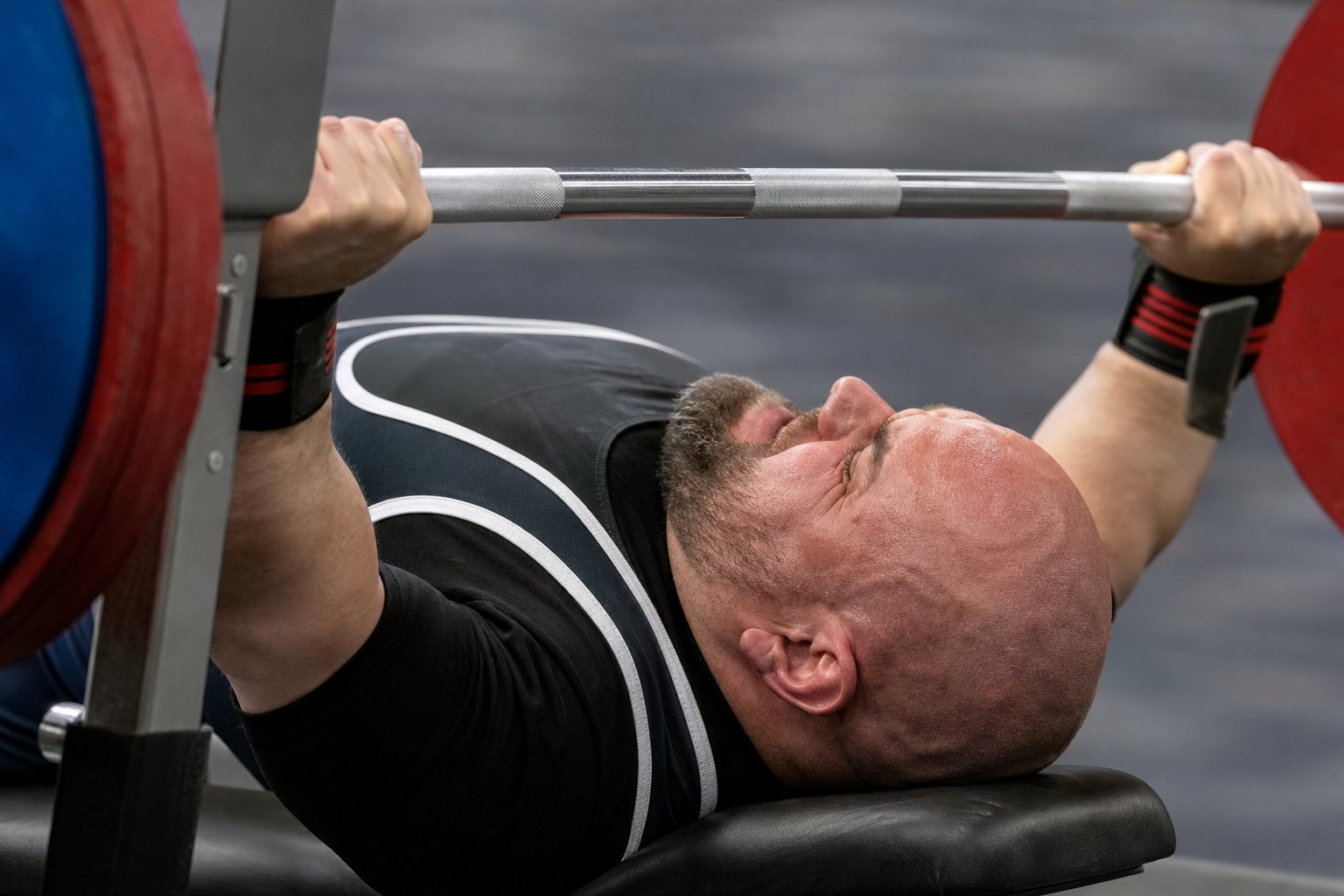
A lifter finishes a long week: bench sessions, wheelchair transfers, a school or work day on the arms. By Friday the front of one shoulder aches every time the bar leaves the rack, and it is easy to push through it. Para powerlifting injury prevention means the habits around the bench, warming up, building load slowly, balancing the strength work, and speaking up about pain, that aim to lower the chance of an injury. They lower the odds; they cannot promise anything.
Quick answer: The shoulder is the key joint to protect: at the Rio 2016 Paralympics 45.5 percent of powerlifting injuries were to the shoulder, and most injuries across two Games were overuse. The best-supported habits are a warm-up, gradual load increases, enough rest and sleep, and a clinician who knows your impairment. Para-specific prevention trials do not exist yet. See a sports medicine doctor, physical therapist or athletic trainer if pain stays in one spot, shows up at rest or at night, or comes with numbness, swelling or weakness, and get urgent help for a head injury with danger signs or for a sudden pounding headache with a very high blood pressure reading.
General information, not medical advice. This page is about lowering risk. What the injuries are and how they are managed is on our Para powerlifting injuries page. Start at the hub.
Why prevention matters in this sport
Willick and colleagues followed 163 powerlifters at the London 2012 Paralympics and recorded 38 injuries, a rate of 33.3 per 1,000 athlete-days, with 61 percent chronic overuse. At Rio 2016 (Ayala and colleagues, 1,410 athlete-days) the rate was 15.6 per 1,000 athlete-days, 63.6 percent were overuse and the oldest group, aged 35 to 75, had the highest rate. The Rio authors wrote that the results support the need to develop injury prevention protocols in this high-risk Para sport. The two studies used different methods, so the rates should not be compared directly.
Warm-up
We did not find a tested injury-prevention warm-up programme for Para powerlifters. Puce and colleagues’ 2022 scoping review found only two studies on warm-up strategies in Paralympic powerlifting. A 2026 cross-sectional survey of 86 South African Para-athletes found that skipping the warm-up was associated with higher injury odds (odds ratio 3.2), while strength training was associated with lower odds; it was not a powerlifting-only study and relied on self-report. A typical warm-up, general practice and not from a Para source, is a few minutes of easy arm movement, shoulder mobility and band work, then light bench sets that build toward the first heavy attempt.
Technique and setup
Consistency is the aim. Practise the same positioning on the bench, the same grip and the same bar path each session, and film sets from the side for your coach. A bar that drifts, or a rushed re-rack, adds stress to the shoulder and can fail a lift: at Paris 2024 an insufficient pause cost American lifter Bobby Body’s third attempt, per Team USA. How you secure your legs and body is governed by the rulebook and your classification, so confirm it with your coach and the official rules, not a website.
Progress the load gradually
We found no sourced percentage rule for Para powerlifting, so none is given here. What the data do show: in a 50-week study of 61 Brazilian Para athletes from swimming, athletics, powerlifting and taekwondo (Madaleno and colleagues, BMJ Open Sport & Exercise Medicine), high stress levels were associated with 1.73 times the odds of a gradual-onset injury the next week, and high fatigue with 1.99 times the odds of a substantial gradual-onset injury. Those are associations, not proof of cause, but they support tracking how stressed and tired you feel, not only the weight on the bar. A simple log of top sets, sleep and shoulder comfort is general practice that makes this easy.
Strength and conditioning
Because the bench loads the chest, front shoulder and triceps, many coaches balance it with upper-back rowing and pulling work and shoulder-stabiliser exercises. That is common practice, not a tested Para programme. If you push a wheelchair or transfer with your arms, count that as part of your shoulder load and ask your clinician how to share it across the week.
Environment, health conditions and equipment
- Heat. Paralympic.org’s nutrition tips note that athletes with spinal cord injury sweat less and are more prone to rising core temperature, so hot rooms and sauna weight cuts need care.
- Autonomic dysreflexia. Balik and Sulla (2022) describe it as a potentially life-threatening condition after spinal cord injury at or above T6, with a sudden rise in blood pressure; the IPC bans deliberately inducing it (“boosting”). Know your warning signs and emergency plan.
- Skin and positioning. General practice, not from our sources: check pressure points after a session if you have reduced sensation.
- Equipment and spotters. At recognised competitions bars, benches and plates must come from World Para Powerlifting approved suppliers. In training, use a stable bench, catchers or safety arms, and trained spotters; never lift heavy alone (general practice).
Any head knock, for example from a fall during a transfer, calls for the CDC HEADS UP steps: remove the athlete from activity, have a healthcare provider assess, and do not return until a provider says so.
What prevention cannot do
No routine removes injury risk, and the evidence base here is thin; the Silverthorne 2025 review of 218 studies calls for more research. Youth-specific Para powerlifting prevention guidance was not found. Gear and setup details are on our gear page; planning is on the training page.
Frequently asked questions
Which body part is hurt most in Para powerlifting?
At London 2012 the shoulder and clavicle accounted for 32 percent of injuries, and at Rio 2016 the shoulder accounted for 45.5 percent.
Does a warm-up really matter?
A 2026 survey of 86 South African Para-athletes linked skipping it to higher injury odds, but no warm-up has been tested specifically in Para powerlifters.
Should I lift through shoulder pain?
Pain that stays in one spot, wakes you at night or limits your lifts should be looked at by a sports medicine doctor or physical therapist. Do not guess.
Is overtraining a risk?
Overuse made up 61 to 64 percent of injuries at two Paralympic Games. In a 50-week study high fatigue and high stress were linked to more gradual-onset injury.
Who can help me build a plan?
A physical therapist or athletic trainer who works with Para athletes, together with a coach who knows the rules.
Sources
- Willick et al. 2016, injuries in Paralympic powerlifting at London 2012 (Scand J Med Sci Sports, DOI 10.1111/sms.12554)
- Ayala et al. 2019, injury epidemiology in powerlifting at Rio 2016 (Translational Sports Medicine)
- Puce et al. 2022 scoping review (PMID 36421643)
- Kunene 2026, injury profile of South African Para-athletes
- Madaleno et al. 2026, daily stress, sleep, fatigue and soreness in Para athletes, 50 weeks (BMJ Open Sport Exerc Med)
- Madaleno et al. 2025, burden of injuries and illnesses in 102 Para athletes (PMID 40848418)
- Paralympic.org: Elizabeth Broad, five nutrition tips for powerlifters (2014)
- Balik and Sulla 2022, autonomic dysreflexia after spinal cord injury (PMID 36120615)
- Hodgkiss et al. 2026, electroceuticals and boosting (PMID 41082173)
- CDC HEADS UP: respond to a concussion
- Paralympic.org: World Para Powerlifting rules
- Silverthorne et al. 2025 scoping review (PMID 40924269)
- Team USA: Para powerlifters at Paris 2024
General information for education only, not medical advice. It does not replace a sports medicine doctor, physical therapist, athletic trainer or your classifier. See how we research our pages in our editorial policy. Back to the Para powerlifting hub, the sports index and the standard sport’s powerlifting guide.