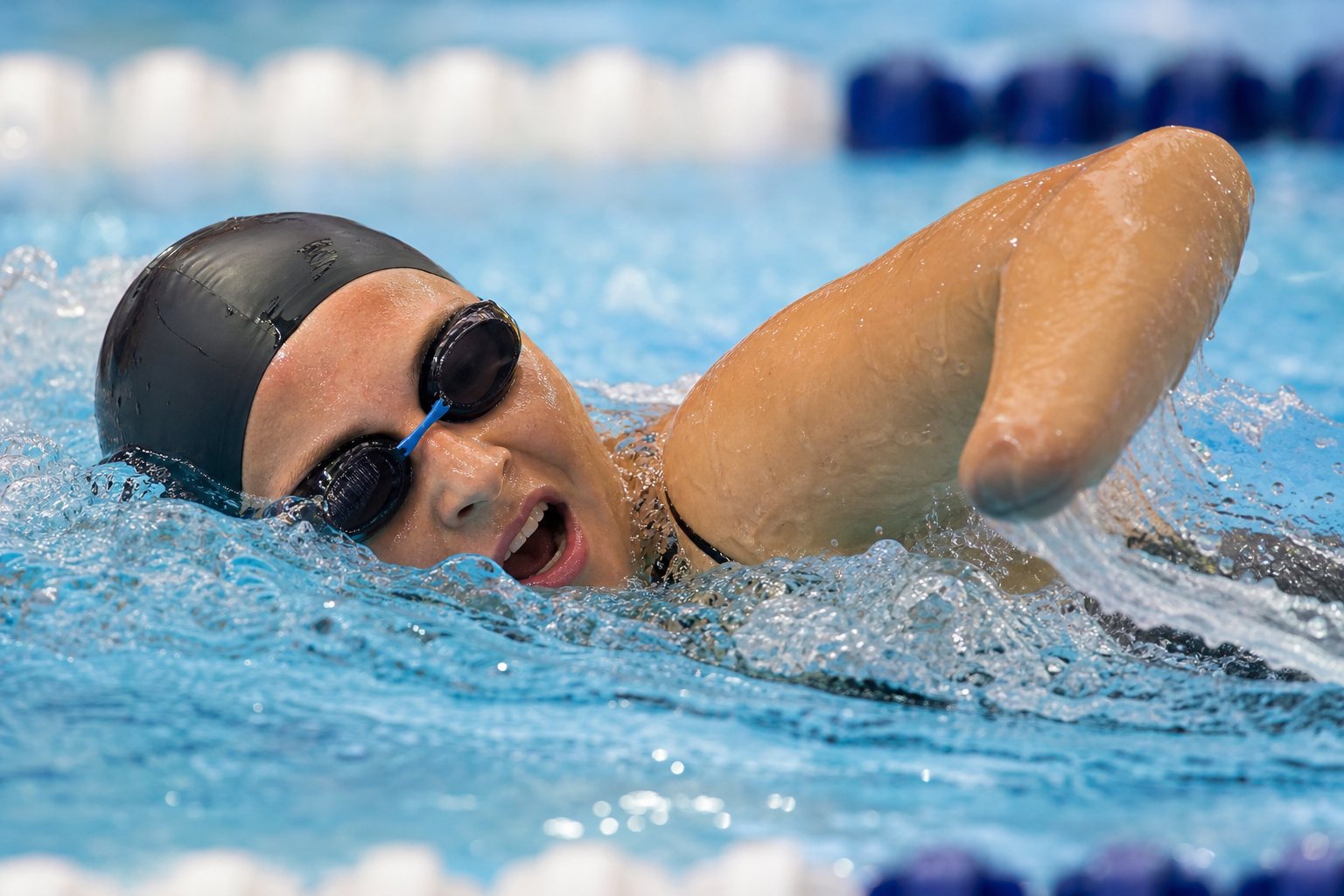
The deck is wet, the next heat is called, and a swimmer who starts from a seated position is being helped onto the edge by a teammate while her coach watches the water, not her shoulders. Para swimming injury prevention is the set of habits around that swimmer, a warm-up, a sensible training load, shoulder care, safe entries and exits, heat awareness and honest reporting of pain, that aim to lower the chance of getting hurt. They lower the odds. They cannot promise anything.
Quick answer: The best-supported focus for Para swimmers is the shoulder: warm up, build volume gradually, keep the shoulder girdle strong and balanced, and report pain early. Research on Para athletes is small and mostly observational, so treat these as sensible habits, not guarantees. See a sports medicine doctor, physical therapist or athletic trainer if shoulder pain lasts, shows up at rest or at night, or changes your stroke, and call emergency services after a head injury with danger signs.
General information, not medical advice. What each injury looks like is on our Para swimming injuries page, so we do not repeat it here.
Warm up before the first lap
We did not find a published injury-prevention warm-up program tested in Para swimmers. The American Academy of Orthopaedic Surgeons’ OrthoInfo page on swimming injury prevention advises a 5 to 10 minute warm-up and strengthening the shoulder and upper back, which is general advice for all swimmers. A typical approach (general coaching practice) is easy swimming, then drills, then a few fast efforts, with dry-land shoulder and trunk activation first if the swimmer has one. Allow extra time for transfers and dressing so the warm-up is not squeezed.
Technique and the shoulder
The shoulder is the main place to protect. In a one-year study of 102 Brazilian Para athletes across swimming, athletics, powerlifting and taekwondo (Madaleno and colleagues, Brazilian Journal of Physical Therapy 2025), injuries to the shoulder complex had the greatest burden, followed by the ankle and the knee. A 2026 ultrasound study (Pozarowszczyk-Kuczko and colleagues) of 43 elite Polish Para swimmers (classes S7 to S10, lower-limb impairments) compared 22 swimmers who had rotator cuff tendinopathy with 21 who did not and found different tendon thickness and structure. It was a snapshot, not a test of prevention. Technique work, with a coach who understands the swimmer’s body roll and pull, is a common way to spread load; a 2025 study (Lee and colleagues) showed that body roll differs in swimmers with central motor impairments.
Training load: build slowly, watch the signs
The IOC consensus on load in sport (Soligard and colleagues, 2016) says rapid increases in training load are linked with more injuries and gradual build-up is protective. In the Brazilian Para athlete cohort, Resende and colleagues (2025) found Para swimmers had lower odds of both gradual-onset (OR 0.65) and sudden-onset injuries (OR 0.52) and less time loss than Para athletics athletes, which suggests swimming is not the highest-risk Para sport in that group. It does not mean swimmers are safe. A related 2026 study of 61 athletes (Madaleno and colleagues) linked high self-reported stress with higher odds of a gradual-onset injury the following week and high fatigue with substantial gradual-onset injury. Simple weekly scores for stress, fatigue and soreness are a low-cost way to spot a bad week early. Add paddles and long sets slowly (coaching practice).
Strength and conditioning
In the Mahmoudkhani study (BMC Musculoskeletal Disorders 2026), 53 elite male Para athletes, including Para swimmers, had shoulder-rotator left-right strength differences at or under 15% across sports. The authors read these as adaptations to the sport, not automatic faults. For swimmers in general, a 2025 randomized trial (Healthcare) and a 2023 study of an elastic-band program tested shoulder-strengthening routines, with mixed results for prevention. Our Para swimming training page and the swimming injury-prevention page cover exercise ideas. Ask a physical therapist to pick exercises that match your impairment.
The pool deck, entries and exits
OrthoInfo says never to dive into shallow or murky water and to swim away from the wall after diving. The same page advises not to swim alone and to avoid swimming when tired, cold or overheated. For Para swimmers a few extra points are general practice: keep the deck dry and clear, plan the route and help needed for entering and leaving the water, agree signals with a coach and tapper, and practise your starts with a spotter. The World Para Swimming rulebook allows starts in the water and from a seat, so you do not have to dive. Start the way you can do safely.
Heat, cold and the body’s temperature control
Gatorade Sports Science Institute’s 2024 review (Goosey-Tolfrey and O’Brien) says athletes with spinal cord injury may sweat less and sense temperature poorly below the injury level, so heat illness is a higher risk, and that injuries at T6 or above carry a risk of autonomic dysreflexia, a sudden dangerous rise in blood pressure. A 2022 expert working group paper in the British Journal of Sports Medicine (Hosokawa and colleagues) adapted prehospital heat stroke guidance for Paralympic athletes. Warm pool decks, hot weather and long meets all count. Hydration, cooling and an emergency plan should be set with the swimmer’s doctor. Our Para swimming nutrition page covers fluids.
Equipment and fit
Competition equipment is regulated by the World Para Swimming rulebook, which bans devices that aid speed or buoyancy and prostheses or orthoses during a race. For everyday training, well-fitting goggles, a cap and, if you use them, earplugs matter for comfort; see our Para swimming gear page. We found no published standard that makes any of this injury-proof.
Younger swimmers
We did not find Para-swimming-specific guidance for children in the sources we read. General guidance from the American Academy of Pediatrics (Brenner, 2016) is for 1 to 2 days off a week and about 3 months a year away from a main sport in 1-month blocks; ask your child’s doctor and coach how that fits their situation.
What prevention cannot do
No habit on this page removes the risk. The research is small and observational, and the 2025 Games meta-analysis (Torvaldsson and colleagues) rated the certainty of Paralympic injury evidence as low. A swimmer can do everything right and still get hurt, and an injury is not a failure of effort.
When to see a professional
- Emergency now: a head injury with worsening headache, repeated vomiting, seizure or growing confusion (CDC HEADS UP danger signs), neck pain after a fall, suspected autonomic dysreflexia in a swimmer with a spinal cord injury, new numbness or weakness.
- Soon: shoulder pain that lasts, pain at night or at rest, pain that changes your stroke, a skin sore or red mark that does not settle, or heavy fatigue and low mood for a week or more. A sports medicine doctor, physical therapist or athletic trainer who knows Para sport can help.
Para swimming injury prevention: FAQs
How can Para swimmers prevent shoulder injuries?
The sources point to a warm-up, gradual build-up of load, shoulder and upper-back strength, good technique and reporting pain early. No program has been proven to prevent shoulder injury in Para swimmers.
Is Para swimming a high-injury sport?
In a one-year Brazilian study of four Para sports, Para swimmers had lower odds of injury than Para athletics athletes. It is a small study; shoulder problems are still the main concern.
Do I have to dive?
No. World Para Swimming rules allow starts beside or sitting on the block and starts in the water. Use the start that is safe for you.
Is heat a risk in a pool?
It can be, especially on a warm deck and for swimmers with a spinal cord injury, who may sweat less. Plan cooling and fluids with a doctor.
When should I stop and get checked?
Stop if pain is sharp, lasts after the session, wakes you at night or changes your stroke, or after any head injury. See a sports medicine doctor, physical therapist or athletic trainer.
Sources
- Madaleno et al. 2025, injuries and illnesses in 102 Para athletes, Braz J Phys Ther
- Pozarowszczyk-Kuczko et al. 2026, rotator cuff in Para swimmers, J Clin Med
- Resende et al. 2025, one-year injuries in Para athletes
- Madaleno et al. 2026, stress, sleep, fatigue and injury in Para athletes
- Mahmoudkhani et al. 2026, shoulder strength in Para athletes
- Lee et al. 2025, body roll in Para swimmers
- Soligard et al. 2016, IOC consensus on load in sport
- Torvaldsson et al. 2025, injury and illness at Olympic, Youth Olympic and Paralympic Games, meta-analysis
- AAOS OrthoInfo: swimming injury prevention
- Goosey-Tolfrey and O’Brien 2024, thermoregulatory challenges in Para sport (GSSI Sports Science Exchange 259)
- Hosokawa et al. 2022, exertional heat stroke management for Paralympic athletes, BJSM
- AAP, Brenner 2016
- CDC HEADS UP: signs and symptoms
- World Para Swimming Rules and Regulations, April 2024
General information for education only, not medical advice. It does not replace a visit with a sports medicine doctor, physical therapist or athletic trainer who knows you and your impairment. See how we write and check our pages in our editorial policy, and return to the Para swimming hub.