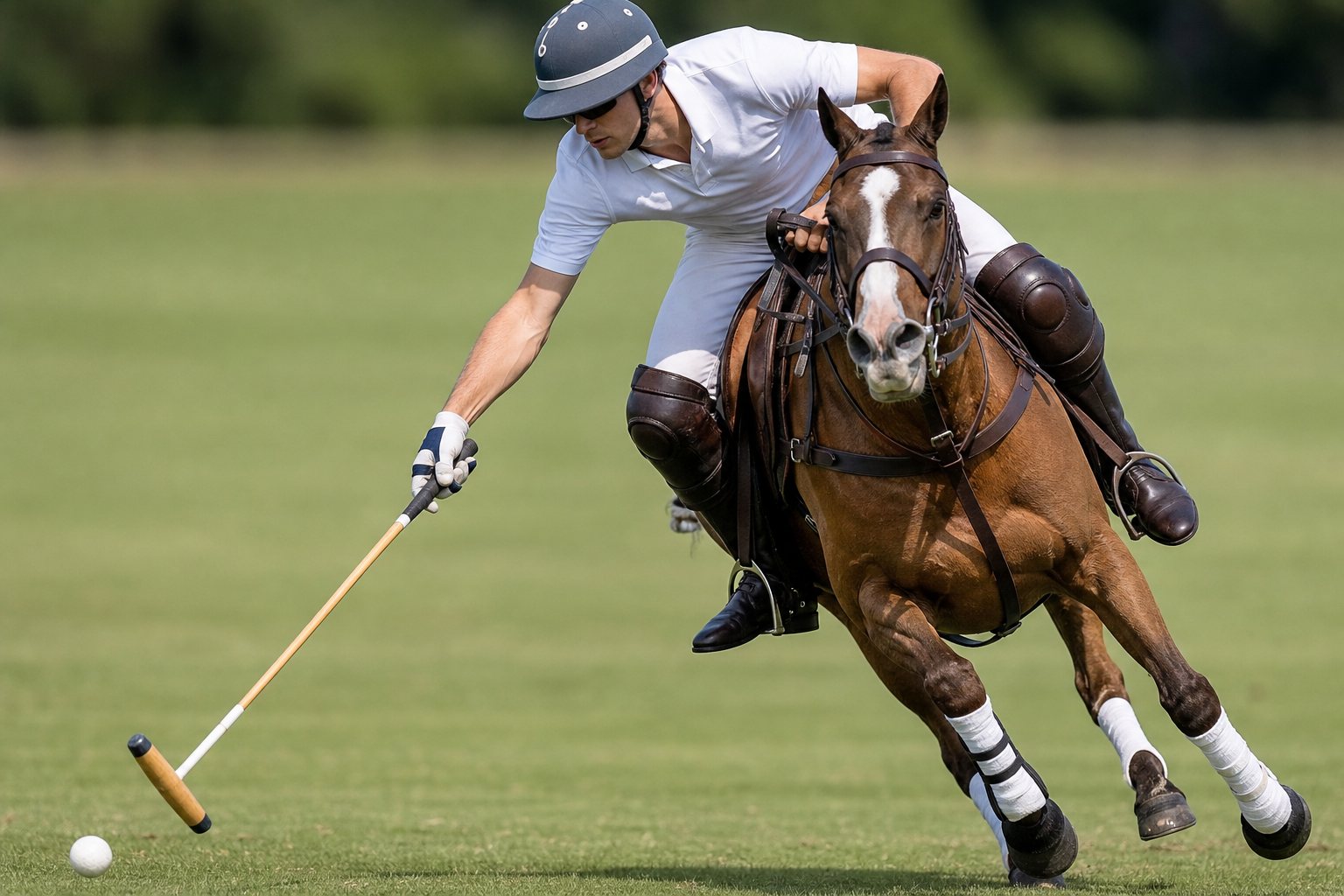
Two goals down in the fifth chukker, a new pony under you and the crowd noise rising, you have about seven minutes and one decision to make: panic, or play the next ball. Polo mental training means practising the thinking skills that help you ride, hit and decide under pressure: confidence, focus, goal setting, imagery, routines and handling mistakes. It is separate from mental health, which we cover below. We found no studies of mental-skills training in polo itself, so this page draws on general applied sport psychology and labels it that way.
Quick answer: Polo asks for calm decisions while a horse, a ball and eight riders move at speed. General sport-psychology skills that coaches use include process goals, imagery, a short pre-ball routine and a plan for mistakes. They may help you prepare but nothing guarantees results. If anxiety, low mood, disordered eating or burnout are affecting daily life, that is a health matter: talk to a doctor or qualified mental-health professional. In the US you can call or text 988 at any time.
General information, not medical advice. This page is about performance thinking. Start at the polo hub and see rules and getting started for how a match works.
Why the mental side is different in polo
Polo is a partnership with a horse, and horses respond to a rider’s tension. The Museum of Polo and Hall of Fame says a handicap rates horsemanship, hitting, horses, team play, game sense and sportsmanship, so judgement counts alongside skill. Decisions are fast: where is the line of the ball, who has right of way, who is behind you. The skills below are general sport-psychology practice. We found no polo trials to quote.
Confidence
Confidence in polo tends to come from preparation you can point to: hours in the saddle, hitting drills, a horse you trust and a fitness base (see training). General coaching advice is to keep a record of what went well each session, so confidence rests on evidence instead of mood. A horse you do not trust is a legitimate reason to feel unsure; talk to your trainer about a more suitable mount.
Focus and attention
The play is continuous within a chukker, with brief stops for fouls. General practice is to narrow attention to one thing at a time: the ball, then the line, then your next hit. A simple cue word (“eyes,” “line,” “swing”) brings attention back after a distraction. After each chukker, use the break to reset: breathe, drink, and agree one adjustment with your team, not five.
Motivation and goal setting
A coaching overview describes layered goals: process goals (what you control, such as keeping your head still on the swing or riding the line), performance goals, and outcome goals (such as winning a cup). Our sources suggest focusing most on process goals because you control them. For example: “hit three clean backshots in this chukker” or “call early on every ball in my area.” Revisit goals after tournaments, not after every ride.
Imagery and visualisation
A Sport NSW (New South Wales Office of Sport) resource describes imagery as mental rehearsal and says it should be built into pre-performance and performance routines, starting as quiet, focused practice. For polo that might mean picturing a full-swing near-side shot, a safe ride-off, or the first throw-in. Imagery supports practice; it does not replace riding. It also should not mean imagining accidents repeatedly if that raises anxiety.
Pre-ball and pre-match routines
The Association for Applied Sport Psychology describes pre-performance routines as a well-supported strategy and notes they vary across sports and athletes (AASP newsletter, 2019). A routine is a short, repeatable sequence of thoughts and actions: check tack, deep breath, a cue word, then play. Keep it short enough to do in the seconds before a throw-in or a penalty hit. Practise it in training so it is automatic.
Handling pressure and fear
Fear is a normal reaction in a sport with real fall risk. A UK survey of 112 players (Sports Medicine Open 2015) looked at risk perception, and the authors noted players’ views of safety kit and medical cover. A separate survey of 145 players (Animals 2025) found that those with higher handicaps rated the risk of horse injury lower, which suggests risk perception changes with experience. General advice: build confidence in small steps, use tested equipment and good ground, and talk to a coach about a graded return after a bad fall. If fear after a fall or head injury stops you riding or affects sleep, see a doctor; possible concussion needs medical care first.
Responding to mistakes and setbacks
Polo moves on instantly. A common sport-psychology approach (general practice) is a three-step reset: notice, release, refocus. Notice the error, take one breath, then pick the next job. Review mistakes after the match with your coach, not during play. Treat injuries as setbacks to be managed with professional guidance, not secrets; see polo injuries.
Decision-making and teamwork
Teams of four share roles: the museum describes the number 1 forward, number 2 support, number 3 field general and number 4 back, and says players may swap during play. Clear, short calls, agreed roles before the match and respect for right of way reduce confusion. Pre-match, agree who covers whom and what happens on a turnover. This is general team advice.
Competition preparation
A basic plan: know the tournament conditions (chukker length can differ by event), arrive early, check horses and gear, use your routine, and have a fuel and fluids plan (see nutrition and athlete health and gear). We have no polo game-day logistics page; ask your club.
Youth
We did not find sourced guidance on mental training specific to young polo players. Parents and coaches should keep the emphasis on enjoyment, safety and effort, and ask a qualified professional if a child seems overly anxious.
Mental health is not the same as mental performance
Mental skills are performance tools. Anxiety that will not settle, depression, disordered eating, burnout, or thoughts of self-harm are health matters for a qualified professional. The 2026 International Olympic Committee consensus statement says mental health symptoms and disorders are common among elite athletes, can have sport-related causes, and can affect performance, and that with appropriate support and treatment many athletes can continue to train and compete. In the US, the 988 Suicide and Crisis Lifeline offers free support by call or text at 988. Outside the US, use your local emergency number or crisis service.
Polo mental training FAQs
Does imagery really work?
General sport-psychology guidance supports it as a practice aid, but we found no polo-specific trial. It does not guarantee results.
How do I handle nerves before a match?
A short routine, slow breathing and a process goal are common general tools. If anxiety is overwhelming, speak to a professional.
How do I get my confidence back after a fall?
Ease back with your coach’s help, and see a doctor first if you hit your head or hurt yourself.
What should I think about during a chukker?
General advice is one cue at a time: the ball, the line, the next hit.
Can a sport psychologist help?
A qualified sport or clinical psychologist can teach these skills and help with health concerns. Ask your club or doctor for a referral.
Sources
- IOC consensus statement: Mental health in elite athletes (Br J Sports Med 2026, PMID 42580854)
- AASP newsletter, May 2019 (pre-performance routines)
- NSW Office of Sport: The power of mental imagery
- 988 Suicide and Crisis Lifeline
- Falls and injuries to polo players (Sports Med Open 2015, PMID 27747839)
- Schumacher A et al. (Animals 2025, PMID 41227466)
- Museum of Polo and Hall of Fame, FAQs
General information for education only, not medical advice. It does not diagnose, treat or clear anyone to play. For your own situation, see a sports medicine doctor, physical therapist or athletic trainer. How we write and check our pages is in our editorial policy.