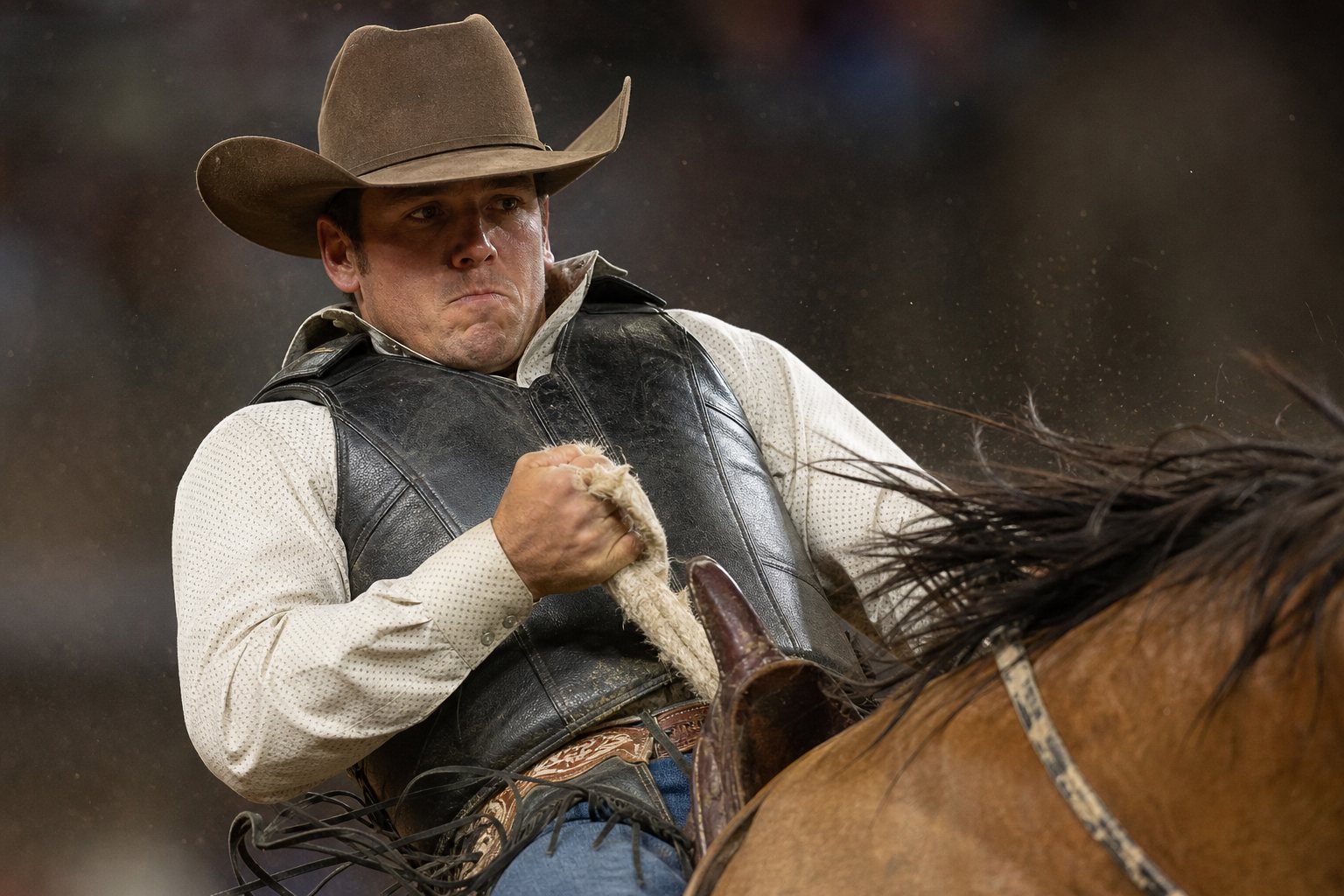
The chute gate swings open, the horse comes out bucking, and a young saddle bronc rider is trying to stay in rhythm with an animal that has no interest in cooperating. A horn sounds at eight seconds, the pickup riders move in, and the crowd waits for two judges to hold up a score. Rodeo rules are less mysterious than they look from the stands: a handful of events, a clock or a score, and a short list of ways to lose your result. This page explains how the main events work, how rides are scored, how a beginner actually starts, and where the official rule books live. For the sport overview, start at the rodeo hub.
Quick answer: Rodeo has two families of events. In the roughstock events (bareback riding, saddle bronc riding and bull riding) a rider has to last eight seconds and is scored on both his own riding and the animal’s bucking. In the timed events (steer wrestling, tie-down roping, team roping, barrel racing, breakaway roping and, in college and high school rodeo, goat tying) the fastest clean run wins. Beginners usually start in youth, junior high or high school rodeo with a coach, not by climbing onto a bull. Exact rules differ by association, so always read the current rule book of the group you enter.
The two families of events
Public rodeo guides, such as the one from the city of Herriman, Utah, sort the sport into roughstock and timed events. Which events exist depends on the level:
| Level | Events (as listed by the organization) | Where we read it |
|---|---|---|
| Professional (PRCA) | Bareback riding, saddle bronc riding, bull riding, steer wrestling, team roping, tie-down roping, barrel racing; breakaway roping is also run at many rodeos | Herriman primer; PRCA rule book (see below) |
| College (NIRA) | Nine events: saddle bronc, bareback, bull riding, calf (tie-down) roping, steer wrestling, team roping, barrel racing, breakaway roping, goat tying | NIRA membership page |
| High school and junior high (NHSRA) | Separate high school and junior high divisions, each with its own events page on the association site | NHSRA home page |
How a roughstock ride is scored
A ride starts when the gate opens. Public primers published by rodeo organizers describe a qualified ride as lasting eight seconds, with the rider holding on with one hand only. If the free hand touches the animal or the rider, there is no score. In bareback and saddle bronc riding the rider must also “mark out” the horse, meaning the spurs are over the horse’s shoulders as it leaves the chute. We could not open the rule-book text itself, so check these details against the current 2026 PRCA Rule Book (PDF).
A qualified ride earns a score out of 100. The secondary guides we found say judges score the rider’s control, spurring and style, and also the animal’s power and difficulty, roughly half and half. That is why a hard-bucking bull can lift a score and why a draw (the animal assigned to a rider) matters. If an animal does not perform, rules usually allow a re-ride; we cannot quote that rule from the primary text, so treat it as a question for the event officials.
How the timed events work
- Steer wrestling: a rider chases a steer from horseback, slides off and brings it to the ground. The clock stops when the steer is down.
- Tie-down (calf) roping: rope the calf, dismount, flank it and tie three legs. Time stops when the tie is secure and the animal stays tied for a set period.
- Team roping: two riders, a header and a heeler, rope a steer by the head and the hind feet. It is the one event where two people share a time.
- Barrel racing: horse and rider run a cloverleaf pattern around three barrels. The pattern is the same everywhere; knocking a barrel over adds a time penalty.
- Breakaway roping and goat tying: breakaway is a quick roping run where the rope breaks away from the saddle; goat tying is a dismount-and-tie event run in college and high school rodeo.
Penalties, barrier rules (a head start into the arena is a time penalty) and what counts as a legal catch are set in each association’s rule book. These are public primers’ summaries, not rule quotes, so please verify details with the rule book for the rodeo you are entering.
How a beginner actually starts
Rodeo is a youth sport as much as a pro one. The National High School Rodeo Association (NHSRA) shows on its home page 14,085 members, 44 US states, five Canadian provinces plus Australia, Mexico and New Zealand, and 1,800 sanctioned events. It runs both a junior high and a high school division, and it directs would-be members to its online membership site or to the state or provincial association. A search summary of NHSRA material says the junior high division is aimed at grades 6 to 8; confirm age and grade rules with your state secretary.
- Get a coach first. General coaching practice, not a rule: roughstock and roping skills are learned with an experienced instructor, a safe animal and the right equipment. Ask local rodeo clubs, 4-H or a college rodeo team for names.
- Start with the timed events if you are new to horses. Barrel racing, breakaway roping and goat tying can be learned at slower speeds than bull riding. That is common practice, not an official ranking of risk.
- Join the right association. Youth and junior high riders use the NHSRA state association; open and amateur rodeos use their own memberships.
- Ask about safety rules. Helmet, vest and mouthpiece requirements vary by association; see rodeo injury prevention and rodeo gear.
College and professional pathways
The National Intercollegiate Rodeo Association (NIRA) is the governing body of college rodeo. Its membership page lists more than 135 colleges, about ten rodeos a year per region, the College National Finals Rodeo each June in Casper, Wyoming, and eligibility rules: at least 12 credit hours, a 2.0 grade point average, up to six years and four cards. College teams normally handle NIRA membership for you.
For the pros, the Professional Rodeo Cowboys Association (PRCA) sanctions rodeos in the US, Canada and Mexico, and its National Finals Rodeo is scheduled for December 3 to 12, 2026 in Las Vegas (dates from event listings; we could not read the PRCA site). A search summary of the PRCA 2026 permit application says a rider begins as a permit member, must be 18 or older, and fills the permit with earnings at PRCA rodeos before applying for a contestant card. Check the form for current requirements and fees.
Olympics and Paralympics
Rodeo is not a sport we found on any Olympic or Paralympic programme, and we did not locate an official page saying either way. Check olympics.com and paralympic.org for the current Games.
Related sports: horseback riding, horse racing and polo. Next on this site: rodeo training and rodeo injuries. All sports: sports index.
Rodeo rules FAQs
How long is a bull ride?
Eight seconds, per public rodeo primers and the major bull riding organizations. The rider uses one hand and is scored on his own riding and on the bull’s performance, out of 100.
What is the difference between roughstock and timed events?
Roughstock events (bareback, saddle bronc, bull riding) are scored rides on bucking animals. Timed events (roping, steer wrestling, barrel racing, goat tying) are won with the fastest legal run.
How do kids get started in rodeo?
Through junior high and high school rodeo (NHSRA state associations), local youth rodeo clubs and 4-H style programs. Contact the state or provincial secretary the association lists, and find a qualified coach before trying roughstock events.
Can you rodeo in college?
Yes. NIRA member colleges field rodeo teams with nine events, and eligibility rules include academic standards (12 credit hours and a 2.0 grade point average, per NIRA).
Where are the official rules?
Each association publishes its own: the PRCA rule book for pro rodeo, NIRA rules for college and NHSRA rules for high school and junior high. Read the current edition before entering.
Sources
- Herriman, Utah: Rodeo 101
- NIRA membership (collegerodeo.com)
- NHSRA home page
- 2026 PRCA Rule Book (PDF)
- PRCA 2026 permit application (PDF)
General information for education only, not medical advice. It cannot replace a sports medicine doctor, physical therapist or athletic trainer who knows you. Read how we work in our editorial policy.