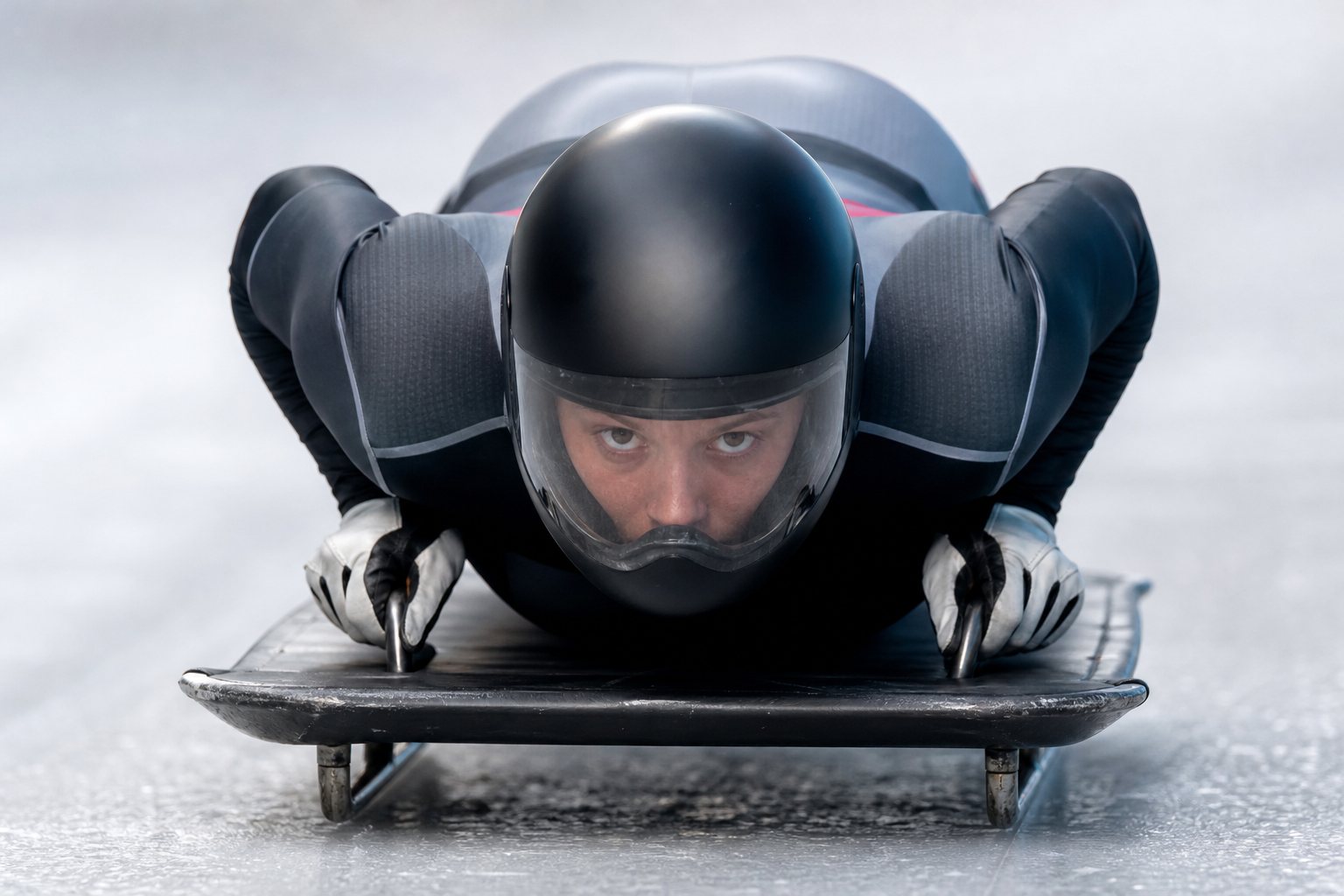
The last training run of the day has gone well, and the athlete is already thinking about the next one. That is exactly when a small thing, a bumpy section of ice, a tired neck or a rushed dive onto the sled, can matter. Skeleton injury prevention is the set of habits that lower the odds of getting hurt: a proper sprint warm-up, strength work, careful build-up of track runs, protective equipment that fits, and honest reporting of symptoms. These habits reduce risk. They cannot promise a crash-free career, and sliding is fast enough that serious accidents happen even to experts.
Quick answer: The best-supported steps for skeleton athletes are a progressive sprint warm-up, building sprint and strength load gradually, learning each track with experienced coaches, a well-fitted helmet and the gear your federation requires, and reporting any headache, fogginess or neck pain after a run. Evidence for individual measures such as neck strengthening is thin. Stop and see a sports medicine doctor, physical therapist or athletic trainer for head or neck symptoms, and call 911 for danger signs.
General information, not medical advice. This page is about lowering risk. What injuries look like and how rehab works is on our skeleton injuries page, so we do not repeat it here. Start at the skeleton hub.
Warm-up
We found no published injury-prevention warm-up programme tested in skeleton, so there is no named routine such as FIFA 11+ to point to. What exists is performance research. A 2013 study of six Olympic-level bob-skeleton athletes found that more intense warm-ups done closer to the sprint produced faster 20-metre sled sprints, and a 2024 study of seven Chinese skeleton athletes tested resisted sled sprints before an ice push test. Both measured speed, not injuries. A progressive warm-up, from easy jogging and drills up to near-maximal starts, is standard practice for sprinters (general coaching practice). Cold tracks make it more important, because a muscle asked for a maximal sprint after standing around is a common setup for a strain.
Technique and track experience
A 2016 study of the Whistler Sliding Centre covered more than 43,200 runs across all sliding sports over four years. Injury occurred in 0.5% of runs, more severe injury in fewer than 0.1%, and more frequent and severe injuries happened at lower track locations. Of 2,605 sliders, 73.6% had made only 1 to 29 runs, and more experience was generally linked to fewer injuries. The authors said incident monitoring, especially of track ejection, should be a priority. The study covered bobsleigh, luge and skeleton together, so it is not a skeleton-only figure.
For skeleton athletes the practical rule is to follow the run progression your coaches set and to learn a new track gradually. A 2018 Frontiers in Neurology review also suggests that pre-run simulation and visualisation might help athletes react better and make fewer errors, while noting that this is a suggestion, not a tested injury-prevention method.
Progressive training load
Adding sprint volume or heavy lifting too quickly is a common route to muscle strain in any sprint sport. No skeleton-specific source gives a safe weekly increase, and we do not offer one. The 2018 review reports that in 2014 the Canadian Olympic skeleton head coach set a maximum of three training runs per day, in response to athletes’ concerns about bumpy ice and post-run headaches. A 2025 clinical commentary on sliding athletes recommends an integrated team, with medical staff, strength coaches and performance staff managing load together. If sessions leave you sore for days, tell your coach and a clinician before pushing through. See skeleton training for the demands of the sport.
Conditioning and strength
- Legs and hamstrings: the push is a maximal sprint. A 2021 meta-analysis of 17 studies in team-sport players found the Nordic hamstring exercise raised eccentric knee-flexor strength with a small sprint benefit. It did not measure injuries, so treat it as a reason to train the hamstrings, not proof of fewer strains.
- Left-right balance: a 2025 study of 16 skeleton athletes found asymmetries between legs in strength and push gait. Whether fixing them lowers injury risk is untested, but a physical therapist can screen for it.
- Neck and upper trunk: the 2018 review says neck strength is felt to be crucial because the head must stay stable against forces of up to 5 g. Evidence is thin: a 2023 meta-analysis in team sports found very low-certainty evidence for a small, non-significant link between neck strength and lower concussion risk, and a 2026 review called evidence inconclusive. Neck training is reasonable but not proven protection, so have an athletic trainer or physical therapist set it up.
Track, ice and cold
The track is the environment. The 2018 review says some skeleton and luge athletes withdraw from competitions where the ice track is too bumpy, which suggests athletes feel track quality matters. You cannot fix the ice yourself, but you can decline a run you do not feel ready for, and teams can report track problems to officials. The review also notes a race physician and paramedic must be present at all sanctioned events, according to the federation rules it cites. Between runs, the CDC advises dressing in layers and knowing the early signs of hypothermia and frostbite.
Protective equipment and fit
The review says helmets are essential in a high-speed crash and that sledding-specific helmet research is still needed. It adds that mouthguards may also help confer some protection, and that helmet standards for skeleton and bobsleigh are slightly stricter than luge but are subject to each athlete’s national federation. It also suggests adding shock absorbers to skeleton and luge sleds and an energy-absorbing layer between the saddle and the rider; these are proposals, not required features. In a crash skeleton athletes must decide whether to let go of the sled, a decision the review lists among things worth discussing with coaches. A well-fitted helmet, replaced after significant impact according to its maker, and a mouthguard fitted to your teeth are sensible. No product prevents concussion. See the gear page.
Youth athletes
Data are limited. The 2018 review reports that at the Lillehammer 2016 Youth Olympic Games 17.5% of skeleton athletes were injured, and 4% at the 2012 Games. Counts are tiny, so these are signals, not risk rates. Young athletes should slide only inside a federation-run programme.
What prevention cannot do
At Sochi 2014, the review reports 10.6% of the skeleton team was injured, mostly in training and none needing more than a day away from sport. That number is reassuring but based on a small team. Elsewhere, serious crashes occur; the Whistler study recorded a fatality due to track ejection. Prevention lowers risk; it cannot remove it.
When to see a professional
- Any headache, dizziness, fogginess or nausea after a run, even a smooth one: stop for the day and see a healthcare provider (CDC HEADS UP: recognise and remove, a provider decides about return).
- Neck, back or arm pain that is sharp, keeps worsening, or comes with numbness or tingling.
- A hamstring or groin pull that does not settle in a few days or returns when you sprint.
- Call 911 for repeated vomiting, a seizure, a worsening headache, confusion or loss of consciousness.
Skeleton injury prevention FAQs
Is there a standard skeleton warm-up?
Not in published research we found. A 2013 study found higher-intensity warm-ups done close to the start gave faster sled sprints in six Olympic-level bob-skeleton athletes.
Does neck strengthening prevent sled head?
Unknown. The 2018 review says it is unclear whether sled head is concussion, repeated smaller impacts or neck strain, and neck-strength evidence in team sports is very low certainty.
Does a mouthguard prevent concussion in skeleton?
Not proven. The 2018 review says a mouthguard may help confer some protection. No product prevents concussion.
How do I lower my risk as a new slider?
Slide only in a federation programme, build track experience step by step and keep sprint and strength load rising slowly. The Whistler study found more experience was generally linked to fewer injuries.
When should I stop a session?
For any head symptoms, sharp or worsening pain, numbness or dizziness. Tell your coach and see a sports medicine doctor, physical therapist or athletic trainer.
Sources
- Whistler Sliding Centre injuries, Br J Sports Med 2016
- McCradden and Cusimano 2018, Front Neurol: concussions in sledding sports (PMC)
- Interdisciplinary management of the sliding athlete, Int J Sports Phys Ther 2025
- Designing a warm-up protocol for elite bob-skeleton athletes, IJSPP 2013
- Post-activation enhancement in Chinese skeleton athletes, PeerJ 2024
- Strength and push gait asymmetry in skeleton athletes, J Hum Kinet 2025
- Nordic hamstring exercise meta-analysis, J Sci Med Sport 2021
- Neck strength and concussion, JOSPT 2023
- Neck strength and concussion risk review, Curr Sports Med Rep 2026
- CDC HEADS UP: signs and symptoms
- CDC HEADS UP: responding to a concussion
- CDC: preventing hypothermia and frostbite
General information for education only, not medical advice. It does not replace a sports medicine doctor, physical therapist, athletic trainer, licensed mental health professional or qualified coach. See our editorial policy for how we research and write.