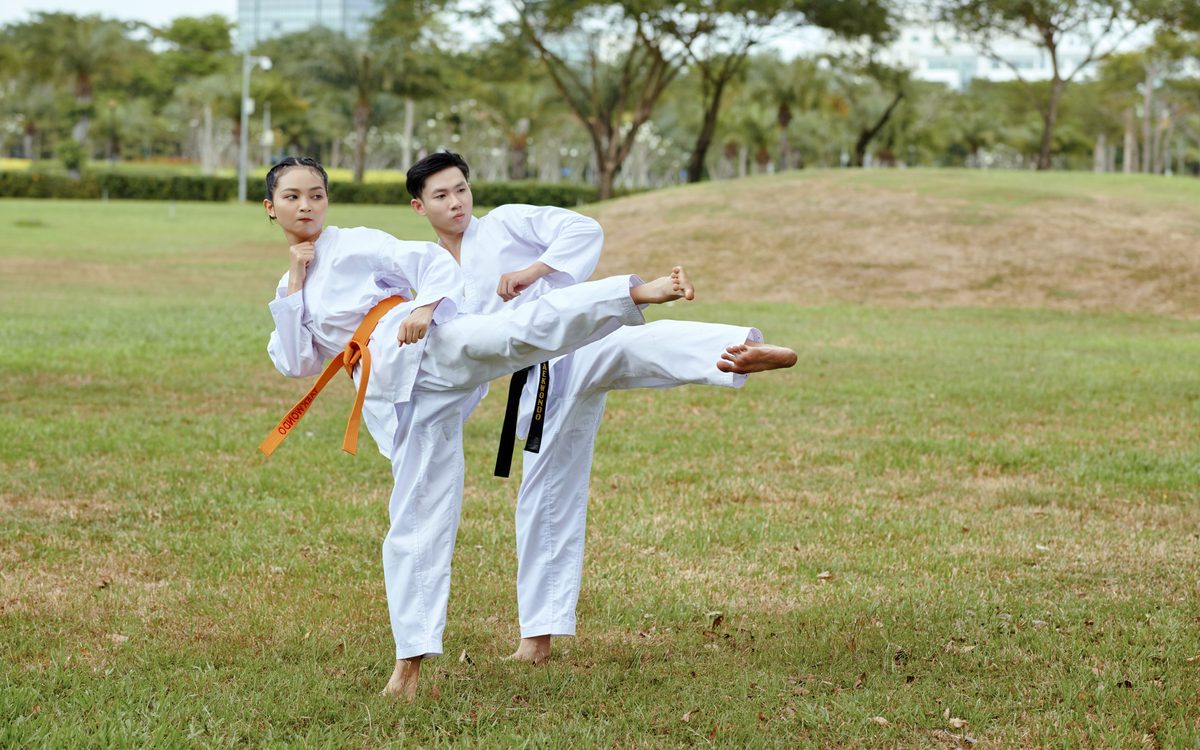
It is the last sparring round of a long Saturday class. A 13-year-old, a little tired, throws a roundhouse kick, plants a bit late on his standing foot and feels his ankle roll on the mat. Nothing is broken, but he sits out the next month, and the coach wonders whether anything could have been done earlier. Taekwondo injury prevention is the set of habits around an athlete, a proper warm-up, sound technique, a training load that grows slowly, strength and balance work, working protective gear, honest reporting of pain and enough rest, that aims to lower the chance of getting hurt. These habits lower the odds. They cannot promise anything.
Quick answer: Most taekwondo injuries are bruises, sprains and fractures of the foot, ankle, knee, face and hand, and most happen from contact in sparring, with a much higher rate in competition than in practice. The best-supported steps are a gradual warm-up, learning to block and kick with control, building training load slowly, strength and balance work, correctly fitting protective gear and reporting head blows. No taekwondo trial proves any program prevents injury. See a sports medicine doctor, physical therapist or athletic trainer for pain that stays in one spot, and call emergency services for head injury with danger signs.
General information, not medical advice. This page is about lowering risk. What each injury looks like is on our taekwondo injuries guide, so we do not repeat it. For the sport as a whole, start at the taekwondo hub.
Where the risk is
Knowing the pattern helps aim the effort. A five-year study of 82 elite athletes in Germany (Geßlein and colleagues, 2020) found the exposure-adjusted injury rate in competition was 6.33 times the rate in training. Ankle and foot, and hand and wrist, were most affected, and fractures were mainly in the hand and wrist. In a Korean study of 285 elite athletes (Son and colleagues, 2020) the rate was 24.86 per 1,000 athlete-exposures in competition against 4.79 in practice. A 2025 systematic review of high-performance taekwondo (García Blanco and colleagues) found direct contact was the leading cause of injury and overuse was more frequent in training. In short: most injuries come from contact in sparring, and some come from overload.
Warm-up
We did not find a published taekwondo warm-up program that was tested for fewer injuries, so there is no named routine to point to. A 2025 paper on adolescent taekwondo athletes (Frontiers in Sports and Active Living) says research linking muscle imbalance, motor function and injury risk in this group is limited. In other sports, balance training and neuromuscular warm-ups have a better record: a 2022 meta-analysis of soccer players (Al Attar and colleagues, 4,959 players) found programs with balance exercises cut ankle injuries by 36 percent, and a review in female athletes (Caldemeyer and colleagues, 2020) supported neuromuscular training for ankle sprains. Those findings come from other sports, so use them as a reasoned model. A common warm-up, which is general practice, is five to ten minutes of easy movement, dynamic leg swings and hip circles, balance and landing drills and then gradually faster kicks before any sparring.
Technique and control
The AAP clinical report on martial arts puts the emphasis on qualified instructors, on teaching blocking, and on waiting to introduce contact until a student has the maturity and skill from non-contact practice. A review of hand injuries in martial arts (Drury, 2017) says proper technique and target selection reduce hand injury risk. Practical points: practise a kick slowly with clean balance before adding speed, learn to block before sparring hard, and expect coaches to stop wild sparring.
Training load and rest
Overuse injuries are tied to doing too much too fast. In a survey of 472 taekwondo athletes (Jeong and colleagues, 2022), the most often reported cause of injury was excessive training and chronic fatigue. In a survey of 263 sport-poomsae competitors (Koh and colleagues, 2017), 65.8 percent reported chronic overuse pain, which was more common in women, those with a prior injury and those with longer training hours. The IOC consensus on load (Soligard and colleagues, 2016) advises monitoring load and avoiding sudden jumps, and the AAP (Brenner, 2016) recommends one to two days a week off from a main sport. The AAP martial arts report notes some evidence of more injury in children training more than about three hours a week. The practical message is to add volume, jumps or sparring rounds gradually and take days off.
Strength, balance and flexibility
Reviews of taekwondo physical profiles (Bridge and colleagues, 2014) describe high lower-limb power and flexibility in international athletes, which is the physical base for kicking. Strength and balance work for the legs, hips and trunk is a reasonable part of prevention, though taekwondo-specific injury trials are missing. See our training page for how this fits in a week.
Weight cutting
A study of 197 elite Korean athletes (Kim and colleagues, 2023) found the injury rate during rapid weight loss periods was 6.88 per 1,000 training hours against 3.66 in normal training. Staying near a competition weight, and avoiding crash cuts, is therefore also an injury-prevention choice. Details are on the nutrition page.
Mats, surfaces and the training space
No taekwondo study we found compares floors, so this is general practice: train on a clean, flat, shock-absorbing mat, keep the space clear of bags and loose gear, and stop when the surface is wet or slippery.
Protective equipment and fit
World Taekwondo competition rules require protectors for trunk, head, groin, forearms and shins, plus gloves, sensing socks where electronic scoring is used, and a mouthguard that must be white or clear and at least 3 mm thick. The AAP report says there is no evidence that headgear or mouthguards reduce concussion, but that mouthguards reduce dental and mouth injuries. Hand protection reduces hand injuries, according to Drury’s review. A protector that slips or a mouthguard that does not fit can be a hazard as well as an annoyance, so check fit before sparring. See our gear page. Concussion is a head-injury risk that equipment does not remove: a 2025 survey of 98 Australian athletes (Brown and colleagues) found 21 percent said they returned to play the same day after a suspected concussion and over 20 percent admitted to hiding symptoms.
For children, USA Taekwondo uses modified safety rules for some age and belt groups, with limits on head contact. Ask a school what it does at each belt.
What prevention cannot do
Even well-run programs have injuries. A bruise from a legal kick or a sprain on a bad landing can happen to a careful athlete.
When to see a professional
See a sports medicine doctor, physical therapist or athletic trainer for pain that stays in one place, hurts at rest or at night, swells, or changes how you kick. Do not play through a possible head injury. Call emergency services for repeated vomiting, a seizure, worsening headache, unusual drowsiness or one pupil bigger than the other, in line with the CDC HEADS UP guidance.
Taekwondo injury prevention FAQs
Can a warm-up prevent taekwondo injuries?
It may help, but no taekwondo study has shown it. In other sports, neuromuscular warm-ups with balance work have reduced ankle injuries. A good warm-up also prepares you to kick well.
Do I need a mouthguard for taekwondo?
World Taekwondo competition rules require one, and the AAP says mouthguards reduce dental and oral injuries. Ask your school what it requires in class.
Does sparring headgear stop concussions?
The AAP report says there is no evidence that headgear or mouthguards reduce concussion. Reporting a head blow and removing the athlete from play is the key step, as in CDC HEADS UP.
How many hours a week of taekwondo is too much?
There is no single number. The AAP martial arts report notes some evidence of more injury in children training more than about three hours a week, and says more study is needed. Watch for fatigue, pain and falling performance.
Is cutting weight dangerous for taekwondo athletes?
A 2023 Korean study found a higher injury rate during weight loss periods, and weight cutting is a nutrition and health issue. Talk to a doctor or sports dietitian before trying to lose weight for a weigh-in.
Sources
- Geßlein M et al. 2020, injury incidence rates and profiles in elite taekwondo (PubMed 31747701)
- Son B et al. 2020, injuries in Korean elite taekwondo athletes (PubMed 32708739)
- García Blanco C et al. 2025, epidemiology of injuries in high-performance taekwondo, systematic review (PubMed 41158919)
- Frontiers in Sports and Active Living 2025, adolescent taekwondo muscle function and injury risk
- Al Attar WSA et al. 2022, balance training and ankle injuries in soccer, meta-analysis (PubMed 35753965)
- Caldemeyer LE et al. 2020, neuromuscular training and ankle sprains in female athletes (PubMed 32067546)
- Drury 2017, hand and wrist injuries in boxing and the martial arts, Hand Clinics (PubMed 27886844)
- Jeong et al. 2022, injury types by taekwondo athlete type (PubMed 36157387)
- Koh et al. 2017, chronic overuse pain in sport-poomsae taekwondo (PubMed 27387495)
- Kim et al. 2023, rapid weight loss and sports injury in elite taekwondo athletes (PubMed 35469548)
- Brown et al. 2025, concussion knowledge, attitudes and behaviours among Australian taekwondo athletes (PubMed 41295792)
- Bridge CA et al. 2014, physical and physiological profiles of taekwondo athletes (PubMed 24549477)
- Soligard T et al. 2016, IOC consensus on load (PubMed 27535989); Brenner JS 2016, AAP (PubMed 27573090)
- AAP clinical report, Youth Participation and Injury Risk in Martial Arts (2016)
- World Taekwondo, Competition Rules and Interpretation (in force 1 June 2026)
- CDC HEADS UP, signs and symptoms and response
General information for education only, not medical advice. It does not replace a sports medicine doctor, physical therapist, athletic trainer, registered dietitian or qualified coach. See our editorial policy for how we research and write.