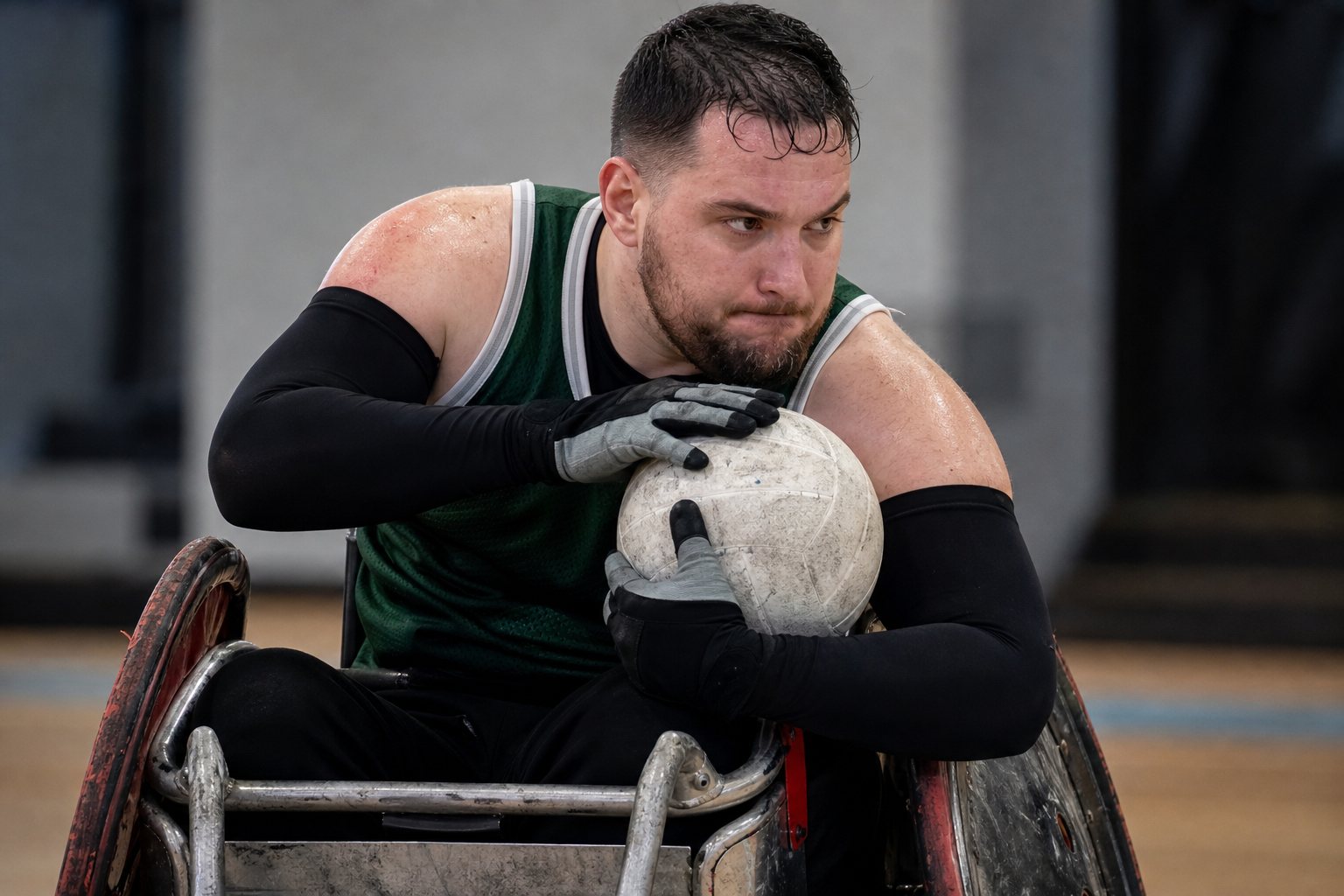
Fourth quarter, a one-try game, and a player with a cervical spinal cord injury is still sprinting to set a pick while the heart rate on his watch barely reads 130. Wheelchair rugby training is the mix of chair skills, sprint and endurance work, upper-body strength, trunk and breathing work and recovery that a player does around team practice. It is also an area where research is thin, so this page says clearly what is sourced and what is general coaching practice.
Quick answer: Wheelchair rugby is repeated short sprints, quick turns and contact in a stop-clock game. Published research on elite players is small, but it supports sprint-style field tests, shoulder strength work, and care with heat and heart-rate readings in athletes with cervical spinal cord injuries. Build any plan with a coach and a clinician who know your impairment, and see a doctor, physical therapist or athletic trainer before starting new loads.
Rules and getting started are on our rules page; shoulder and heat safety are on injury prevention. For the standing game, see rugby training, written for standing players. General information, not medical advice.
What the game asks of the body
A match is four 8-minute periods with the clock stopped at every whistle, and a team has 40 seconds to score once it has the ball. In a 2018 study of 19 elite players, Gee, Lacroix and West compared a 20 m by 20 m repeated sprint field test with game play and found good agreement for peak heart rate and blood lactate and excellent day-to-day reliability. They concluded the test reproduces the physiological demands of elite game play and could help with selection and monitoring training. That is a small sample from one research group, but it gives coaches a simple, cheap test: repeated all-out sprints in the sport chair.
Players are not all the same. In a study of 18 experienced players, Goosey-Tolfrey and colleagues had athletes sprint 15 seconds on an instrumented ergometer in their own sport chair. Higher-point players (class 2.0 and above) covered about 3 m further and were faster over 28 m than lower-point players (6.95 s against 8.03 s), with higher peak power, but there was a lot of overlap, and some lower-point players beat some higher-point players. The authors also measured left-right differences in push power, which higher-point players showed more of, and suggested these could be addressed with training or chair set-up.
Heart rate: useful, but read it carefully
Many coaches monitor intensity with a heart-rate strap. In a study of 43 men at the 2015 Parapan American Games, Gee and colleagues found that players with a cervical spinal cord injury had lower average and peak heart rates in competition than players without one (average 111 against 155 beats per minute; peak 133 against 178). They attributed this to injury of the spinal autonomic pathways. So a “low” heart rate may not mean low effort. Ratings of perceived exertion, session length and sprint times are practical alternatives; our gear page mentions monitors in that light.
A sensible weekly shape (general coaching practice)
There is no published weekly template for wheelchair rugby players. The shape below is general practice, adapted from standard team-sport planning, not a prescription. Your team coach and clinician should adjust it for your impairment, your pain and your schedule.
- Team practice, 2 to 3 sessions: chair skills, passing and dribbling, set plays, scrimmage with contact.
- One sprint or interval session: repeated sprints in the sport chair, with full recovery between sets. The 20 m by 20 m test above is a way to measure progress every few weeks.
- One or two strength sessions: rows, pulling and rotator-cuff work for the shoulders and upper back, plus trunk work as your impairment allows. Shoulder strengthening links to lower pain in the studies on our injury pages.
- Easy aerobic work: arm-crank, handcycle or steady pushing, kept short enough that you recover before the next practice.
- One real rest day and a plan for travel weeks.
For a general-health yardstick, the international scientific exercise guidelines for adults with spinal cord injury (Martin Ginis and colleagues, 2018) recommend at least 20 minutes of moderate to vigorous aerobic exercise twice a week and three sets of strength exercises per major working muscle group twice a week for fitness and strength benefits. That is a floor for health, not a target for an athlete, and players with a high-level injury should check blood pressure and heat limits with their doctor first.
Strength, trunk and breathing
- Shoulders and upper back: a 2026 survey of 61 US wheelchair rugby athletes (Rider and colleagues) found less shoulder pain in athletes who warmed up more often (r = -0.53) and did shoulder strength training (r = -0.34). It is a snapshot, not proof of cause.
- Breathing: in a small randomised trial, 10 Paralympic wheelchair rugby players with motor-complete cervical injuries trained their inspiratory muscles for 6 weeks (West and colleagues, 2014). Diaphragm thickness and inspiratory muscle strength rose compared with placebo, and peak aerobic work showed a strong trend upward without reaching significance. It suggests inspiratory muscle training may help, but the study was tiny.
- Trunk and blood pressure: a 2022 study of 11 players with tetraplegia tested electrical stimulation of trunk muscles in a lab; it is a research tool, not a routine part of training.
Periodisation and camps
Periodisation means arranging the year into phases: a build phase with more volume, a sharpening phase closer to competition, and a lighter phase around key tournaments. This is general coaching practice. One wheelchair-specific finding is worth building in: in 18 male players, Murphy and colleagues (2021) found that a three-night training camp cut total sleep by about 38 minutes, so protect sleep on camp weeks. See our recovery page.
Frequently asked questions
How often should a wheelchair rugby player train?
There is no published standard. Most players fit team practices around strength, sprint and easy aerobic work with at least one rest day. Your coach and clinician should set the amount from your history, pain and recovery.
What is the best fitness test for wheelchair rugby?
A published option is the 20 m by 20 m repeated sprint test, which matched game-play heart rate and lactate in 19 elite players. It is a monitoring tool, not a verdict on a player.
Can I use heart rate to judge effort?
Use it with caution. Players with cervical spinal cord injuries showed lower heart rates in competition than players without, so pair it with perceived exertion and performance.
Is strength training useful for shoulders?
Survey data link shoulder strength work and warm-ups to lower shoulder pain scores in US players, and exercise programs have lowered shoulder pain in wheelchair users in trials. Get a program designed by a clinician.
Do high-point and low-point players train differently?
Their roles and sprint profiles differ, so work is often tailored, but there is no published split. Ask your coach what your role needs.
Sources
- Gee, Lacroix, West 2018: 20×20 m repeated sprint field test (PubMed 29373205)
- Goosey-Tolfrey et al. 2018: sprint and propulsion asymmetries (PubMed 29350429)
- Gee et al. 2020: heart rate in elite wheelchair rugby (PubMed 31855910)
- Martin Ginis et al. 2018: exercise guidelines for adults with SCI (PubMed 29070812)
- Rider et al. 2026: shoulder pain in wheelchair rugby (PubMed 41734286)
- West et al. 2014: inspiratory muscle training in Paralympic athletes with cervical SCI (PubMed 23530708)
- Kouwijzer et al. 2022: trunk muscle stimulation in wheelchair rugby (PubMed 33166206)
- Curtis et al. 1999: shoulder exercise protocol in wheelchair users, randomised trial (PubMed 10432262)
- Murphy et al. 2021: sleep in wheelchair rugby athletes (PubMed 33997778)
- World Wheelchair Rugby: International Rules, April 2026 (PDF)
General information for education only, not medical advice. It does not replace a visit with a doctor, physical therapist or athletic trainer who works with wheelchair athletes. See how we write and check our pages in our editorial policy.