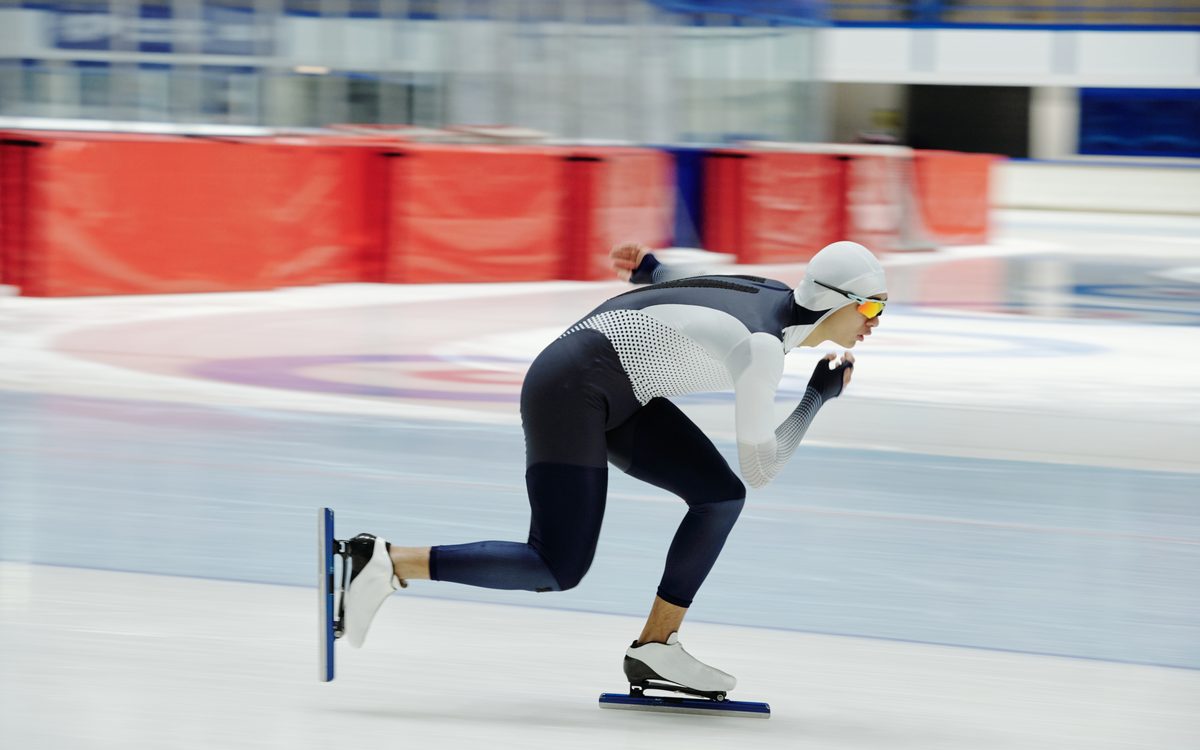
A skater finishes a 5000 m and steps off the oval with a knee that feels tight and a little sore. It happened last week too. Most injuries in long track are not dramatic crashes. They are the slow ones, a knee, a low back, a lower leg, that build over a season spent in a deep crouch. Long track speed skating injuries fall into two groups: sudden ones, such as falls, collisions and blade cuts, and gradual overuse problems. This page gives the numbers we could find, the general principles of rehab, and when to see a professional. It does not diagnose anything. To lower your risk, see our injury prevention page; for the sport itself, see the speed skating hub.
Quick answer: In the best long track data we found, 84 Dutch skaters aged 15 to 21 had a weekly prevalence of health problems of 30.5%, and overuse injuries of the knee caused the most lost days, followed by the thoracic spine and lower leg. Sudden injuries to the head, shoulder and lower back caused the most lost days of that kind. The research is small and mostly in elite youth. See a sports medicine doctor, physical therapist or athletic trainer for any pain that lingers, and get urgent help for a head injury with danger signs or a deep cut.
What the numbers say
The most useful long track study is a one-season follow-up of 84 highly trained Dutch skaters aged 15 to 21 in 2019/2020 (Hendricks et al., Br J Sports Med, 2024). The skaters reported 283 health problems, 187 injuries and 96 illnesses. The average weekly prevalence of health problems was 30.5%. Sudden-onset injuries happened at 2.0 per 1,000 hours and illnesses at 3.2 per 1,000 hours. The table shows the “burden”, days of time loss per 1,000 hours, for the regions with the highest numbers.
| Type | Region | Days lost per 1,000 hours |
|---|---|---|
| Sudden | Head | 5.6 |
| Sudden | Shoulder | 2.9 |
| Sudden | Lower back (lumbosacral) | 2.2 |
| Overuse | Knee | 11.0 |
| Overuse | Upper back (thoracic spine) | 6.8 |
| Overuse | Lower leg | 3.9 |
| Overuse | Lower back (lumbosacral) | 2.5 |
These are one group’s results, so they may not match a club skater. A 2024 scoping review of ice speed skating (Hendricks, Verhagen and van de Water, Scand J Med Sci Sports) found competition injury rates from 2% to 18% of participants and seasonal prevalence of physical complaints up to 84% for back pain. It described the studies as limited and few of high quality.
Knee pain
The knee had the highest overuse burden in the Dutch study, which fits a sport that is mostly spent with the knees bent. Konings et al. (Sports Med, 2015) describe the crouch as favorable for speed but demanding on the working muscles. Knee pain has many causes, so what matters is to describe it to a professional: where it hurts, when and how it changed with training. Do not assume a cause from the internet.
Back pain
Back pain turns up everywhere in skating. A Dutch cross-sectional study of 236 young elite athletes (van Hilst et al., J Back Musculoskelet Rehabil, 2015) reported 60% 12-month prevalence of low back pain among speed skaters. Longer training hours were associated with higher odds. A German study of inline speed skaters with back pain (Ruhe et al., Chiropr Man Therap, 2012) found sacroiliac joint involvement in about 90%, but that group is inline skaters, so we do not apply it to ice. Any back pain with numbness, weakness, fever or loss of bladder or bowel control needs prompt medical care.
Groin, hip and lower leg
We did not find long track surveillance data that gives verified groin numbers, so we do not quote any. The American Academy of Orthopaedic Surgeons (AAOS OrthoInfo) describes a sports hernia (athletic pubalgia) as a strain or tear of soft tissue in the lower abdomen or groin, seen in ice hockey, soccer and wrestling, which often improves with rest and may return with sport. See a clinician rather than guessing. The Dutch study listed the lower leg among overuse burdens (3.9 days per 1,000 hours).
Falls, collisions and blade cuts
Long track is raced in pairs, so crashes are less common than in short track, a point from the format, not a study. They still happen, particularly in the mass start and team pursuit. The ISU’s Communication 2636 names cuts, concussions and puncture wounds from skates as risks in team events and the mass start. A survey of 95 elite short track skaters (Quinn et al., Am J Sports Med, 2003) listed lacerations from the knee down at 11.1% of previous on-ice injuries; that is short track, but it shows what blades can do. For bleeding, general first aid is direct pressure and a call to 911 (US).
Concussion
The head had the highest sudden-injury burden in the Dutch study. The CDC’s HEADS UP guidance is simple: recognize the signs, remove the athlete from activity, and have a health care provider decide when to return; “When in doubt, sit them out.” Danger signs, such as repeated vomiting, a worsening headache, confusion or loss of consciousness, call for emergency care. A 2014 helmet test found speed skating helmets nearly eliminate skull fractures, but rotational acceleration remained near the high end of concussion probability (Karton et al., Br J Sports Med). The 2022 Amsterdam consensus recommends a short period of relative rest, 24 to 48 hours, followed by a gradual return, which a clinician guides. We do not give return-to-play timelines.
Rehab principles (general)
This is general information from sports medicine sources, not a plan for any person:
- Get a diagnosis first. Pain with a similar feel can have different causes.
- Early on, many overuse problems are managed by adjusting training load rather than stopping everything, as a clinician advises.
- Rehab usually builds from pain-free movement to strength, then to sport-specific work such as the low position, in steps.
- Return to ice or to full training is a decision for the clinician and skater together, not a calendar date.
- There is no universal recovery time. We do not quote one.
Our recovery page covers sleep, load and soreness versus injury.
When to see a professional
See a sports medicine doctor, physical therapist or athletic trainer for pain that lasts more than a few days, pain at rest, swelling, a joint that catches or gives way, or any change in skating form from pain. Go to emergency care for a deep cut, a suspected broken bone or head injury danger signs.
Long track speed skating injuries FAQs
What is the most common injury in long track speed skating?
In the Dutch youth study, knee overuse had the greatest time-loss burden, and head injuries led among sudden injuries. That is one elite youth group.
Is long track safer than short track?
Racing in pairs means fewer collisions by design, but we did not find a study that compares the two directly. Both have overuse injuries.
Why does my back hurt after skating?
We cannot diagnose it. Back pain is common in speed skaters (60% 12-month prevalence in one Dutch study), so tell a coach and see a professional if it persists.
Can I skate through knee pain?
Pain that persists or worsens deserves an assessment first. A clinician can advise what is safe.
How long does a skating injury take to heal?
It depends on the injury and the person, and no honest single number exists. A clinician can give a range after an exam.
Sources
- Hendricks et al., health problems among Dutch youth long track skaters, Br J Sports Med 2024
- Hendricks et al., scoping review, Scand J Med Sci Sports 2024
- Konings et al., Sports Med 2015
- van Hilst et al., J Back Musculoskelet Rehabil 2015
- Ruhe et al., back pain in inline speedskaters, Chiropr Man Therap 2012
- Quinn et al., injuries in short track speed skating, Am J Sports Med 2003
- Karton et al., speed skating helmets, Br J Sports Med 2014
- Amsterdam 2022 consensus statement on concussion in sport, Br J Sports Med
- CDC HEADS UP, signs and symptoms and response
- AAOS OrthoInfo, Sports Hernia
- ISU Communication No. 2636 (21 May 2024)
General information for education only, not medical advice. It does not replace a visit with a doctor, physical therapist or athletic trainer. See how we write and check our pages in our editorial policy.