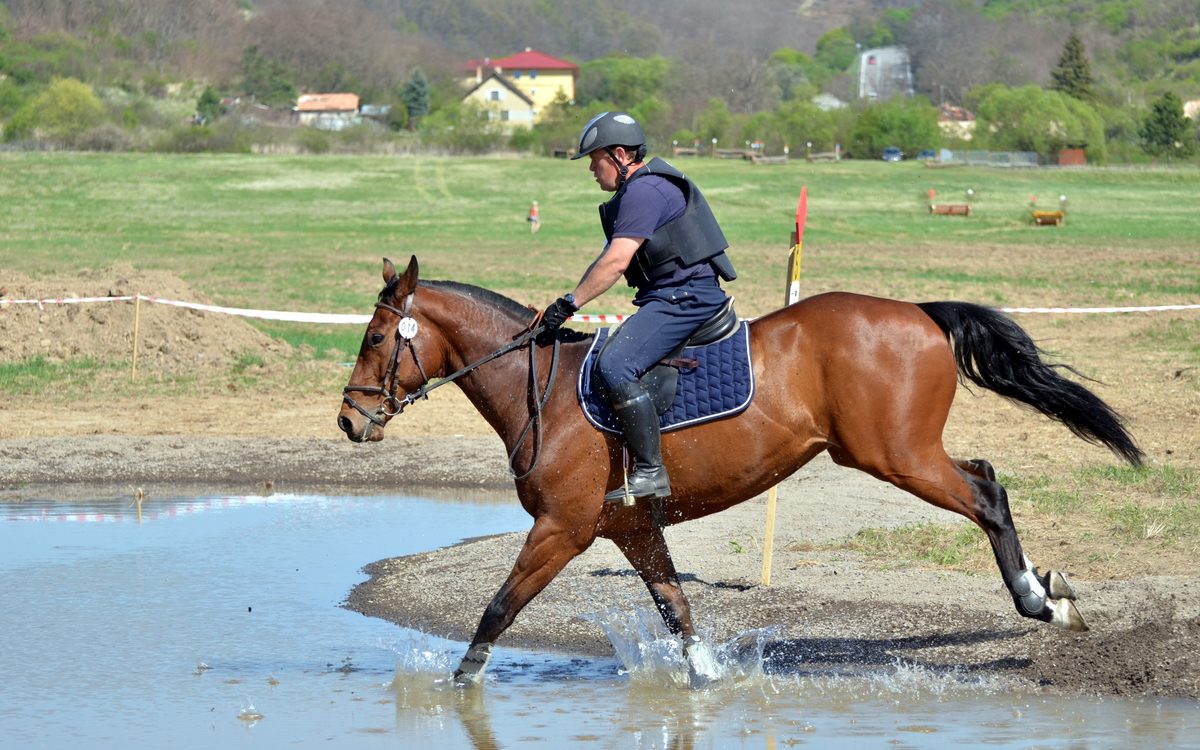
The rider is in the start box, the starter is counting down from ten, and the fence she has been dreading for a week, a big drop into water, suddenly feels huge. Her horse feels her breath catch. Eventing is unusual because the athlete has to manage her own nerves and a prey animal’s response to them, across three phases in a row, with a fall possible on the middle one. Eventing mental training means the practiced skills riders use to stay focused, confident and decisive under pressure, which is different from mental health care, covered below.
Quick answer: Common mental skills for riders are a short pre-ride routine, calm breathing, simple cue words, imagery of the course and a plan for mistakes. A small interview study of five professional event riders found they used goal-setting, pre-performance routines, self-talk and imagery to manage arousal, but controlled trials in eventing are scarce. These skills do not guarantee results. Anxiety, depression, disordered eating or burnout are health matters: talk to a qualified professional, and in the US call or text 988 in a crisis.
What the research shows, and does not
Equestrian sport psychology research is thin. A Hartpury University study interviewed five professional event riders about psychological interventions, and they described goal-setting, pre-performance routines, self-talk and imagery, much as athletes in other sports do. A study of 62 German riders in dressage, show jumping and eventing looked at trait anxiety and the direction of pre-competition arousal (that is, whether nerves feel helpful or harmful), though we could not retrieve its findings. A 2024 trial in show jumpers (not eventers) reported that mindfulness training and imagery both improved anxiety and performance, with no difference between them, but it was published in a Persian-language journal and its link to eventing is indirect. In short: the tools are plausible and widely used, and strong eventing-specific proof is limited.
Confidence and focus
Confidence for an eventer comes mostly from preparation: schooling over similar fences, a fit horse and rider, and a level that matches your experience. A Swedish study of adult eventing riders found that attitude to risk-taking was the only factor predicting injury, so a calm, honest read of your readiness is itself a skill. Focus in eventing shifts from dressage precision, to bold forward riding, to counting strides over rails. A common coach tip, general practice, is to break the day into three separate jobs and to give each its own short reset.
Goals, motivation and setbacks
- Process goals. “Keep my heels down and my eyes up through the water” is more controllable than “win”. Many sport psychologists favour process goals, a general practice statement.
- Motivation. Ask what you enjoy: the horse, the challenge, the people. Keep a short list of what went well after each event.
- Setbacks. A refusal, a rail or a fall is part of the sport. Under the scoring, the first refusal costs 20 penalties and the third eliminates the pair, so having a plan for what you do in the next fence, a deep breath, a circle and a firm leg, is common coaching advice.
Imagery, routines and handling pressure
- Imagery. Walk the course on foot, then picture it with your eyes closed: the line, the canter, the rhythm to each fence, the feel of the landing. Imagery is common among riders and event professionals; evidence in eventing itself is limited.
- Pre-ride routine. A short fixed sequence before you enter the arena or start box (check girth, helmet strap, three slow breaths, one cue word) gives the mind something to do. This is general practice.
- Breathing and self-talk. Slow breaths with a longer exhale and a calm phrase like “steady, forward” are simple to learn. Your horse tends to match your tension, so calm is useful for both of you.
- Pressure. Nerves are normal. Some riders find that reframing “I am nervous” as “I am ready” helps; others prefer a quiet routine. Try options in training before competition.
Decisions on course
Eventing demands decisions in motion: take the direct route or the long one, ask for another stride or collect, keep going or retire. The USEF rules include compulsory retirement at certain jump penalty totals at Training level and above, and riders can choose to retire any time. Deciding in advance, with a coach, when you will pull up (“if my horse is tired”, “if I lose a stirrup”) is common practice, and it takes the emotion out of the moment. See eventing injury prevention.
Competition preparation
Logistics such as packing, timing and warm-up plans are on the horseback riding competition day page, so we do not repeat them. Mentally, the week before an event is for light, familiar work and rest rather than new tests. On the day, walk the course with your coach, write down your plan for each combination and let your support team handle the rest. Heat, hunger and short sleep all make nerves worse, so see nutrition and recovery.
After a fall
Fear after a fall is common and not a character flaw. Follow medical advice first: after a head knock, the CDC HEADS UP rule is to stop and let a healthcare provider decide when you can return. See eventing injuries. When you do return, coaches commonly suggest going back to a level where you feel secure, then building in small steps. If fear stays strong, a sport psychologist or licensed mental health professional can help.
Mental health is separate from mental performance
Mental skills are about performance. Anxiety that will not settle, low mood, loss of interest, disordered eating, constant exhaustion or burnout are health matters. The IOC published a consensus statement on mental health in elite athletes in 2026, and the same ideas apply to recreational riders: ask a qualified professional. In the United States, you can call or text the 988 Suicide and Crisis Lifeline at 988, any time. If you are outside the US, contact your local emergency or crisis line. Eating concerns are covered in nutrition and athlete health.
Eventing mental training FAQs
How do I stop being nervous before cross-country?
Some nerves are normal. A fixed routine, slow breathing and a plan for each fence help many riders. If worry takes over, talk to a coach or a qualified professional.
Does visualization really work for riders?
Professional event riders interviewed in one study said they used imagery, and imagery is common in sport. Controlled eventing trials are scarce, so treat it as a tool, not a guarantee.
How do I get my confidence back after a fall?
Get checked first if you hit your head. Then many coaches suggest returning to a comfortable level and building slowly. If fear persists, a sport psychologist can help.
Can my nerves affect my horse?
Many riders and coaches believe so; horses read tension. Calm breathing and a steady routine are common ways to help both of you.
Where can I get help for anxiety or low mood?
Start with a doctor or licensed mental health professional. In the US, call or text 988 in a crisis.
Sources
- Straight from the horse’s mouth: professional event riders and psychological interventions (Hartpury)
- Trait anxiety and precompetitive arousal in dressage, show jumping and eventing (Comparative Exercise Physiology)
- Swedish eventing injury study (PubMed)
- Mental health in elite athletes: IOC consensus statement 2026 (PubMed)
- USEF Rules for Eventing
- CDC HEADS UP: respond
- 988 Suicide and Crisis Lifeline
General information for education only, not medical advice. It does not replace a sports medicine doctor, physical therapist, athletic trainer or qualified coach. See our editorial policy for how we research and write.