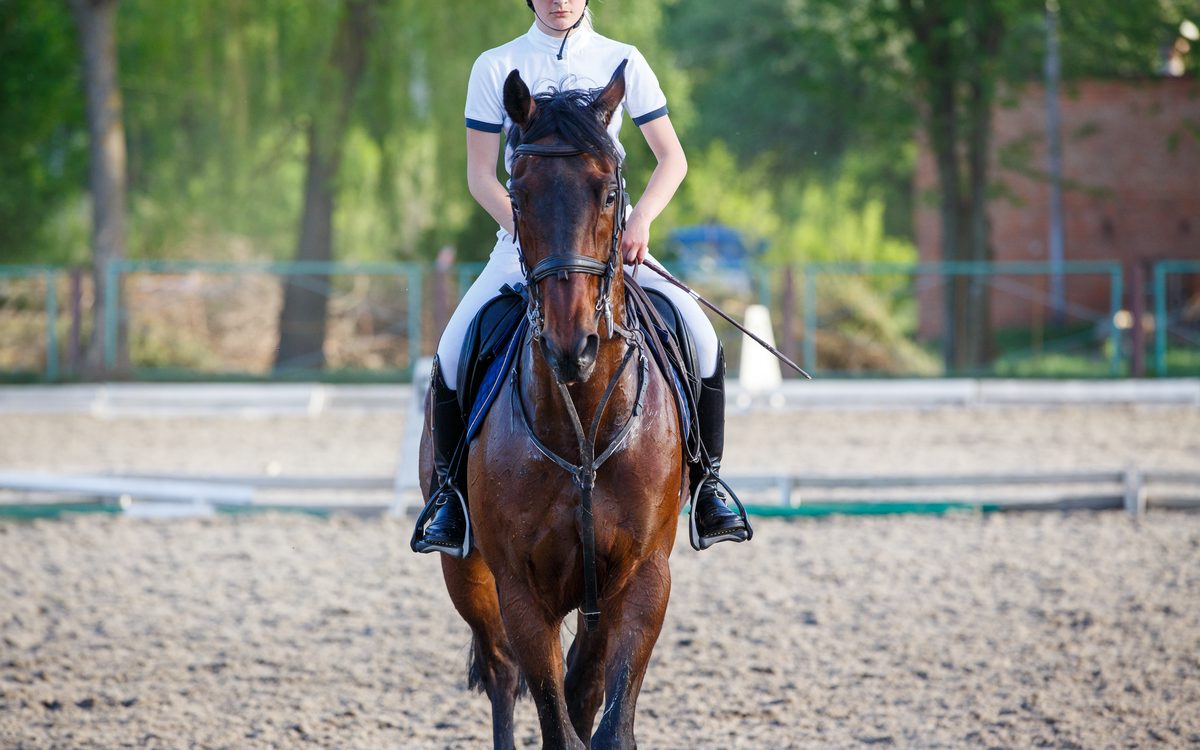
The ring steward calls the next rider. The horse, fresh from the warm-up, tosses his head at the white boards, and the rider notices her own heartbeat in her ears. For the next five minutes everything she has practiced has to be ridden in order, with one hand on a four-legged partner who can feel her nerves. Mental training is the set of skills athletes practice, such as focus, goal setting, imagery and routines, to perform closer to what they can do in training. In dressage it has a twist: the rider’s tension travels down the reins to the horse. This page covers those skills and where the evidence is solid or thin. Most of it is general sport psychology, not dressage research, and we say when that is the case. Mental performance is also a different thing from mental health, which has its own section below.
Quick answer: Mental skills such as a pre-ride routine, simple goals, imagery and calm breathing are common in sport psychology, and some have research support in sport generally, though not for dressage specifically. They do not guarantee a better score. If anxiety, low mood, eating worries or burnout are affecting your life, that is a health matter: talk to a doctor or qualified mental health professional, and in the U.S. call or text 988 in a crisis.
Why the horse makes this different
A small 2013 study (von Lewinski and colleagues) measured six horses and their riders at a public performance and an identical rehearsal. Both horse and rider showed stress responses in each, but the rider’s heart rate rose more at the public performance, from about 91 to 150 beats per minute, compared with about 94 to 118 at the rehearsal. The authors concluded that spectators affected riders’ heart activity more than their horses’. It is a tiny study, and it does not tell you what to do about it, but it fits what riders describe: nerves are real, and they belong to the rider. A 2019 survey (Bell and colleagues) also found that signs of distress in horses were commonly missed, regardless of owners’ experience, which is a reason to work with a coach who can read the horse.
Confidence
Confidence in dressage usually comes from competence: knowing the test, having ridden it cleanly at home, and a horse you understand. General coaching practice is to build it deliberately. Ride the test in pieces, then whole, then in a lesson with a coach as judge, then at a schooling show a level below your target.
Focus
A test is a string of small tasks: this corner, this transition, this circle. Many sport psychologists suggest narrowing attention to the next movement, not the score. A 2011 meta-analysis (Hatzigeorgiadis and colleagues) of 32 studies found self-talk had a moderate positive effect on sport tasks, with instructional cues (such as “breathe” or “tall” or “inside leg”) more effective for fine-motor tasks than motivational ones. Dressage is mostly fine, precise work, so short, instructional cues have the best fit, but the studies were not on dressage.
Goal setting and motivation
Useful goals are specific and in your control. Process goals (hold the contact on the centerline, breathe through the walk) are more reliable than outcome goals (win the class), because judges and horses are not yours to control. Many riders also compete against their own earlier percentage. This is general coaching practice.
Imagery
Mentally riding the test, with the letters, the feel of the transitions and your breathing, is common in dressage coaching. It is widely used in sport, and the evidence base is mixed and not dressage-specific. Practice in a quiet place, from your own point of view, and also rehearse a recovery from a spook. It is a tool alongside riding, not a replacement.
Pre-ride routines
A routine is a short, repeatable set of steps: a breath, a look at the arena, a cue word, a picture of the first movement. A 2020 randomized study (Wergin and colleagues) of 54 beach volleyball players found no difference in serving accuracy under mild pressure between routine interventions and a control group, and the authors noted their pressure manipulation may have been weak. Honest summary: routines are popular and may help you feel settled, but a clear performance benefit is unproven. Try yours in schooling shows.
Handling pressure and arousal
- Breathe out slowly. A longer exhale is a commonly taught way to settle. It also lowers the tension the horse feels.
- Know your test. Know the pattern so your attention is free for the horse. Many riders use a caller (a reader) at schooling shows, where the rules allow it. Check the current rulebook.
- Plan for the warm-up arena. Crowded warm-ups are a stressor for both of you. Have a plan for where you will ride and when to go in.
- Do not take it out on the horse. A rough ride after a bad test is a welfare issue.
Setbacks
A spook, a wrong-lead canter or an error of course in the middle of a test does not have to end it. A common coaching rule is the one-movement rule: reset on the next letter. Afterward, watch the video, write down one thing that went well and one to fix, and talk to your coach before judging the score. Judging is subjective, and a 2026 study found equestrians define harmony in different ways (Wolframm and colleagues), so one judge’s opinion is one opinion.
Competition preparation
See dressage rules and getting started for tests, levels and attire basics, and dressage gear for the helmet. A simple plan: a packing list the night before, arriving early, a warm-up schedule written on a card, and one goal.
Mental health is not the same as mental performance
Mental skills help performance. They are not a treatment for anxiety disorders, depression, disordered eating or burnout. The IOC’s 2026 consensus statement on mental health in elite athletes says mental health symptoms and disorders are common in elite athletes, may have sport-related causes, and can affect performance, and it recommends routine screening and monitoring. A 2021 survey of 493 female equestrians (Forino and colleagues) found riders perceived the ideal equestrian body frame as smaller than their own and that body dissatisfaction was associated with feeling self-conscious when riding, a reminder to take body-image worries seriously. See dressage nutrition for RED-S warning signs. If you are struggling with anxiety, low mood, eating worries, burnout or thoughts of self-harm, see a doctor or qualified mental health professional. In the U.S., the 988 Suicide and Crisis Lifeline is available by call or text at 988.
Dressage mental training FAQs
How do I stop being so nervous before a test?
Nerves are normal; a small 2013 study found riders’ heart rates rose more in public than in rehearsal. A routine, a known test and slow breathing are common tools, but they do not guarantee calm. If anxiety is severe, see a professional.
Does visualization work for dressage?
It is widely used in sport and in coaching, and evidence is mixed. There is no dressage-specific proof. Use it alongside riding.
Does my nervousness affect my horse?
Riders’ tension can change how they sit and use their hands, and horses respond to that. Studies show both partners have stress responses, but research cannot tell you how much one affects the other.
What should I think about during a test?
Short, instructional cues for the next movement, which self-talk research in sport supports for fine tasks.
When is it more than nerves?
If worry, low mood, sleep trouble, eating problems or loss of interest in riding last or interfere with life, talk to a doctor or mental health professional.
Sources
- von Lewinski M et al. Cortisol release, heart rate and heart rate variability in the horse and its rider, Vet J 2013
- Hatzigeorgiadis A et al. Self-talk and sports performance: a meta-analysis, Perspect Psychol Sci 2011; Wergin VV et al. Pre-performance routine interventions in beach volleyball serving, PLoS One 2020
- Bell C et al. Improving the recognition of equine affective states, Animals 2019; Wolframm IA et al. Equestrian definitions of harmony, Animals 2026
- Reardon CL et al. Mental health in elite athletes: IOC consensus statement (2026), Br J Sports Med 2026; Forino et al. Body image perception in female equestrians, J Equine Vet Sci 2021
- 988 Suicide and Crisis Lifeline
General information for education only, not medical advice. It does not replace a visit with a doctor, physical therapist or athletic trainer. See how we write and check our pages in our editorial policy.