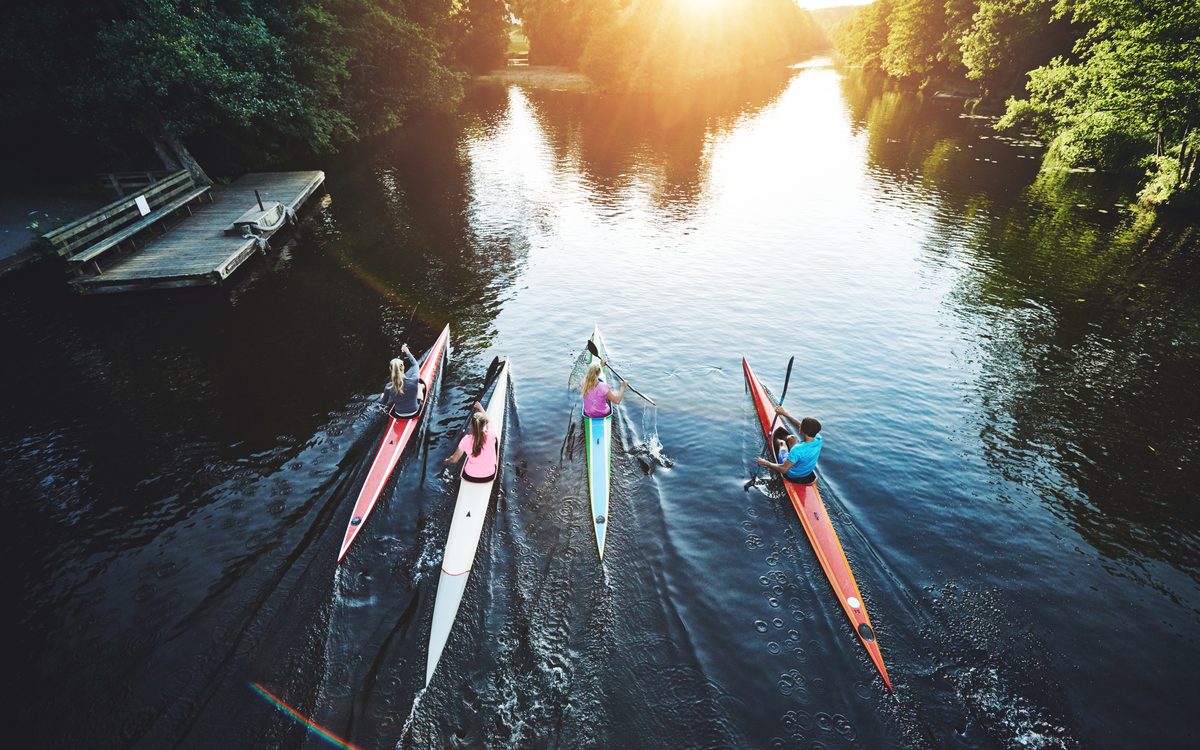
The horn goes, and for the first few seconds nothing looks like racing at all: eight narrow boats on flat water, paddles biting, every crew trying to get a long, tippy hull up to speed without wobbling. By the time a spectator has worked out who is ahead, a 200 metre race is nearly over. Canoe sprint skills, rules and getting started is the practical side of that sport: how a race is run, which rules actually decide results, what a beginner learns first, and how to find a club. For the bigger picture, start at the canoe sprint hub or the parent canoeing page.
Quick answer: Canoe sprint is a straight-line race in your own lane over 200, 500 or 1000 metres, and the first boat across the line wins. Under the 2025 International Canoe Federation (ICF) rules, a second false start by the same crew is a disqualification, and a boat that leaves its lane is disqualified. Kayakers sit and use a two-bladed paddle; canoeists kneel and use a single blade. The simplest way to start is a local club, which you can look up through ACA Paddlesports, the US national governing body.
How a race is run
A sprint regatta is built from short, sharp rounds. The ICF rules describe heats, semifinals and finals, with boats advancing according to a progression plan the competition committee picks for each event. At a world championship, the heats are seeded from the official ICF world ranking and the rest are drawn by lot. Lanes for the semifinals and finals are set automatically by earlier results, so the fastest boats are rewarded with the middle lanes. A semifinal is skipped if every boat entered would reach the next round anyway. For 500 and 1000 metre events at a world championship, the rules ask for at least 30 minutes between a boat’s rounds. Olympic races have eight boats.
Each boat has its own lane, at least 9 metres wide, and for races up to 1000 metres the whole boat must stay inside a 5 metre wide central strip of that lane from start to finish. If you drift, you must go back at once. A boat that leaves its lane is disqualified, and a boat that fails to come back or gains an advantage may be disqualified too.
The start: where most rules bite
- Before the race. Athletes must be on the water in the starting area at least three minutes before the race and lined up in their lane two minutes before.
- The commands. The starter says “Ready, Set, Go.” At “Set” the boat must not move forward, and paddling before “Go” is a false start.
- False starts. A false start brings a buzzer. The offending boat gets a warning, and a second false start by the same athlete or crew is a disqualification.
So the first lesson in racing, as opposed to paddling, is composure at the line: you are being asked to hold still, then explode on a signal, with eight lanes of people trying to do the same.
Other rules that decide results
- Capsize. A capsize eliminates the boat from that race (recorded as DNF in the ICF rules).
- Paddles. A broken paddle is not replaced mid-race, and a paddle must never be attached to the boat.
- No help. Taking pace or receiving assistance from boats not in the race is not permitted, and boats not racing must stay off the course while a race is on.
- Safety build rules. A boat must stay buoyant when full of water, and no part of the athlete’s body may be attached to the boat in any way.
Boats and what the letters mean
Events are named by boat type and crew size. “K” is a kayak and “C” a canoe; the number is how many people paddle. So K-1 is a single kayak, K-2 a double and K-4 a four, while C-1 and C-2 are single and double canoes. The ICF also lists C-4 events at world championships. Men’s, women’s and mixed events exist at world championships; the Olympic list is shorter (see below). In a kayak you sit inside the hull, use a two-bladed paddle and steer with a foot-controlled rudder; the rules allow at most one rudder, mounted under the hull. In a canoe you kneel, use a one-bladed paddle, and steer with the paddle alone, because the rules do not allow rudders on canoes. Permanent knee rests attached to the floorboard are permitted.
Basic skills a beginner learns first
This section is general coaching practice, not an official syllabus. Clubs differ, so follow your coach. Most programs start with safety and balance before speed:
- Water safety: wearing a life jacket, getting back in after a capsize, and knowing what to do if you are separated from the boat. See canoe sprint injury prevention.
- Balance and posture: sitting or kneeling tall in a narrow boat, usually in a wider, steadier training boat first.
- The forward stroke: placing the blade near the feet, pulling it past the body using the trunk, and lifting it out cleanly. Coaches often break this into catch, pull and exit.
- Rotation and timing: using the trunk and legs, not only the arms, and keeping a steady rhythm, which matters even more in crew boats.
- Starts and stroke rate: introduced after the basics are stable.
Levels, age groups and where racing happens
The ICF age rules count by calendar year. The first year an athlete can compete in an ICF competition is the year of their 15th birthday. The last year in the junior group is the year of the 18th birthday, and the last year in the under 23 group is the year of the 23rd. Masters events have a minimum age of 35, with age bands set by each discipline. The ICF holds Junior and Under 23 World Championships.
In the United States, ACA Paddlesports runs sprint selection for national teams and lists the ACA Sprint National Championships for July 28 to 31, 2027, at RIVERSPORT in Oklahoma City. ACA says local and regional races do not need a competition license, while team trials and nationals do; check the ACA site for current rules.
Olympic status (as of 2026). For the Los Angeles 2028 Games, Paddle Worldwide (the ICF) reports ten sprint medal events, with racing at Marine Stadium in Long Beach on 25 to 29 July 2028. The Paralympic discipline is para canoe, which has its own classification system.
How to find a club
- Use the ACA’s “Find a Club” locator and its list of competition clubs, then ask each club if it runs learn-to-paddle days.
- Ask if boats and paddles are lent to beginners before you buy anything. Racing boats are specialist equipment, and the ICF sets their length and minimum weight.
- Ask what the club requires for life jackets, supervision and swim ability, and whether coaches hold current qualifications.
The official ICF rulebook is linked in the sources below; it is written for officials, so ask a coach to translate.
Canoe sprint rules and getting-started FAQs
Do I need to be a strong swimmer to try canoe sprint?
Clubs set their own entry rules, so ask. Racing boats tip easily, a capsize ends a race under the ICF rules, and the US Coast Guard counted 21 canoe drownings in 2024, none of them wearing a life jacket. Wear a properly fitted life jacket and ask what your club requires.
What is the difference between a K-1 and a C-1?
A K-1 is a one-person kayak: you sit, use a double-bladed paddle and steer with a rudder. A C-1 is a one-person canoe: you kneel, use a single blade and steer with the paddle.
How is canoe sprint different from canoe slalom?
Sprint is a straight-line race in a lane on flat water, won by speed. Canoe slalom is run through gates on a whitewater course.
What distances are raced?
The ICF rules list 200, 500 and 1000 metres as the standard distances, and its world championship program can also include 5000 metres. The Olympic program uses the shorter distances.
At what age can children compete?
The ICF lets athletes enter ICF competitions from the year of their 15th birthday, and from the year of the 13th birthday in international age-group events with adapted formats. National clubs and regions set their own youth programs, so ask the club.
Sources
- ICF, Canoe Sprint Competition Rules 2025 (articles 1.4, 3.3 to 3.5, 10.1 to 10.4, 13.4).
- ICF / Paddle Worldwide, Canoe sprint and programme and quotas confirmed for LA28.
- ACA Paddlesports, Sprint.
- US Coast Guard, Recreational Boating Statistics 2024.
General information for education only, not medical advice. It does not replace a sports medicine doctor, physical therapist, athletic trainer, dietitian or coach who knows you. How we write: see our editorial policy.