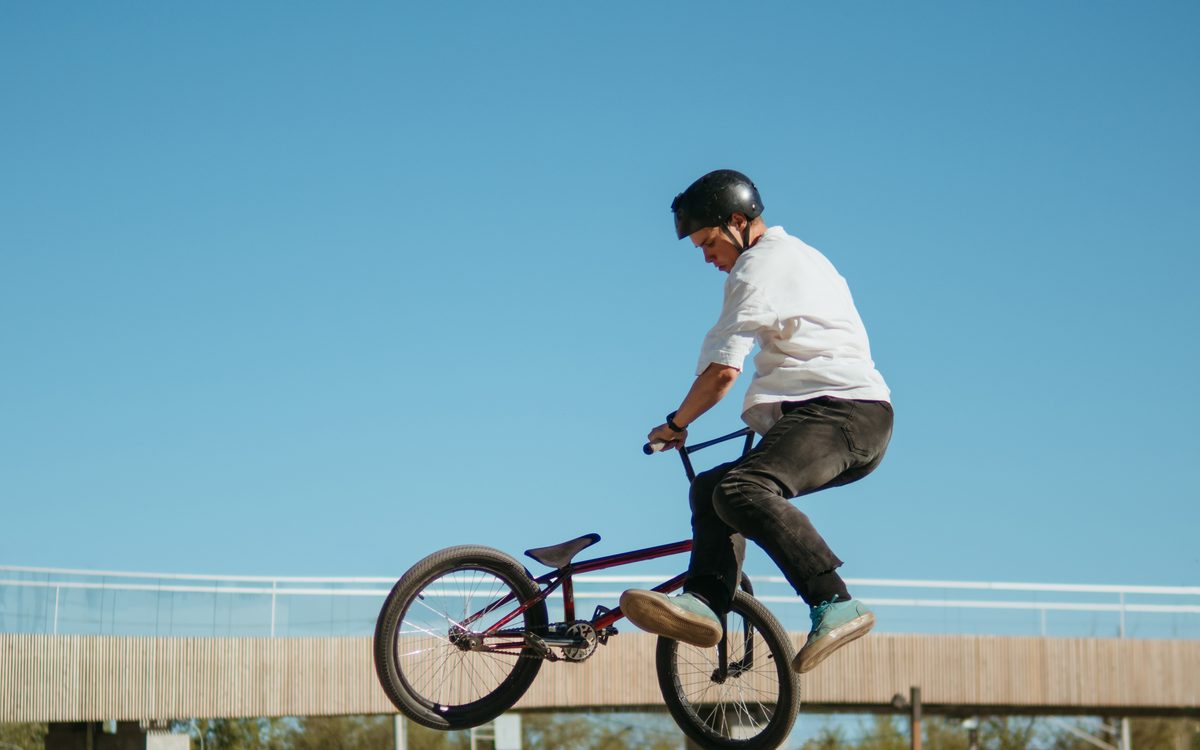
Late in a long park session the quarterpipe looks the same as it did two hours ago, but your hands are tired, your landings are a little heavier, and the trick you stuck ten times this morning is suddenly harder. BMX freestyle injury prevention is the set of habits that lower the chance of getting hurt: a proper warm-up, the right feature for your level, a bike that has been checked, protective gear that fits, a load that builds slowly, and stopping when form fades. They lower the odds. They do not remove the risk of a sport where crashes are part of learning. For injury detail see the injuries page.
Quick answer: Use a dynamic warm-up, learn tricks in small steps on features that match your level, check your bike and protective gear before every session, and stop when you are tired. Research shows BMX has high injury rates but little proven prevention, so these are sensible habits, not guarantees. See a sports medicine doctor, physical therapist or athletic trainer for pain that lasts, and get urgent care for a head injury or severe pain.
What the research says about the risk
The British Journal of Sports Medicine reported that at Tokyo 2020 about 22% of BMX freestyle athletes were injured, compared with 27% in BMX racing and 9% across all athletes. A 2025 meta-analysis in BMJ Open Sport & Exercise Medicine found BMX had the highest injury incidence of any competitive cycling discipline, with the upper limb accounting for 65.21% of BMX injuries, and a 2026 survey of 192 cyclists found hand fractures and shoulder dislocations were most frequent among BMX athletes. Those figures come mostly from elite competition, and a 2025 scoping review in Sports Health found that few BMX prevention strategies have been evaluated and that most studies did not use recommended surveillance methods. In other words, the advice below rests on general sports-medicine practice more than on BMX trials.
Warm-up
No federation or study we reviewed publishes a BMX freestyle warm-up programme, so this is general practice used across sports: 5 to 10 minutes of easy riding or light movement, dynamic moves such as leg swings, hip circles, arm circles and bodyweight squats, wrist and shoulder mobility, then easy rolls on small features before anything big. Hold long static stretches for after the session. A 2026 systematic review of stretching in flexibility-dependent sports found static stretching improved flexibility but was associated with small negative effects on immediate performance, while dynamic stretching showed small gains, which is why many coaches prefer dynamic moves before riding.
Technique and progression
- Match the feature to your level. Learn a new trick on the smallest feature, then step up in small increments.
- Break tricks into steps. A trick that has five parts should be rehearsed in parts. Do not try the full version at full height first.
- Learn to bail. Practise getting off the bike and rolling or running out of a crash. Many coaches teach this early; it is general practice, not a studied intervention.
- Look before you drop in. Collisions in busy parks are avoidable. Wait your turn.
- Commit or bail. A half-committed trick is a common way to get hurt. Bail early if it feels wrong.
Training load and fatigue
No source we reviewed gives a numeric load limit for BMX freestyle. General sports-medicine practice is to increase riding and strength volume gradually, and to leave rest between hard days. Many crashes happen late in a session, so a simple rule is to stop a trick, and the session, when your form drops. Sleep is part of this: the CDC recommends at least 7 hours for adults, 8 to 10 for teens and 9 to 12 for children 6 to 12.
Strength and conditioning
The 2025 Frontiers in Physiology review of BMX freestyle athletes describes strong upper-body, core and lower-limb strength as characteristics of elite riders and points to injury prevention work that addresses the demands of the rider-bicycle interface. Strong legs, shoulders and a stable core are sensible ways to help the body take landings. Our training page sets out the weekly shape. Whether strength work lowers injury rates in BMX has not been tested in the studies we reviewed.
Surfaces, weather and heat
Concrete parks are hard and get hot. Wet ramps, gravel, dust or sand on a landing, and loose or cracked surfaces change how a bike behaves, so check conditions before you ride and skip features that look unsafe. The National Athletic Trainers’ Association says heat acclimatization takes 7 to 14 days. Drink fluids and take shade breaks in hot weather, and see the nutrition page.
Protective equipment and fit
The AAOS says helmets reduce the risk of serious head injury by nearly 70%. The Consumer Product Safety Commission points BMX riding to a helmet certified to ASTM F2032, notes that no helmet has been proven to prevent concussion, and that bike helmets are built for one impact, so replace a helmet after a hard crash. Some park helmets are certified to other standards, so read the label and the park’s rules, and check the fit: snug, level on the forehead, strap fastened. Gloves protect palms; a mouthguard can protect teeth. See our gear page for how to separate certified standards from maker claims. Protective gear helps with some injuries and does not stop others, and nothing prevents a fracture on a hard fall.
Bike checks
Before each session, general practice is to check that the bars, stem, cranks, pedals and wheels are tight, tyres are in good shape, and any brakes work. A loose part at speed on a ramp is a bad surprise. Mechanics at a local bike shop can inspect a bike if you are unsure.
Young riders
Kids should ride with a helmet, in a park that matches their age and skill, with an adult nearby, and learn on small features. Strength work should be supervised by someone qualified. See our BMX hub for family-oriented pages.
What prevention cannot do
You can reduce your chances but not eliminate them. The scoping review calls for better studies, and professional riders with the best coaching still get hurt. If you ride, accept some risk and manage it.
When to see a professional
- After any blow to the head: stop riding and be seen by a healthcare provider. The CDC lists headache, dizziness, confusion, balance problems and feeling slowed down among concussion signs. Call 911 for repeated vomiting, a seizure, worsening headache, slurred speech or one pupil larger than the other.
- Pain, swelling or loss of movement in a wrist, collarbone, shoulder or ankle after a fall.
- Pain that comes back each session or is getting worse.
BMX freestyle injury prevention FAQs
Should I wear a full-face helmet for BMX freestyle?
Standards and park rules differ. The CPSC points BMX riding to ASTM F2032 helmets, and some park helmets carry other certifications. Read the label and the park’s rules, and choose a helmet that fits well.
Do wrist guards help in BMX freestyle?
We did not find a BMX freestyle study that tests them, so we cannot say they prevent injuries. Upper limb injuries are the most common in BMX, so many riders choose gloves and discuss other protection with a coach or sports medicine doctor.
When should I stop riding in a session?
Stop when you are tired, your form drops, or you have a hard fall that hurts. Many coaches treat tiredness as a stop sign because late-session crashes are common, but this is general practice.
Does strength training prevent BMX injuries?
Strength, core and balance are described as important traits for elite riders, but we did not find a trial showing BMX injury rates fall after strength training. It is still a sensible part of training.
How do I lower the risk of concussion?
A well-fitted helmet reduces serious head injury risk, but the CPSC notes that no helmet is proven to prevent concussion. Ride within your level, avoid riding when tired and learn how to bail.
Sources
- British Journal of Sports Medicine 2023: injuries and illnesses at Tokyo 2020 (PubMed)
- BMJ Open Sport & Exercise Medicine 2025: injury and illness across competitive cycling disciplines (PubMed)
- BMC Sports Science, Medicine and Rehabilitation 2026: severe injuries in competitive cycling over an Olympic cycle (PubMed)
- Sports Health 2025: injuries, risk factors and prevention in BMX, scoping review (PubMed)
- Frontiers in Physiology 2025: physiological and physical characteristics of BMX freestyle athletes (PubMed)
- 2026 systematic review: acute stretching durations in flexibility-dependent sports (PubMed)
- AAOS OrthoInfo: Bicycle Safety
- CPSC: Which Helmet for Which Activity?
- CDC HEADS UP: signs and symptoms of concussion
- NATA: exertional heat illnesses
- CDC: about sleep
General information for education only, not medical advice. It does not replace a sports medicine doctor, physical therapist, athletic trainer or registered dietitian who knows you. See our editorial policy for how we write and source our pages.