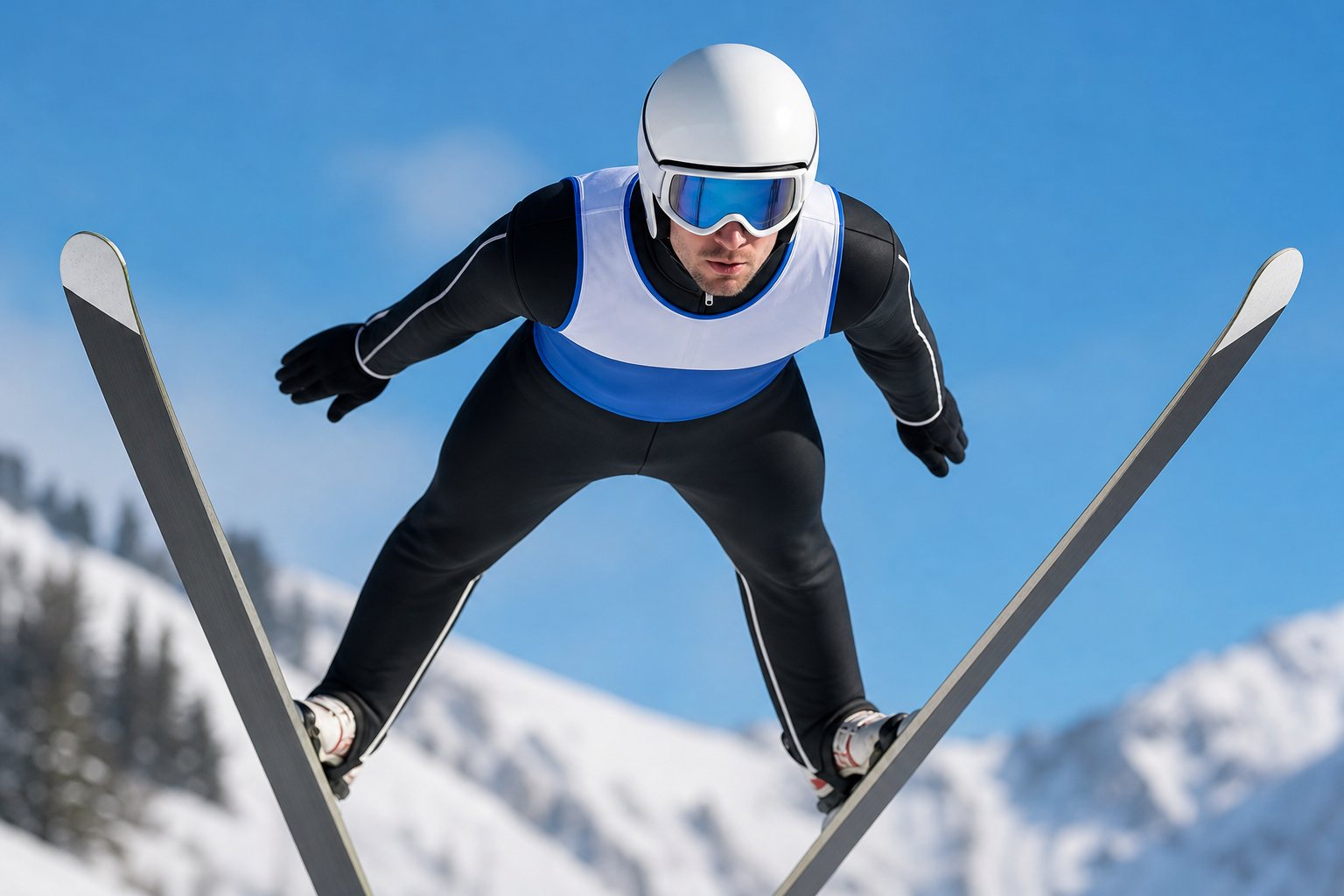
A ski jumper’s biggest moment lasts about as long as a deep breath: a sprint down the in-run, a violent push off the edge, a few seconds of flight. Most of the work happens far from the hill, in weight rooms, on trampolines and in gym halls. This page looks at what that work is aimed at, and what the published evidence does and does not say. It is general information; a coach should write any real plan. For the basics of the sport, start at the ski jumping hub.
Quick answer: A 2026 review of Olympic snow sports lists ski jumping among the “gravity and technical” disciplines, where neuromuscular power and technique matter most, and says data on ski jumping are limited. A sensible week mixes technique work, power and strength training, and easy days, built up slowly under a coach. Anything that sounds like a precise formula here is general coaching practice, not a tested ski-jumping program.
What the sport asks of the body
Zoppirolli and colleagues (Scandinavian Journal of Medicine & Science in Sports, 2026) place ski jumping, alpine, freestyle and snowboarding in a “gravity and technical” group and Nordic combined as a hybrid. In plain words: explosive leg power at take-off, balance and control in flight, and a landing that absorbs force. The same review flags large gaps, including sex-specific research and energy availability. A 2026 review by Funato and Sakurai found that most biomechanics research looks at normal and large hills, with small, medium and flying hills understudied, and that landing research is insufficient.
Hips and knees deserve attention. A 2025 survey of 22 elite ski jumping and Nordic combined athletes (Vasavada and colleagues) found jumpers reported worse hip symptom scores than Nordic combined athletes, and the authors suggested hip strength and conditioning might help knee and ankle outcomes. It is a very small study, so it points to a sensible habit rather than proving anything.
Strength and power
Power training is the centre of most jumpers’ off-season. General coaching practice, not a ski-jumping-specific protocol, includes squat and hinge strength, jumping and landing drills, sprints, and trunk and hip work. One broader study of 1,544 people (Keiner and colleagues, Biology of Sport, 2025, not about ski jumpers) found back-squat strength explained roughly half the variation in jump height, with diminishing returns at higher strength levels. That suggests strength is useful but not the whole story. Technique, mobility and timing matter too.
- Imitation jumps. Practising the take-off movement on the ground, a widely used coaching drill, lets technique be repeated without the hill.
- Landing practice. Controlled, soft landings with both knees bent are the base of the telemark landing. Our injury prevention page explains why.
- Mobility. Hip, ankle and thoracic mobility help the in-run crouch and the flight position; see the recovery page.
Endurance and general fitness
Ski jumping is not an endurance sport, but a 2026 narrative review of endurance training in Olympic winter sports (Sperlich and Holmberg) describes a “feeder-function” model in which endurance supports recovery and resilience in some sports, and it proposes a framework for when endurance is a main limiter or a supporting capacity. Where ski jumping fits that framework is not spelled out in the abstract we read. General practice is to keep an easy aerobic base so training days can be repeated.
A sensible weekly shape (general coaching practice)
We found no published weekly template for ski jumpers, so the following is a common-sense outline for a club-level athlete, not a prescription:
- Technique days. Hill sessions on snow or plastic with a coach, or imitation drills when the hill is closed.
- Strength or power days. Two, with full recovery between hard efforts.
- Easy days. Light aerobic work, mobility and sleep. Not optional.
- One full rest day. Every week.
Young jumpers should follow their club coach’s plan and keep other sports and play in the mix; ask a coach what is appropriate for the athlete’s age.
Periodisation basics
General coaching practice splits the year into a build phase (summer and autumn: strength, power, plastic-hill jumping), a competition phase (winter: fewer, sharper sessions) and a recovery phase. Hill jumping can continue in summer on plastic surfaces, per USA Ski Jumping. The rule worth remembering is to change one thing at a time and add load gradually.
Tracking and testing
Many national teams use jump tests and force plates. For most club athletes, simple notes (sessions done, how legs felt, sleep, any pain) tell a coach more than a gadget. If a niggle lasts, stop and see a sports medicine doctor, physical therapist or athletic trainer.
Ski jumping FAQs
Do ski jumpers need to be strong or light?
Both ideas appear in the research. Strength and power help take-off, and weight affects distance; see our nutrition page for why the sport limits very low body weight.
How many days a week do ski jumpers train?
We found no published figure. Club athletes follow their coach’s plan; most plans mix technique, strength and easy days.
Is endurance training useful for jumpers?
A 2026 review describes endurance as a supporting capacity in some Olympic winter sports; ask your coach how much suits your level.
Can I train for ski jumping without a hill?
General practice includes imitation jumps, strength and landing drills. Real jumping should only be done on hills your coach has cleared.
Where do injuries fit into training?
See our injuries page for injury patterns, and see a professional if pain lasts.
Sources
- Zoppirolli et al., Olympic snow sports review, 2026
- Funato and Sakurai, biomechanics of jump distance by hill size, review, 2026
- Vasavada et al., hip, knee and ankle outcomes in elite Nordic jumping athletes, 2025
- Keiner et al., strength and jump performance, Biol Sport 2025 (not ski jumping specific)
- USA Ski Jumping, Ski Jumping 101
General information for education only, not medical advice. It does not replace a visit with a sports medicine doctor, physical therapist or athletic trainer. See how we write and check our pages in our editorial policy.